


 4 Photos
Milton Miller
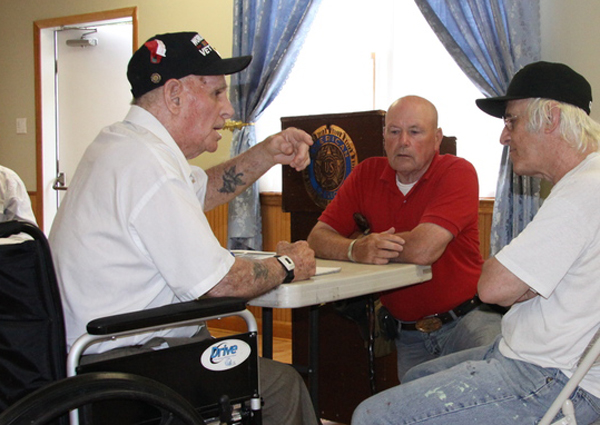
Brian Carabine and Hugh King discussed the fate of the Amagansett Coast Guard lifesaving station last Sunday afternoon.
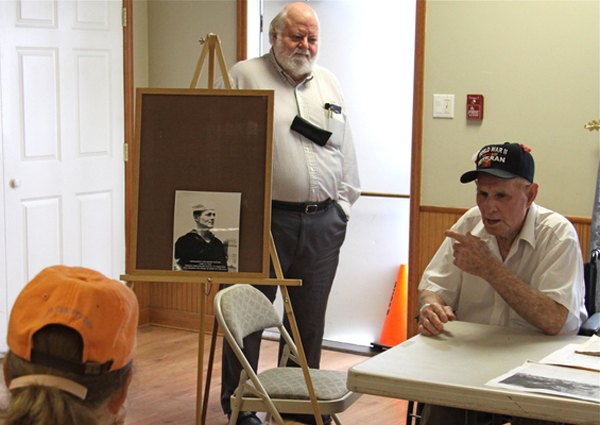
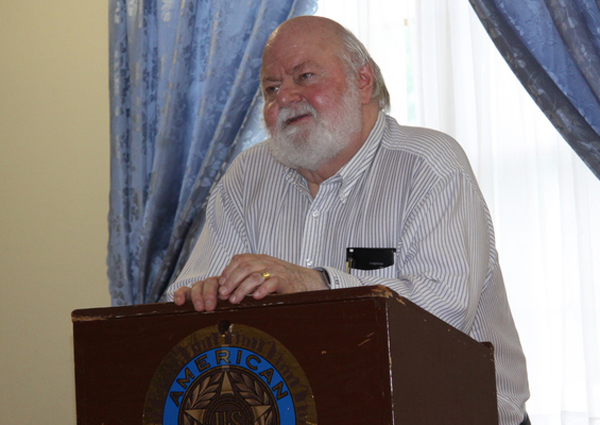
Larry Barnes and Milton Miller discussed the history of the lifesaving station.
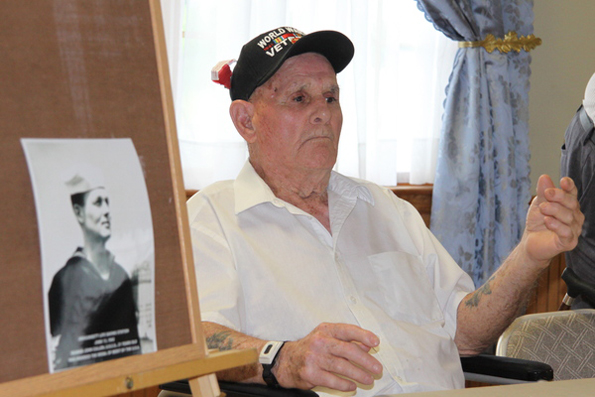
Milton Miller remembered the heroism of Seaman Second Class John C. Cullen
It was 68 years ago this Sunday that four Nazi saboteurs landed on the beach in Amagansett, just 300 yards east of the Amagansett Lifesaving Station, where they met a befuddled Coast Guard guard who alerted the country to their presence on the beach.
At the time, it was the country that was in danger, as the spies had plans to blow up bridges and power plants in a precursor to modern terror tactics.
But here in East Hampton, what is in danger now is the lifesaving station itself. Built among the dunes alongside Atlantic Avenue in 1902 by the United States Lifesaving Service, which merged with the Coast Guard before the first World War, it was one of five lifesaving stations in East Hampton Town.
The building, where Coast Guard lifesavers had bunks and a mess hall, was sold for $1 to the Carmichael family after World War II, and was moved to another site off Bluff Road in 1966. The family donated the building back to the town in 2007, after which it was moved back to its original location after its foundation was found in the dunes near Atlantic Avenue.
East Hampton Town had planned to spend $173,000 in Community Preservation Fund money this year to renovate the building, and last fall signed a 10-year lease with the East Hampton Historical Society to create exhibits about the town’s maritime history in conjunction with the society’s work at the town’s Marine Museum on Bluff Road.
But that plan was put on hold after the town’s use of CPF money came under intense scrutiny after numerous improper transfers from that fund were made to cover shortfalls in the town’s operating budget. Several residents cried foul at the proposal at a public hearing last year, since the CPF law requires that the property be purchased using CPF money if that fund is used to pay for renovations. And because the town did not purchase the land the lifesaving station sits on through the CPF, last December CPF money was pulled from the project, leaving the lifesaving station in limbo.
In the ensuing months, word of the delay reached Milton Miller, a veteran who spent 22 days on Iwo Jima after he was transferred from the Coast Guard to the Navy during the war. Mr. Miller, who was raised in a fisherman’s village on the bluffs not far from the station, called an emergency meeting at the Amagansett American Legion Hall on Sunday, in the hopes of rallying support to save the lifesaving station.
“I’m an old Bonacker and I don’t care who knows it,” he said. “The lifesaving service goes back to the 1800s. The men that served there were all local fishermen—Lesters, Millers, Skellingers and Paynes.”
Mr. Miller looked with reverence at a picture he had posted on an easel of Coast Guard Seaman Second Class John C. Cullen, who was patrolling the beach on that night in 1942 when he saw the Nazi spies crawling out of the water with duffel bags full of explosives. Seaman Cullen, who spoke briefly to one of the spies, promised not to mention he’d seen them, then returned to the Coast Guard Station to alert his superior officers and the national military. What happened that night on the beach in Amagansett was not made public until the war was over.
“I wouldn’t put my credentials up against this man’s. I left three children to join the service, but this is about a man who saved my town,” he said. “This town never recognized this man, never did anything to honor him. I never did nothing compared to what this guy did for this country.”
Mr. Miller said that he hopes the lifesaving station will include exhibits honoring the servicemen who worked at the stations throughout East Hampton—at Ditch Plain, Hither Plain, Napeague, Amagansett and Georgica, during the heyday of the lifesaving service.
“The process is starting to allow the historical society to start work. Once that’s done, we can honor the beach patrols. They haven’t been acknowledged,” said Brian Carabine, a former commander of the East Hampton Veterans of Foreign Wars, who attended the meeting. “During the war, ships were sunk all over this place, but nobody knew about it because they didn’t want to panic people,” he added.
Larry Barnes, whose father, Warren Barnes, was the chief bosun’s mate at the lifesaving station the night the Nazis landed, shared their belief that the building should be saved and used to honor the servicemen.
“The only thing left us is that building. We’ve got the opportunity. I hope we’ll be able to get the funds to restore it,” he said. “I have visions of that building winding up being kindling for a beach party.”
Richard Barons, the executive director of the East Hampton Historical Society, said this week that his organization has shifted the focus of a capital campaign planned for later this year from improvements at the East Hampton Marine Museum to the lifesaving station after learning that the town could not renovate it. He said that the project, including the exhibits and the renovations, is expected to cost between $350,000 and $400,000. The historical society is currently renegotiating its lease with the town because, in order to apply for grant money, it will need to have a 50-year lease. Mr. Barons said that the contract is currently in the town attorney’s office.
The physical improvements include building decks around the building, whose doors are currently several feet above grade, and replacing the modern doors, windows and fixtures with ones that better suit the historical period in which the building was designed.
“We thought, wouldn’t this be a wonderful instance to tell the war story,” said Mr. Barons. “That building is very important. We think it’s as important as the Montauk Lighthouse, really. It would be a great place to show more interesting wreck material, which, of course, is about the lifesaving station. The marine museum has no storage at all, and we could incorporate things about fishing, about the relationships Native Americans had with the original colonists.”
“We wanted to be quite creative with the exhibits, with computer monitors, programs on lifesaving boats that would provide interaction for kids,” he added. “We knew we would be scooting into the 21st century. It was expensive but exciting. Kids wouldn’t have to spend a lot of time to get the flavor of what went on on that beach.”
Mr. Barons said that those plans may be scaled back if the historical society needs to take care of the renovations, but added that he would like to take advantage of renewed interest from the National Endowment for the Humanities and other organizations in recounting the history of World War II.
“That’s an enormous thing for little old us to take care of,” he said of the building. “But it’s really the story of the community. So many families were involved in one way or another with the beach, the building, the wrecks and the war.”


