


 2 Photos
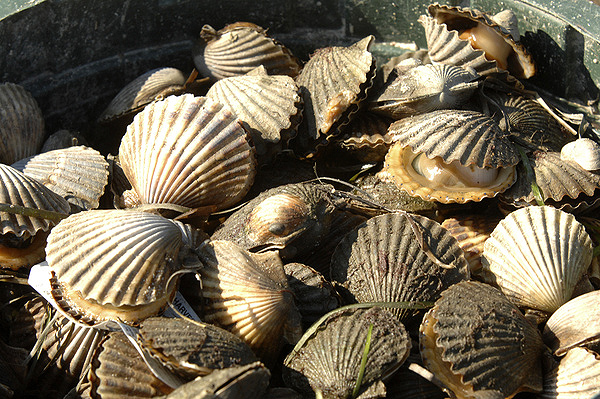
This year's scallop harvest my not be a good one due to Red Tide. DANA SHAW
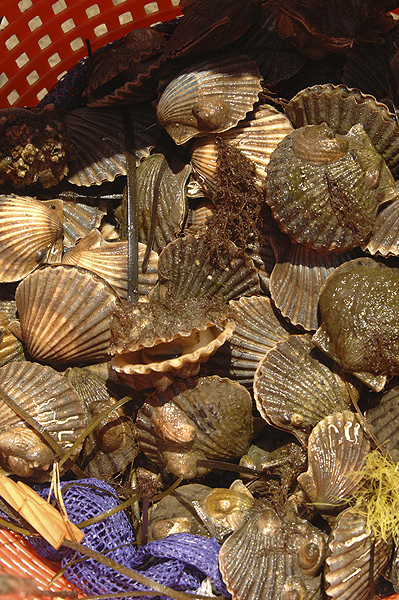
This year's scallop harvest my not be a good one due to Red Tide. DANA SHAW
Just a few weeks ago, baymen and shellfish experts were brimming with optimism about what was expected to be a banner bay scallop harvest when the season opens next month. Some pointed to the predictions as a sign that the local scallop population had finally gotten past the devastation wreaked by brown tides in the 1980s and 1990s.
This week, much of that optimism has evaporated.
Scientists from Long Island University, completing underwater surveys of scallop populations in the Peconic Estuary as far east as Orient earlier this month, said they found as much as 90 percent mortality rates in the mammoth “set” of bay scallops that they recorded at the start of the summer.
At the same time, baymen scouting the sections of bay bottom they planned to dredge for scallops next month came back to the dock with very discouraging reports of very few live, adult scallops to be found. Areas that had been loaded with small scallops at the end of last winter, spurring the favorable forecasts for this fall, were found to be barren, save for baby scallops, called “bugs,” and the shells of adults that have perished.
“This banner scallop season that was predicted last year doesn’t look like it’s going to happen,” said Ed Warner, a bayman from Hampton Bays who also serves as a Southampton Town Trustee. “Now it actually looks like it’s going to be the worst year we’ve had in a few years.”
Mr. Warner said the reports he’s heard from baymen from the North Fork and East Hampton have been the same: the scallops are gone.
Many baymen are blaming the die-off on this summer’s red tide, massive blooms of algae that stained the waters of Shinnecock, Peconic and Gardiners bays, and many of their tributary harbors and creeks, a brownish red in August and September. The species of algae, called
cochlodinium
, is not harmful to humans but has been shown to be fatal to fish and shellfish, and has been blamed for the deaths of fish caught in fishermen’s traps and even in the open waters of shallow creeks.
Dr. Stephen Tettlebach, a marine science professor at Long Island University’s C.W. Post campus, who conducts shellfish surveys throughout the Peconic Estuary twice a year, said the scallop die-off is not completely across the board. Most of the adult scallops in some select areas seem to have survived the summer, but he stressed that those instances are few. He also pointed out that the areas that had the densest concentrations of young scallops and presented the best examples of the scallop rebound in the spring seem to have seen the highest rates of mortality.
Northwest Harbor in East Hampton, Orient and Hog Neck bays in Southold and Southold Bay all saw steep die-offs of the large sets of scallops they had in the spring.
Additionally, a large percentage of those scallops that have survived, Dr. Tettlebach said, appear to be smaller in size than they would typically be at this time of year—a hint to the scientist that the issue has something to do with their food source. Scallops, like most shellfish, are filter feeders that strain microscopic organisms, algae primarily, from the water around them. The brown tides of the 1980s and 1990s were devastating to the scallops and other shellfish, because while the algae species that caused the brown tides has not been found to be toxic itself, the shellfish would not eat it for some reason. When the dense blooms exploded and choked the bay of all other species of algae, the scallops starved to death.
“It’s a bummer, but it’s not unprecedented,” Dr. Tettlebach said. “There were years, before the brown tide even, when the densities were not great and the scallops were small. We hope it’s just a downturn this year and we’ll see a rebound next year.”
Dr. Tettlebach said it appears as though the scallops died fairly recently, because the divers found enormous numbers of dead scallops that still had their shells attached at the hinge, whereas tide and wave action will cause the two halves of the shell to break apart over time. “We call those ‘cluckers,’” Dr. Tettlebach said. “This was the highest density of cluckers we’ve ever seen.”
That finding, suggesting a late-summer spike in mortality, would lend credence to the red tide being at the heart of the shellfish deaths. The late summer red tide outbreak this year was more widespread and denser in many areas than it has ever been since first appearing in East End waters in 2004. The algae blooms were visible in portions of Three Mile Harbor for the first time this summer.
“It was as bad as I’ve ever seen it,” said Jon Semlear, a bayman from Sag Harbor who fishes in Noyac Bay and also serves as a Southampton Town Trustee. “This was the worst late summer and fall fishing I’ve ever had, and, the last three or four years, it’s been getting worse and worse. The fish smell [the red tide] coming, and they get out of there. And they say it lays on the bottom at night, and that’s where the shellfish are.”
According to Dr. Christopher Gobler, a marine scientist from Stony Brook University, the
cochlodinium
algae—actually, a dinoflagellate organism that can swim through the water column—tends to rise in the water column during the day and sink to the bottom of the bay at night. In laboratory experiments, Dr. Gobler’s science students at the university’s Marine Science Center in Southampton have shown that the algae blooms can kill both fish and shellfish in a matter of hours.
Some scientists have taken to calling the late summer algae bloom a “mahogany tide” rather than a red tide to differentiate it from a different species of red algae that has bloomed in Shinnecock Bay in May and June in recent years, one that carries a biotoxin that can be harmful to humans.
Mr. Warner speculated that the small size of the surviving scallops might mean that they stopped feeding in a futile attempt to avoid the toxic effects of the red tide. He noted that there did appear to be a very large spawn before the scallops died.
“That shows me that they’ve been stressed out and they want to get rid of their spawn as fast as possible,” he said. “Hopefully, they will survive, and next summer will be different. I’m always the optimist who believes that things are getting better, but I can’t say that this time.”
If the late summer red tide is to blame for the die-off of scallops, it will be the first time the latest scourge has impacted wild shellfish since the infamous brown tides that devastated a once-giant industry that revolved around their harvest, supplying as much as 40 percent of the bay scallops consumed nationwide. Hundreds of families of baymen left the industry after the collapse, leaving only a few dozen baymen working on the East End. In recent years, as the scallops returned to faint shadows of their former abundance—and the value of another species, razor clams, skyrocketed—some men had returned to bays for work. The latest die-off of scallops will be yet another setback to the industry.
“This will be a real tremendous blow to us,” Mr. Semlear said. “Things are bad. I don’t know what this will mean—what’s next?”


