


 8 Photos
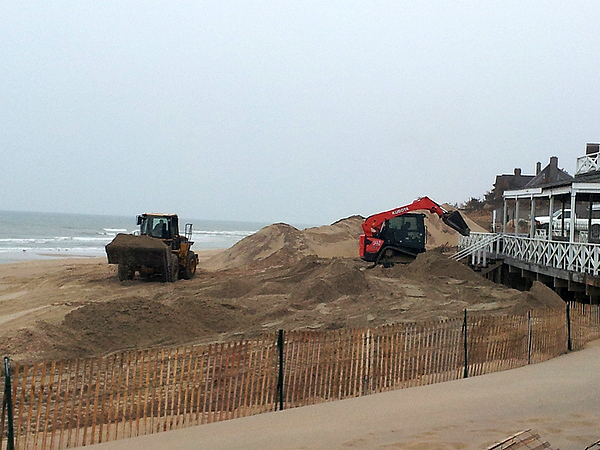
Contractors shored up the beach in front of the East Hampton Main Beach pavilion last week. VIRGINIA GRIFFITHS
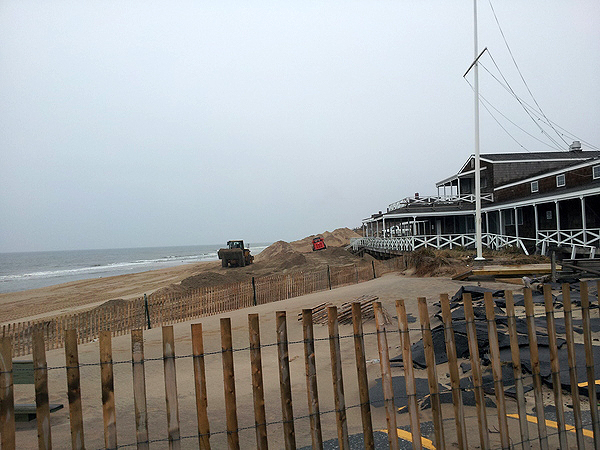
Contractors shored up the beach in front of the East Hampton Main Beach pavilion last week. VIRGINIA GRIFFITHS
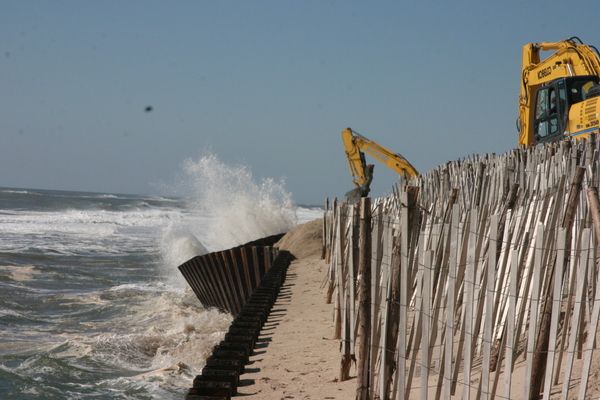
The bulkhead along the beach front near the Water Mill Beach Club partially collapsed after a severe North Easter in March
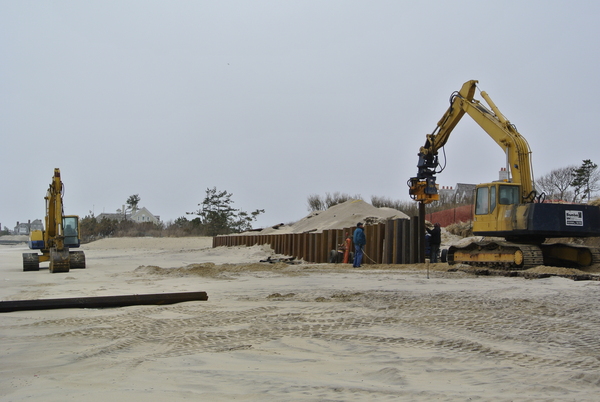
but has since been shored up.
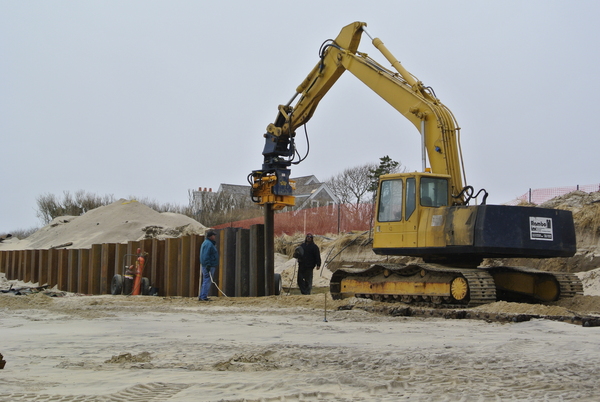
A bulkhead being erected off of Little Plains Road in Southampton Village.
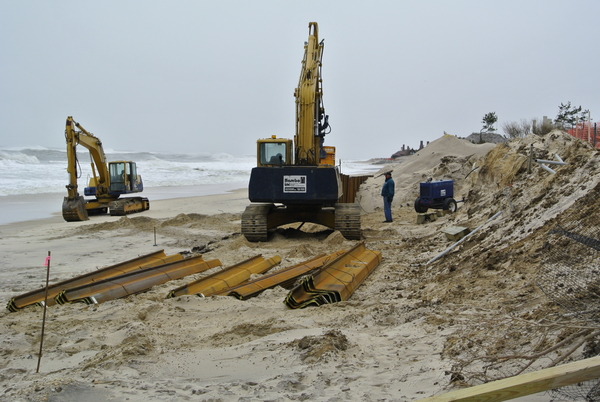
A bulkhead being erected off of Little Plains Road in Southampton Village.

A bulkhead being erected off of Little Plains Road in Southampton Village.
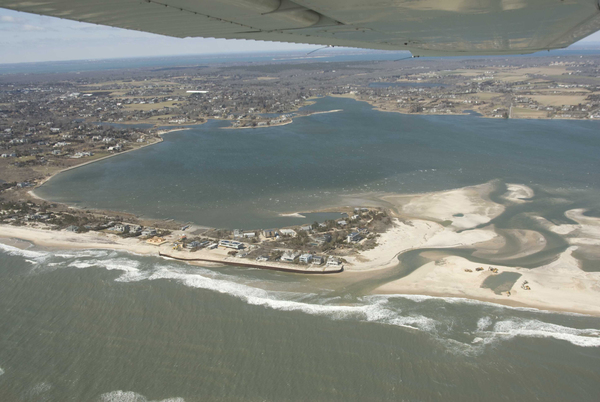
The bulkhead along the beach front near the Water Mill Beach Club partially collapsed after a severe North Easter in March
The erosion caused by Hurricane Sandy and an active winter storm season has rekindled a broad debate across the South Fork about how best to protect both structures along the coastline, and the soft sand beaches that fuel the local resort economy.
For property owners in places where Sandy’s surge erased the barrier of beach and dunes, and the parade of winter storms repeatedly threatened homes and property with damage or destruction, the idea of erecting “hard” protective structures of wood, steel or stone to hold back the waves has been taken up with a vigor not seen since the mid-1990s. This time around, however, there are the added wrinkles of new understanding about global warming, billions in Sandy recovery dollars, and the relatively new consideration of “beach nourishment”—the massive mechanical rebuilding of beaches.
The discussion has been especially urgent in Montauk, where the business district flooded during Sandy and a number of large hotels had their very foundations hammered by waves, and in Southampton Village, where several large estate owners have skirted long-understood prohibitions and installed steel and stone walls at the foot of their properties in the months following the storm.
In both places, public officials have recently voiced support for allowing hardened protections, calling for exceptions to decades of public policy.
In Southampton Village, Mayor Mark Epley has said that in places where there are gaps between seawalls built 50 years ago or more, property owners should be allowed to put in hardened protections to hold off the ill effects of neighbors’ walls.
“You’re never going to remove the bulkheads in that area, so let’s let the people that are the weak point install something,” Mr. Epley said recently.
At the same time, he acknowledged that in the parts of the village where there are no seawalls in place already, the beach is much wider, and that expanding their use to protect properties in general should be restrained.
Last week, East Hampton Town Supervisor Bill Wilkinson pressed members of the Town Board to throw their influence, in principle, behind allowing the use of stone walls to protect the foundations of the oceanfront hotels as part of a hoped-for U.S. Army Corps of Engineers project to rebuild the beaches in the low-lying hamlet.
“I’ve made no bones about it: I’ve been very supportive of protecting those motels that contribute so much to the economic stability of the hamlet of Montauk,” Mr. Wilkinson said. “It’s down to protect or retreat. I’m in favor of protecting.”
To protect or to retreat is the question at the very heart of the shore-hardening debate.
Seawalls—be they actual walls of steel or wood, or sloping hills of giant boulders—have been something of a conundrum for beachfront communities nationwide for decades. Many were built along the oceanfront of both coasts in the early two-thirds of the 20th century as development first moved to the shoreline and storm damage became an issue. Seawalls, for the most part, held back the waves when the storms hit and saved structures from destruction.
But it was soon discovered that they also greatly accelerated the erosion of sand from the beaches between them and the ocean. In some places where walls were built along the oceanfront, parts of New Jersey in particular, beaches vanished within years.
The physics are simple: Waves crashing into the walls during storms deflect back, taking with them far more sand than they would if they could run up a natural beach slope and then retreat. In places where walls abruptly end, the wave energy wraps around the corners, scouring out deep gouges in the sand and dunes at either terminus.
The nature of Long Island’s orientation, with prevailing southerly winds pushing gentle waves and sand ashore, typically repairs such scars given a period of calm, as is generally seen most summers. In places where other factors do not interrupt the natural process, a stretch of years without exceptionally severe or frequent storms can obscure seawalls behind hundreds of feet of sand—as was seen, generally, between 1997 and 2010.
But over longer periods of time—in some cases, centuries—seawalls halt the natural process that creates beaches and dunes.
Experts say Long Island is slowly being whittled away, by currents sweeping down the shoreline and rising sea levels, and if the beach and dune system cannot move landward, as it has steadily since the last Ice Age, the beaches will soon vanish.
“The downside, there is no argument: A seawall will eventually result in the destruction of the beach,” said Dr. Robert Young, a coastal geologist who has been hired by the Southampton Town Trustees to help them formulate an official policy regarding hardened structures on the beachfront. “North Carolina and South Carolina banned them altogether 25 years ago. The other side of that, of course, [is that] in North Carolina a lot of houses have fallen in [the water].”
Advocates of seawalls have argued that humans, particularly those inhabiting the South Fork, are clearly not going to simply walk away from their oceanfront properties so that the beaches may migrate landward, so officials might as well find a way to protect both their houses and the public beaches.
The options for the very long term—the 22nd century and beyond—are rather cut-and-dried in today’s understanding: some developed areas simply will have to be conceded to the sea’s advance. But for the next several decades, with accelerating rates of sea level rise, the option of holding back the tide, literally, exists. Beach nourishment can raise and push the buffer of sand out hundreds of feet.
“The ideological conundrum is the fact that shoreline-hardening structures are designed specifically to preserve the residential or commercial structures behind them, but it will be at the expense of what they call the dry beach,” said Robert Herrmann, a coastal management specialist with En-Consultants Inc. in Southampton. “Renourishment is the great equalizer, or at least it can be in theory.”
Since the early 1990s, beach nourishment has maintained the broad beaches in front of West Hampton Dunes Village, a community wholly destroyed by erosion just years earlier. This coming fall, 125 residents of Sagaponack and Bridgehampton will foot the $25 million bill for the nourishment of six miles of beach there.
But beach nourishment is not a fix-all, and in exceptional circumstances a storm or series of storms may gobble away even an engineered beach before it can be rebuilt mechanically again. In such instances, seawalls can protect the houses and businesses for the period of exposure between nourishment work.
Much of the recent debate about the issue of shore-hardening has focused on events in Southampton Village, where the construction of two steel seawalls—ostensibly “in place and in kind” replacements of decades-old wooden bulkheads—sparked outcry from the Town Trustees and residents as storm waves erased the beach in front of one just weeks after it was completed. Calmer weather returned a narrow ribbon of sand between the steel and the sea, but the beach remaining is only such in the most technical sense and vanishes with each passing storm.
Beach nourishment there could dampen the threat posed by a seawall. Last month, members of the Southampton Town Trustees, while mulling what their policy should be in the future, suggested that they could allow shore-hardening structures but make them contingent on nourishment work being done seaward to maintain a healthy beachhead.
“We’ve done it in the past—placed requirements on permit approvals,” Trustee Eric Shultz said. “We can say, we’ll let you rebuild that seawall or bulkhead, but you have to guarantee that there will be 150 feet of beach, too. It’s one of the things we’re discussing.”
Dr. Young warned that should seawalls like those in Southampton Village be allowed to remain, or more built, massive nourishment projects will become a necessity. “The primary reasoning behind banning seawalls is not driven by environmental concerns—it’s driven by economic concerns,” he said. “That beach is the economic engine for the whole community. So the question becomes, what are you protecting and how much is it worth to have your whole community paying to let people keep their oceanfront homes in place?”
In Montauk last week, New York Sea Grant specialist Jay Tanski told a large audience of East Hampton Town officials and community leaders who gathered at Gurney’s Inn that towns like East Hampton, and even hamlets like Montauk in particular, need help gathering information about that vast number of variables that affect their coastal condition. They also discussed what could be their best options for dealing with erosion and the impacts of severe storms in the coming decades.
Mr. Wilkinson, who did not attend Mr. Tanski’s presentation, said the hard protections being sought by hotel owners are out of his Town Board’s hands. Still, he said the town should be willing to consider such an option if it is paired with the Army Corps beach renourishment work.
“I’m simply trying to advance the discussion,” he said. “The issue is the hard structure, period, and whether the town is willing to consider it.”


