



 3 Photos


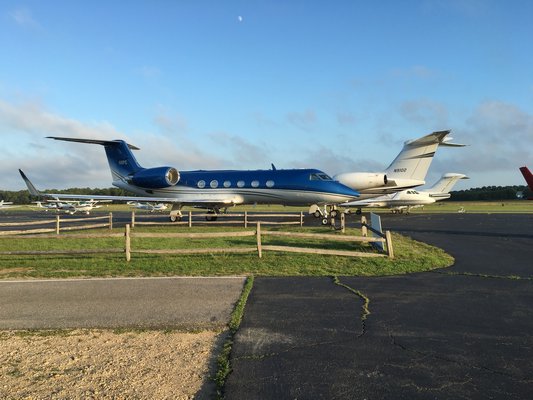
Impatient with town efforts to tone down the din of East Hampton Airport, some residents of the neighborhoods that surround the property say they are going to start looking for avenues through which they can convince the town to abandon the airport use altogether.
A group calling itself Say No To KHTO—referencing East Hampton’s official airport code—announced its formation this week, led by Barry Raebeck, a teacher and author who lives near the airport and was one of the founders of the Quiet Skies Coalition, a citizens group that formed in 2011 to push for reduction in aircraft noise.
But with traffic at the airport continually increasing and “meaningful aircraft noise abatement” a failure, Mr. Raebeck said he is splitting from the Quiet Skies Coalition and taking up the cause of finding an entirely new use for the airport property.
“This huge tract of town-owned, commercially zoned land can better serve our community in a variety of ways,” Mr. Raebeck is quoted as saying in a press release sent to local media outlets on Monday. “In terms of jobs per acre, the airport is a bust, a lost opportunity for the community.”
The statement nods to leases the town has signed recently with non-aviation companies, who are grabbing up portions of the airport property for more than 50,000 an acre, per year. At those rates, the group’s statement says, the town could be generating between $10 million and $15 million, and generate far more jobs, if it closed down the airport and dedicated the property to commercial uses.
The group calls for the town to begin exploring other alternatives for the property, from commercial uses to wind or solar power generation, affordable housing, or parks and recreation. The group claims that it will begin working on development plans for the airport to present to the community, in hopes of casting the airport in a new light “so that taxpayers and voters of East Hampton can fully understand what the airport is costing the community.”
At least one Town Board member was unconvinced at first blush.
“The airport is an asset to the town, I have always felt that way,” Councilwoman Sylvia Overby said. “I’m waiting to see if we, as the proprietors, are able to control our airport. We’re doing this step by step—and we have to do that within the legal parameters of the law—and we’ll continue to work toward a quiet, sustainable airport that is a benefit to the people of East Hampton.”
Last year the Town Board adopted curfews for all aircraft using the airport and a more narrow curfew for especially noisy aircraft. The board also adopted a limit on the number of trips a given aircraft can make to the airport in a week, but that rule was blocked by a federal judge after legal challenges by aviation industry interests. There are seven lawsuits pending against the town over the various new controls it has tried to exert on the airport.
Earlier this month the town released statistics of the airport traffic patterns this summer, showing a 3-percent increase in overall traffic at the airport compared to the first seven months of 2015. Helicopter flights, however, continued to drop, down 10 percent this year and more than 20 percent overall since the curfews were imposed. The percentage of the total flights that are helicopters, the biggest generators of noise complaints, has dropped from 33 percent in 2014 to 18 percent this year so far.


 on Aug 23, 2016