


 2 Photos
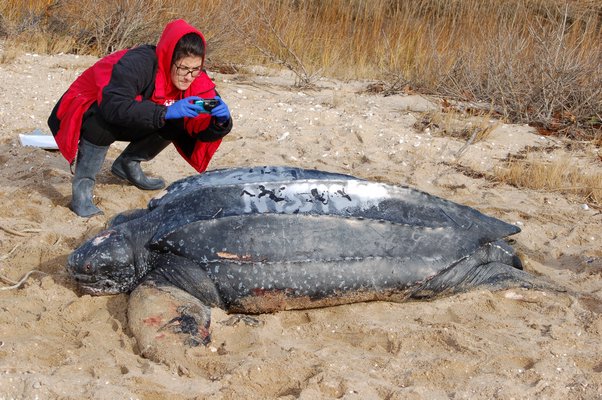
The first step in the necropsy is documenting any external injuries. MIKE BOTTINI
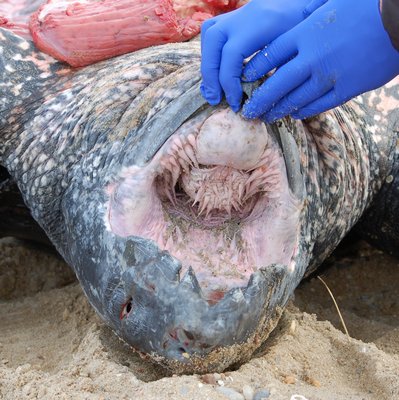
Among the unusual features of the leatherback sea turtle are the soft fleshy spines in its mouth and throat that move and guide its soft prey - jellyfish - down into its stomach. MIKE BOTTINI
Last week, I had the opportunity to observe the dissection of a leatherback sea turtle that had washed ashore in Three Mile Harbor, East Hampton. The dissection was part of a necropsy to determine the cause of death, and was performed by staff from the Riverhead Foundation for Marine Research and Preservation.The massive 6-foot-long turtle had been drifting around the harbor for over a week before someone secured it to a pier at Halsey’s Marina. The first, and often the most complicated, step in the necropsy involved moving the huge turtle to a suitable location for dissection and burial. East Hampton Marine Patrol was on hand to tow the creature to a somewhat isolated beach nearby, where Town Parks workers took over with a payloader to position the turtle above the tide line.
Christina Hansen and Natassia Balek from Riverhead Foundation began the necropsy with a thorough examination of the turtle’s exterior, photographing any scars and abrasions and taking measurements of its carapace (upper shell) length and width. Common causes of adult mortality include drowning via entanglement with fishing gear and collisions with vessels.
Metal tags on the inside edge of both of the rear flippers were noted, and the tag’s code (T67442) was transcribed. A handheld scanning device revealed a bar-coded pit tag embedded under the skin of the left front flipper that could be read just like the bar code on groceries in the supermarket.
Sea turtles are pelagic. Only the mature females come ashore to nest and lay eggs, and in the case of the leatherbacks, this happens once every two or three years. Western Atlantic nesting areas are adjacent to the warm waters of the Caribbean, Gulf of Mexico and the ocean as far north as the Carolinas. Many of these nesting areas are monitored by biologists, and it is when the females come ashore to nest that tags are put in place.
Although males may be tagged at sea as part of extricating them from fishing gear—a common cause of leatherback mortality—most tagged leatherbacks are females. And that was the case with the turtle at Three Mile Harbor. A computer search of her coded tags revealed that she nested on Trinidad Island in the West Indies. I was not able to find the date it was tagged.
The turtle was flipped over onto its back, and the first incisions were made around the plastron, or lower shell, in order to remove it and access the internal organs. By all appearances, this leatherback seemed to be quite healthy, with no internal bleeding or fluid in the body cavity. Some organs were bagged for further examination at the foundation’s lab, and the reminder of the corpse was buried on the upper beach.
The death of these magnificent sea creatures is an unfortunate incident, but a careful necropsy can provide useful information for turtle biologists working toward protecting and better understanding them.


