


 2 Photos
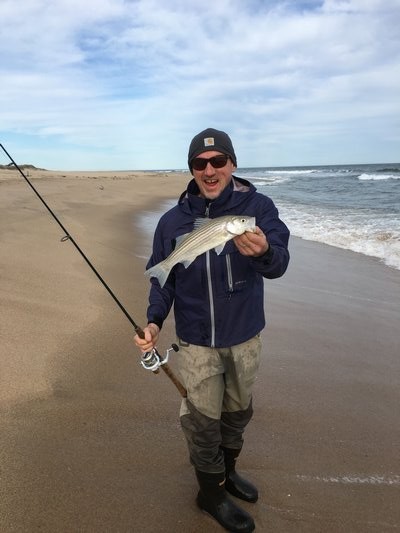
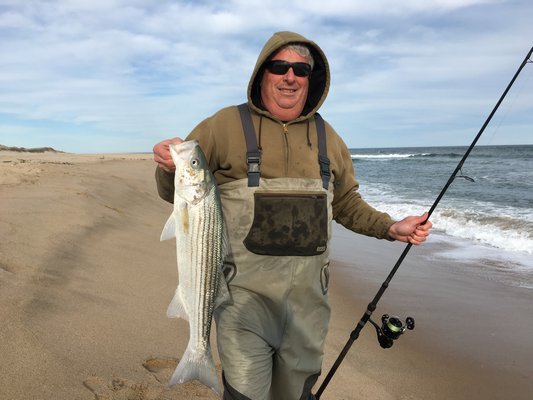
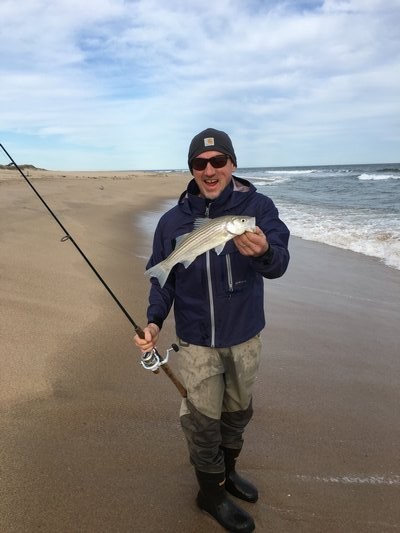
It’s still April, so I guess we here on the South Fork have to be pretty happy that there are striped bass to be caught, even if the sizes of fish that we see New Jersey anglers catching this week leaves us feeling a little left out.Some pretty amazing numbers of fish for this early in the season were being caught from the beaches all over the South Fork this week. I heard of some guys catching 10 to 20 fish in a session, which is full-bore surfcasting for any time of the year.
The fish we’ve got are mostly still very small, immature fish, but a handful of keepers have been taken. I’ve yet to hear of a weakfish caught, but I know that some of the eager beavers (with Hamptons Surf Club trophies in mind) have been poking the usual weakfish spots already this week. Perhaps on the backside of the blow Tuesday and Wednesday …
Striped bass fishing this time of year comes with a bit of a moral conundrum for those anglers with a conservationist bent. In New Jersey and around the New York Bight, striper fishermen have to shake off the winter cobwebs in a hurry, because the spring run has become among the best fishing of their season since the bunker resurgence has the Hudson spawning fish heading into New York Harbor to begin their run to the freshwater with the feedbag on. Those big fat fish—the real jumbos with fat bellies are all females—are headed to spawn and, if they’d lived for a few more weeks, would have laid millions of eggs.
But those fish have spawned many times before. And so, in a way, those of us on the fringes of the major spawning areas (there certainly are some fish that spawn in the Connecticut River and likely can be caught here on their way there) have an even more vexing moral dilemma. Keeper-sized fish are relatively rare for us, but when they do come along, aside from the very large outliers, it is likely that a 28- or 30-inch fish has never spawned in its life before it is caught. And so, with the health of the overall population at stake, killing it is an even more brazen robbery of the stock.
The justification in all this is that, to an extent, we are a drop in the bucket. A few thousand fish taken out of the population of millions during the few weeks when they are in shore, on their way upstream, shouldn’t really spell any sort of threat to stripers.
Fisheries scientists, for all the skepticism we have about their knowledge when they tell us we have to catch fewer fish, have said that the striper seasons don’t need to be cut back to protect spawning stocks, as of now. But we all have a vested interest in the stock of stripers being as robust as possible, and we should at least ask ourselves if the fish flopped in front of us needs to die to fulfill our mission, whatever that may be.
If there’s one good thing social media has done to striper fishing, it’s made the photo of angler and conquered beast the most important thing. (Which reminds me, I need to do a refresher on how to take good fish photos …)
More and more fishermen these days are fairly well-off and increasingly pursuing their quarry for the sport and bragging rights more than for the dinner table. Surfcasting, in particular, is a crusade of sportsmen, and finding, fooling and besting the fish is the goal. Most of the best surfcasters I know release a lot of the fish they could keep if they wanted to—and I don’t just mean beyond their one-fish-per-day limit. Besides, carrying a heavy fish all the way back to the truck is a pain in the ass.
Full disclosure: With a dwindling supply of frozen fillets in my freezer, if I were to catch a keeper this week, I would be hard-pressed to release it.
But it’s a thought that bears keeping in mind.
Catch ’em up—and keep ’em if you want to. See you out there.


 Michael Wright on Apr 26, 2017