


 1 Photo
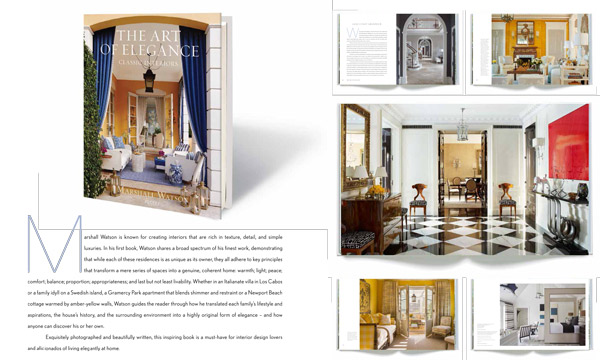
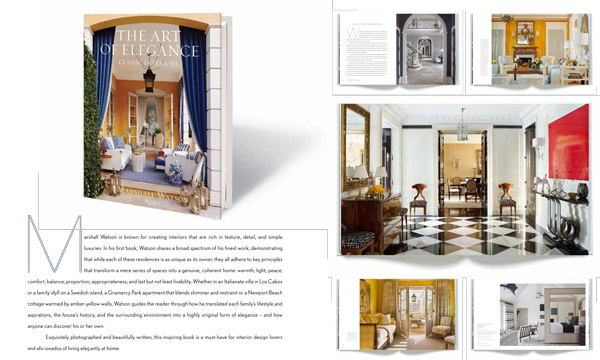
"The Art of Elegance" blad.
I have frequently been asked how I went about putting together my book, “The Art of Elegance,” a collection of my interior design work and the stories that accompany that work. I answer them by saying that I was new to the world of publishing, with no primer to follow. I wish that someone had shared with me what I am about to outline in this article. I stumbled through this process rather slowly. So I hope these words may be applicable not only to interior designers, landscape designers and architects, but also to those interested in publishing their own work such as photographers, fashion designers and artists.Four years ago, I came to the decision that I had a large enough body of unpublished work to merit a book. Well, at least I had come to that conclusion, but I needed to convince others that my conclusion had merit.
In order to convince a reputable book producer or agent of the viability of a book of my work, I had to assemble scouting shots from previous photo shoots and published magazine articles of my very best work. Because I was not familiar with the pitching process, I would have been better served had I selected work from my collection that followed a strong initial theme. I ended up developing a strong theme with my book producer. I strongly advise commissioning a book producer or agent to navigate the process for you. Many designers and artists feel that they are well enough prepared to approach the publishers directly, but it is tricky.
A good book producer or agent, whose taste, advice, and integrity you respect, scours the entire body of your work. The producer then helps to sift out the essence of your work, advising what has maximum appeal to the current market and what audience the work will attract. He or she then directs you to the projects that you should initially photograph, record or feature in order to help sell your book.
Once you have photographed and assembled several of your most dynamic projects, the producer helps put together several mocked up chapters, with a proposed book cover. This is done with the help of a talented book designer, or graphic artist. I was quite impressed with how professional the mock-up of the book and chapters initially appeared. It seemed a monumental effort, but was essential to enable the agent or producer to more effectively pitch the book to publishers.
Even though my initial book title and cover were never actually used, the labor-intensive mock-up was highly effective for my producer to get meetings with the various publishers. It attracted a good deal of attention and many offers.
Once the offers have been evaluated and a publisher is selected, a contract is drawn up. This contract refers to the length of the book, the size of the book, production time for the book, advances, reimbursements, sales and rights, etc. The publisher assigns an editor to oversee the production of the book. Lawyers are consulted. And once everything is signed, it is off to the races.
At this point, I needed to schedule about 15 photo shoots for all the projects to be featured. Photographers and stylists are hired. If the book is to have text, as in my case, a writer was to be contracted and several interviews were lined up to find the perfect fit.
Once the photography is completed, the writer begins submitting story drafts and thus begins the process of editing photos, text, captions, and stories with the producer and the book designer. For me, this was both exciting and frustrating. It was exciting to see the stories visually and verbally unfold. But it was frustrating to have to cut and edit photos and descriptions that all seem like precious children to me.
Most surprising to me about the process was that we completed the book before submitting it to the publisher’s editor. Of course, my editor ultimately made essential edits and the final decision on the book cover, but was otherwise quite uninvolved until it was submitted. (However, my book designer made 12 versions of the book cover for the publisher’s editor until they finally settled on one!)
Next step was seeing the completed book mock-up. Perhaps the most exciting moment is when one sees all the pages laid out from cover page to book jacket linen, from table of contents to credits. Once this is approved, it is sent off for color correction, a process that takes at least three tries. Once the publisher, editor, book designer, book producer, author and writer have stamped their final approvals, the precious tome ships to the manufacturer in Italy, Germany or China—most go to China—and six months later, via the “slow boat from China,” the finished books finally arrive.
But this is hardly the end of the long road, because, while the book is being printed, a promotional brochure called a “blad” has to be created. The blad is sent to all the shelter magazine editors, bloggers, newspapers and public relations agencies in the hope that it stirs up interest and coverage. This electronic brochure details the cover and several chapters as a teaser. This is also a time consuming effort, but well worth the work. The designer-author then awaits responses, juggling exclusives in priority placements, scheduling launch dates and signings. Most publishers are understaffed and overworked and have little time for organizing the promotional process for these books, and so the task is left primarily in the hands of the author.
Though seemingly unsurmountable, the tasks that confront a designer, artist or writer in producing their own book, are all a part of a very rewarding and humbling process. It is an extremely collaborative and richly memorable experience. I would recommend the adventure to those who do not get frustrated easily and to those who have a very strong constitution.


 on Jul 31, 2017