


 3 Photos
Jonathan Brandeis
far left

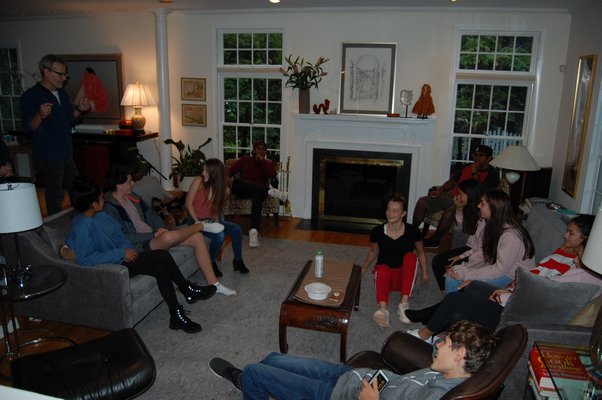
directing high school students from Southampton and Sag Harbor before shooting a PSA on the Suffolk County Social Host Law. JON WINKLER
With the nation in the throes of an opioid epidemic, more focus is being placed on preventing youth from starting down the path to addiction.
A handful of groups on the East End are dedicated to this mission and offer programming year-round for students in an effort to help them avoid making decisions that experts say have the potential to spiral out of control.
On November 14, SAFE (Substance Abuse Free Environment) in Sag Harbor partnered with the Sag Harbor Elementary School Parent Teacher Association to host a seminar called “Drugs and Alcohol: What Every Elementary School Parent Needs to Know.”
The seminar focused on understanding risk and protective factors and incorporating substance-abuse prevention into parenting. According to organizers, the event was held as a part of ongoing efforts on the East End to curb teen substance abuse, which a 2016 survey completed by the Southampton Youth Bureau shows occurs in higher numbers in the region when compared to national abuse statistics.
“The East End has some great, great stuff going on,” said Kym Laube, the executive director of Human Understanding and Growth Services, or HUGS, and program director of SAFE in Sag Harbor. “But the East End also has a ton of drugs and alcohol. Part of it is tourism, part of it is ‘come party in the Hamptons,’ part of it is that it’s just such our norm, we’ve never questioned it.”
It Takes A Village
Community coalitions believe that the best way to create real, lasting change is by challenging community norms—a process that can take decades, according to Ms. Laube.
In 1998, the federal government created its Drug Free Communities program, which offers grant funding to coalitions throughout the country. When it was first funded, the program received $10 million in funding for 92 coalitions, but has grown to support 2,000 coalitions with $95 million in grants offered in 2016.
Two groups that have benefited from the DFC program on the East End are SAFE in Sag Harbor, originally the Sag Harbor Community Coalition, and Riverhead Community Awareness Program Inc., or CAP. Grant funding is worth $125,000 per year for five years, as long as the coalitions can match it with resources in kind, and can be awarded only twice.
“The coalitions that are most effective are acting as catalysts in the community,” said Dr. Jeffrey Rodman, an addiction counselor and DFC grant advisor. “They can create a program and provide training in the community, and then the coalition can kind of let that go and let it run on its own. For a lot of communities, often there is a big learning curve on … how to use the federal grant to benefit the community.”
The DFC grant has relatively strict guidelines for what coalitions can and cannot do with the money. Everything done with the grant must be based on evidence-based programming, and must impact as many community members as possible. Additionally, the coalitions must include representatives from the 12 community sectors—youth, parents, school, media, business, law enforcement, religious/fraternal, professional, youth-serving, LGBTQ, civic/volunteer and healthcare.
SAFE in Sag Harbor was derived from the Sag Harbor Coalition in October 2016. That group still serves as the parent of SAFE and partnered with HUGS to achieve nonprofit status after its founding in 2012, which allowed it eligibility for the DFC Grant.
Danielle Laibowitz was hired last year as the organization’s new project coordinator. According to Ms. Laibowitz , the majority of her time so far has been spent restructuring the coalition so it can meet DFC standards and most of the work in the community has been giving out information through training and mailing sheets on the impacts of illicit substances.
Coalitions receiving the grant must conduct surveys of youth and parents and report their findings to the government. The surveys focus on things such as perception of risk and 30-day use history of drugs and alcohol by students.
“Because I came in in the third year of the grant, and the survey wasn’t done correctly, we are going to re-do and we hope to see something,” Ms. Laibowitz said.
In recent years, SAFE has helped plan a new pre-prom event at Pierson High School with the help of the school’s Parent Teacher Student Association. The pre-prom event includes a red carpet and professional photographer. But more important, according to Superintendent of Schools Katy Graves, students attending prom are now required to use school-provided transportation to the prom venue. Since these steps were implemented, Ms. Graves said there have been zero substance-abuse related incidents at prom.
Riverhead CAP, which has been around since 2006 and was awarded the DFC grant in 2013, has been lauded for its efforts. In 2017, it received the “GOT OUTCOMES!” award from Community Anti-Drug Coalitions of America for its short-term successes addressing underage drinking.
“We’ve implemented several strategies to address underage drinking in our community,” said Kelly Miloski, Riverhead CAP’s community prevention specialist. “Including on- and off-premise alcohol retail compliance checks, our pre-prom and red carpet events, Intervention Procedures Responsible Server trainings, radio public service announcements, our life-skills training program at Pulaski Street School, and the town’s first alcohol policy for public events.”
One service that both coalitions perform is providing prescription medication “take-back” events. On those days, the groups partner with local municipalities and law enforcement agencies to provide a way for people—including many senior citizens—to dispose of their prescription opioids in a safe way. The county also partners with groups for “take-back” days.
“There’s so many seniors who have these crazy amounts of prescriptions,” Suffolk County Legislator Bridget Fleming said, noting that many teens will try medications found in family medicine cabinets, including opioids. “[They have], like, 80 pills, and they were being turned in, which means they weren’t being used. But, unfortunately, they were in the medicine chest, which means that if you have kids at home and they have friends, they come over, one of them may be involved [with drugs] or not—that’s a situation we can prevent with these drug take-backs and with education.”
Ultimately, students say the coalitions have the ability to challenge the perception that underage substance use is acceptable, in the hope of reducing the number of teens who will eventually abuse alcohol, which can lead to other kids of substance abuse, with deadly effects.
“That culture is so normalized that we are only talking about heroin and opioids and fentanyl and getting upset about that, but nobody just starts using that stuff,” said Hope Brindle, a 2018 Pierson High School graduate and intern at HUGS. “It always starts somewhere else, and we are normalizing marijuana, we are normalizing alcohol, and that’s where people start.”
Before It’s Too Late
While the coalitions put their efforts into changing community norms and delaying first-time use, other agencies devote their time to the kids who are at-risk or are already abusing substances.
A major indicator of a young person being “at-risk” is mental health. A 2018 study by the National Institute on Drug Abuse found that 60 percent of minors in community-based substance use disorder treatment programs also met the criteria for another mental illness.
“In comparison to national statistics, our kids have always reported high levels of symptoms of depression. … This year it’s even higher,” said Nancy Lynott, the head of the Southampton Town Youth Bureau. “One of the big things we learned this year is that stress plays a big role in almost every kid’s life.”
The Southampton Town Youth Bureau and organizations like HUGS provide services to not only help reduce high-risk behaviors but also give kids activities that do not involve the use of illicit substances. The Youth Bureau sponsors events like beach nights and music competitions, while HUGS is known for its Long Island Teen Institute retreat on Shelter Island.
“We put them in a campsite for three days, and in those three days they turn in their cellphone, and we bring them through a set of activities that are youth-led, youth-inspired and youth-driven,” Ms. Laube explained. “Because it has become very clear to me that there are very few opportunities for kids to connect where alcohol and pot are not at the epicenter of what they’re doing.”
The Long Island Council on Alcoholism and Drug Dependence, or LICADD, has programming and counseling for kids who are at risk or who are already using.
“Instead of giving them the option of ‘I’m going to be allowed to use and reduce my stress,’ or ‘I’m not allowed to use and I’m stuck with my stress,’ we want to offer the option of ‘Well, let’s have a conversation about why you’re using,’” said Adam Birkenstock, LICADD’s clinical director. “Let’s have a conversation about reducing your dependence on something and replacing it with something else and increasing your coping skills so … maybe you’re less dependent on whatever you’re using. So it helps people move toward a place of sobriety, or perhaps using less over time, instead of feeling like it’s between these two extremes.”
Schools Changing Their Focus
Instead of relying only on traditional Red Ribbon Week assemblies, many schools on the East End have been shifting away from formal anti-drug programming and toward student development of life skills and encouraging extracurricular activities.
“All the research shows that when you’re connected to a positive community, whether it’s theater or band or football or student council or whatever it is, you’re less likely to engage in those behaviors,” Hampton Bays Superintendent of Schools Lars Clemensen said. “We monitor those statistics—how many kids are taking part in at least one activity. Because that is a big defense against kids making that initial decision to go down the wrong road.”
In the Sag Harbor School District, administrators try to keep the students involved year-round by offering summer camps in subjects like art and basketball.
“I always encourage parents—you never know what your kid’s interests are going to be until they are exposed to things,” Ms. Graves said.
For local schools, the identification and prevention of risky behaviors starts as early as kindergarten. For the younger grades, the curriculum is very different than what would be taught in middle schools and high schools. According to Mr. Clemensen, kindergartners learn things like how to be a good friend, being inclusive and finding trusted adults.
These skills, while they are not directly anti-drug, are meant to set the foundation for kids to lead a drug-free life, according to Adam Fine, the East Hampton High School principal and chairman of the East Hampton Adolescent Mental Health and Substance Use Task Force.
“We are kind of operating under the guise of kids know drugs are bad,” Mr. Fine said. “We don’t need to spend time on educating kids on how bad opioids are or how bad marijuana is, we need to get to the root of some of those underlying behaviors.”
For students consistently showing signs of mental health problems, risky behaviors, or both, the Hampton Bays School District holds weekly meetings with school administrators, psychologists, counselors and social workers to make sure they are applying their resources appropriately.
“[We] brainstorm on how we engage with that student and that family. Maybe it’s drug related, maybe it’s not. But we feel that that intimate level of watch is important. Kids don’t even know that that meeting is happening,” Mr. Clemensen said.
Educators are realizing that they are not going to discipline students into sobriety, Mr. Clemensen explained. While discipline does happen through suspensions and other, more strict, methods, he said, there is often a counseling piece attached.
“We don’t pre-judge kids here. We know that kids are going to have problems and substance abuse is going to be one of them,” Mr. Fine said. “Once we get past the fact that, yeah, we discipline, then it’s, like, ‘Okay, what can we do for you?’”


