


 5 Photos
Library board chairman Tom Twomey discusses the lawsuit at a press conference on Thursday. KYRIL BROMLEY

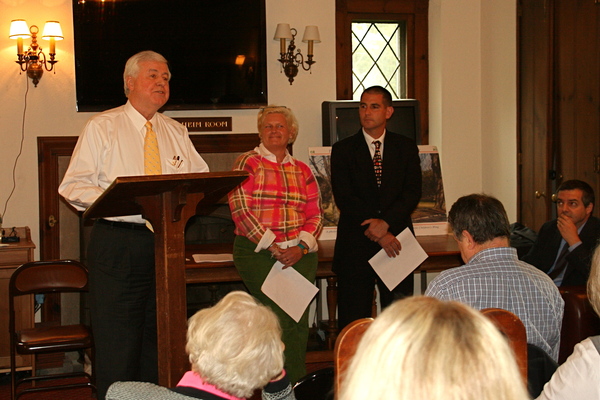
Library Director Dennis Fabiszak and Tom Twomey
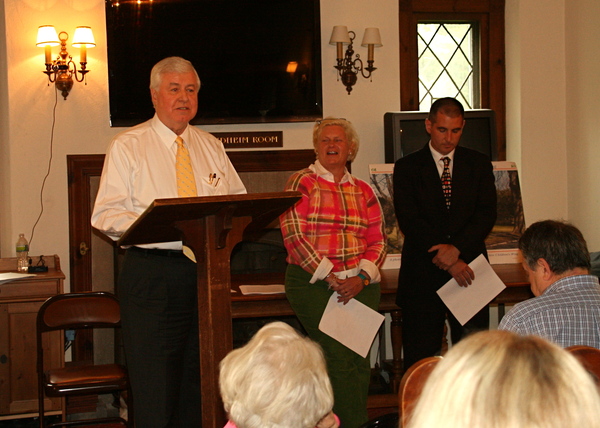
library board chairman
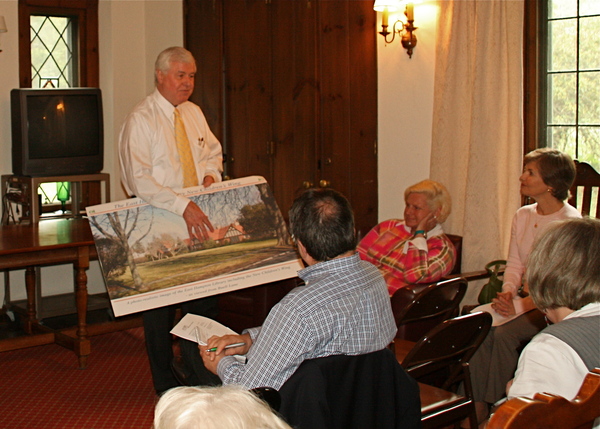
with a sketch of the children's room additon. KYRIL BROMLEY
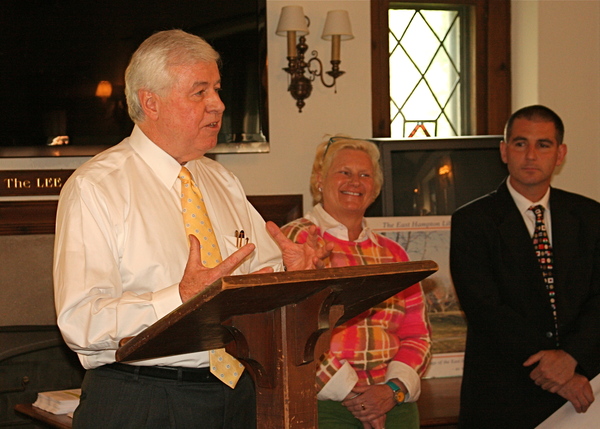
Library board chairman Tom Twomey discusses the lawsuit at a press conference on Thursday. KYRIL BROMLEY
Mayor Paul F. Rickenbach announced Friday that the village would not appeal a State Supreme Court decision supporting the East Hampton Library’s proposed children’s wing addition, which the East Hampton Village Zoning Board of Appeals had rejected last July.
“We are very happy that the village has taken action so quickly and look forward to moving ahead and building a library everyone will be proud of,” Dennis Fabiszak, the library director, said Friday.
Library officials now can focus on raising the remaining $2-plus million they will need for a new children’s wing, for which they could conceivably break ground by the end of the year. It will allow the library to add more children’s books, have a space devoted to young adults, and create a meeting room in the basement that will be accessible to the handicapped, including seniors, by elevator.
“We are so pleased!” said East Hampton Library President Doreen A. Niggles at a press conference at the library last Thursday. “Unfortunately, an entire generation of young children lost the benefits of these programs.”
In a 14-page decision filed on May 17, the court said denying the application, which was first submitted in 2003, had been “irrational.” State Supreme Court Justice Thomas F. Whelan supported the library’s argument that the expansion, while in a residential neighborhood, would be in keeping with the character of the Main Street neighborhood, which includes churches, commercial and cultural buildings like Guild Hall— “in other words,” said Library Board Chairman Tom Twomey at the celebratory press conference last Thursday, “perfect for a library.”
In its determination, the ZBA said that the library’s environmental impact statement had not persuaded the board that the expansion would not harm the property and the surrounding area.
Jeffrey Bragman, who represented the Village Preservation Society, which opposed the application, said on Tuesday that the society believed that the parking and square footage “were too big for the site” and that the addition would encroach too much on what is called the Osborne green behind the library.
Library officials have said that 84 percent of that two-acre open space would be preserved. About two years ago they put up a fence demarcating how far the addition would extend behind the library, and last Thursday it was marked with small white signs, indicating where different parts of the expansion would be situated.
In his ruling, Justice Whelan also issued a special permit and the two variances the ZBA had denied.
The addition still needs Design Review Board approval, but that board unanimously approved a roughly 10,000-square-foot proposed addition even before it was scaled back in 2004.
It now stands at 6,800 square feet, with half of that underground. Mr. Twomey said the above-ground portion would be “less than half the size of a tennis court.”
“I’ve been waiting for this for eight years,” Mr. Twomey said last Thursday of what he called the “landmark decision.”
At the press conference, Bill Esseks, the library’s attorney, said officials had attended “40-something hearings before the ZBA” over seven years before the application was denied.
East Hampton Library officials filed a suit last year after the ZBA rejected the proposed addition.
“The Zoning Board of Appeals application of the East Hampton Library has been arduous and contentious,” Mayor Rickenbach said in a statement issued after a closed session of the Village Board at midday Friday. “There have been, in our opinion, a number of missteps on both sides.”
“The decision of Supreme Court Judge Whelan ends the litigation as far as an appeal is concerned. While we might take issue and argue with the specific conclusions in this case, we choose not to. We believe it is time to move on, put an end to costly legal fees, and begin the process of healing the community on this issue.”
As of Friday, East Hampton had spent $63,000 on the litigation, Village Administrator Larry Cantwell said.
“We spent tens of thousands of dollars on expert testimony from architects, traffic engineers, library consultants, landscape architects, and environmental scientists to get this permit to build our modest children’s wing,” Ms. Niggles said in a statement last Thursday. Library supporters took pains to point out that taxpayers did not contribute to those expenses, and that the addition itself will be paid for with private donations.
The court also backed up the library’s claim that it is an educational institution entitled to special treatment in zoning matters, which will be afforded to “all libraries in New York State.”
Mr. Bragman said that is a departure from designating only schools and churches as “privileged” uses, but that reasonable conditions can still be imposed in matters of zoning.


