


 1 Photo
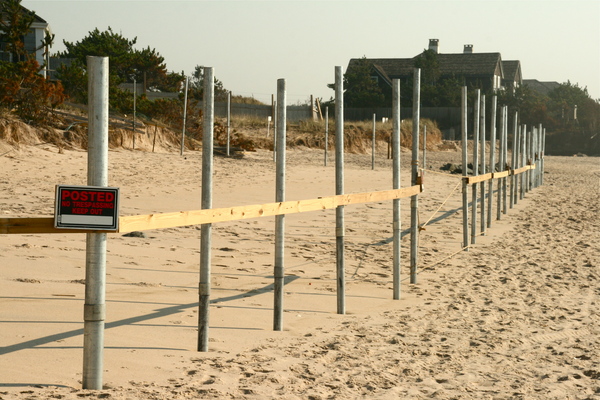
Mollie Zweig, the owner of an oceanfront house near Georgica Beach, and her contractor, Robert Sullivan, have been ordered to appear in court for violating an East Hampton Village stop-work order on a fence they were building on the beach.
In addition, the New York State Department of Environmental Conservation sent a notice of violation to Ms. Zweig on Friday for building an unapproved accessory structure in an area adjacent to tidal wetlands, Bill Fonda, a DEC spokesman, said on Tuesday.
East Hampton Village Code Enforcement Officer Thomas Lawrence hand-delivered the stop-work order last Thursday and then, after work continued that day, the two summonses on Friday. Ms. Zweig and Mr. Sullivan were ordered to appear on October 17 in East Hampton Town Justice Court.
Mr. Sullivan has been overseeing construction of the fence in front of Ms. Zweig’s property on Georgica Beach since the day after Hurricane Irene, which gouged away the dune between her house and the public beach. Zack Zweig, the property owner’s son, said the family was trying to prevent the town from taking his family’s property.
Neighbors and others say that the fence impedes access to and enjoyment of the public beach. It has even inspired a Facebook page, “Friends of Georgica Beach.”
The village attorney, Linda Riley, said on Friday that the issue is not who owns the property.
“The issue is about the fencing, construction on a beach,” she said. “The fact is that it’s a beach now.”
One section of the village code prohibits constructing a fence on a beach without permission from the East Hampton Town Trustees, she said. The fence also does not comply with two other sections of village law, she said, that govern coastal erosion hazard areas and the preservation of dunes.
Mr. Sullivan started putting in 6-foot galvanized steel pipes, between which he said he intended to put snow fence, the week following the hurricane. He said last week, after adding “private property: no trespassing” signs as well, that in addition to trying to protect private property, he was trying to prevent someone from getting hurt on rocks left exposed after the storm.
The fence is one foot within the Zweigs’ southward property line, Mr. Sullivan and Mr. Lawrence both said.
“They don’t lose property rights,” Mr. Lawrence said: “Zweig’s metes and bounds are called.”
Mr. Lawrence said that in East Hampton Village, the seaward property lines of some oceanfront tracts were historically defined by beach grass or by the mean high water mark, both of which can change over time.
However, he said, the Zweigs’ property boundaries are clearly defined in their deed.
In addition, Mr. Lawrence said, while waterfront property owners can lose property through continuing erosion, the temporary “evulsion” loss from a onetime storm event is something different.
The beach has already regained 5 or 6 feet in height and is wide enough he said, that he saw three sets of vehicle tracks, side by side, on Tuesday.
“They just want it regulated,” Mr. Lawrence said of village officials, which was a point Village Administrator Larry Cantwell had made last week.
Mr. Lawrence delivered a stop-work order to Mr. Sullivan on Thursday, also sending it by certified mail.
“Unfortunately,” he said, “later in the afternoon I observed that the poles were being extended” upward to compensate for a buildup of sand.
Since Mr. Lawrence delivered the two summonses on Friday, he said, “no further action has occurred other than the addition of sand.” Mr. Sullivan could not be reached for comment on Tuesday.
As for the DEC: Mr. Fonda, the spokesman, said that officers visited the property on September 1 and September 6. A certified letter was mailed to Ms. Zweig on September 9.
She will have 30 days to contact the DEC and schedule a compliance conference that typically produces a “consent order” to “undertake certain acts,” Mr. Fonda said. He would not say specifically if that means removing the fence.
Noncompliance after the terms are worked out in the conference can mean a DEC fine of up to $10,000 per day per violation, Mr. Fonda said.
Meanwhile, the clock started ticking on Friday as far as village fines are concerned. The alleged violation of dune preservation law could mean up to $1,000 per offense, with each day the violation continues considered a separate offense. The alleged violation of coastal erosion law could mean fines of up to $250 or imprisonment of up to six months or both, with each day of a continuing violation considered a separate offense. The alleged violation of building a fence without the trustees’ consent could mean a fine of between $100 and $250 or imprisonment of up to 15 days or both.
However, Mr. Lawrence said, “we are quite hopeful that by the time we get there permits will be in place or in process.”
Lori Miller-Carr, the East Hampton Town Trustees’ secretary, said she was with Trustee Clerk Diane McNally last Thursday when an application for the fence was handed to Mr. Sullivan at Georgica Beach.
Repeated calls to Ms. McNally were not returned, and the Trustees’ attorney, John Courtney, said he could not comment for the record pending a meeting of the Trustees for the first time in three weeks on Tuesday, September 13.
A statement was issued Friday through WordHampton for the Citizens for Access Rights, a grassroots group supporting East Hampton Town in its lawsuit over the public’s access to a stretch of ocean beach in front of private property on Napeague. It said the group is closely monitoring the situation at Georgica Beach.
“The end result of the obtrusive and unapproved structure at Georgica is the inability for the general public, and emergency services, to effectively traverse the beach,” the statement said in part.


