


 3 Photos
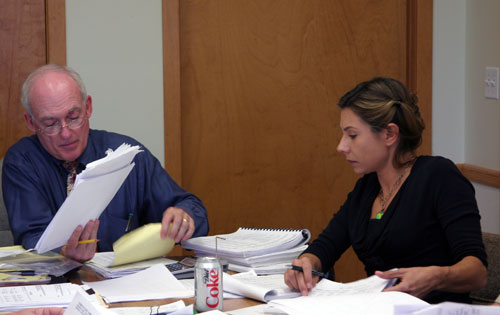
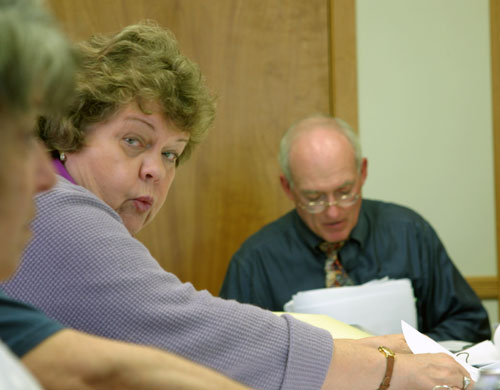
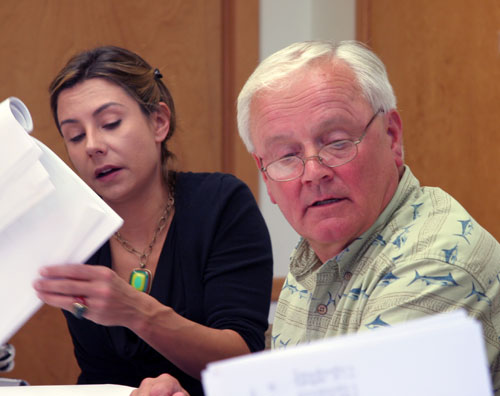
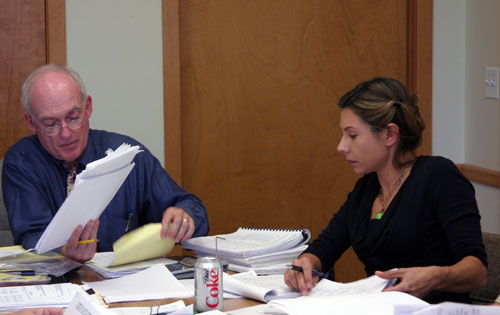
With the town poised to hit residents with tax increases in the neighborhood of 18 percent in 2009, East Hampton Town Board members agreed on Tuesday to forego any salary increases for themselves next year, as had been proposed in the supervisor’s budget.
The Town Board agreed their raises should be eliminated in light of the financial turmoil the town has found itself in and the need for steep tax increases in already difficult economic times. Councilman Pete Hammerle said during Tuesday’s board work session at Town Hall that he had spoken with each board member individually and that all had thought dropping the raises was a wise move.
“It has become apparent that we are all willing to forgo our raise next year,” Mr. Hammerle said. “That will give us a $12,000 savings. As far as other elected officials go … we’re going to leave them alone, as proposed in the budget.”
The decision to give up the proposed 3.75-percent raises for the four board members, who currently earn $60,500 a year each, and Supervisor McGintee, who earns $96,800, may have been as much a political gesture as a fiscal move in the wake of revelations in the last 10 months of the town’s growing deficit.
Three of the current board members—Councilmen Pete Hammerle and Brad Loewen and Councilwoman Pat Mansir—were all on the board in the period of 2005 to 2008, when the deficit in the town’s general funds grew from zero to an estimated $10 million or higher. The deficit was first revealed late in 2007 when the 2005 audit, not released until after the 2007 elections, showed the town beginning to struggle with red ink.
Councilwoman Julia Prince took office in 2008, just weeks before it was revealed that the deficit had ballooned into the millions of dollars in 2006. In the months since, financial reports have shown that the deficit was probably exceeding $8 million by the end of 2007 and will likely climb by another $4 million by the end of 2008.
The raises proposed by the supervisor paralleled the contractual salary increases that union civil service workers will get next year. He said in a recent interview he included the raises in the budget plan because it “would have been presumptuous of me” to withhold raises for board members and that they could make a decision on the matter themselves as they reviewed the plan and settled on a final budget.
Some workers would get 4.75 percent raises in Mr. McGintee’s plan because of seniority bonuses; and some department heads are scheduled to get significant raises in 2009.
Cutting their own salaries came easy for the board members during Tuesday’s work session. But several other lines of the budget spurred heated debate about spending habits, realistic forecasting of costs and return on investment for everything from new computer software to employees in the tax assessors office.
On several topics, Mr. McGintee, whose $67 million budget plan would cut millions in spending but calls for an 18.75-percent tax hike for town residents, found himself at odds with board members who wanted to cut spending further to lower the tax impact on residents. The supervisor, repeatedly pointing to the deficit and four straight years of over-spent budgets, and warned board members not to make unrealistic cuts that could mean another unbalanced budget at year’s end.
“This budget cannot finish in the negative,” Mr. McGintee said. “If it finishes in the red, you’re right back to where you started. We need financial solvency.”
Board members haggled over funding lines for attorneys fees, computer specialists and a proposal to hire a new full-time employee in the tax assessors office to deal with assessment grievances. Mr. Hammerle and Councilwoman Mansir called for tight purse strings and making do with little or no increases in appropriations.
“I don’t want to wait, I want to cut,” Mr. Hammerle said when asked if the board wanted to wait until the information technology department head Bob Pease returned from vacation to explain why the department needed a $100,000 funding boost. Mr. Hammerle and Ms. Mansir argued that things like training on new computer systems, upgrades in basic software and the purchase of new computers could be put off for another year, when the town will not be proposing such a big tax hike. “This is not the year for this kind of increase,” Mr. Hammerle added. “This is going to be a rough year for everybody and this reflects like there are no problems going on. This is just one of the expanding new departments that have to stop expanding.”
Mr. McGintee continued to warn them that certain costs lay ahead, whether the board budgeted for them or not, and that the town’s once ample funding surplus, which provided a cushion from minor over-expenditures, is gone.
“I’ll be relying on all of you, you’ve got to have the funds to cover your costs,” the supervisor said. “It’s the reality of the situation and if you leave yourself short, there is no surplus. If we come up with a fictitious number ... there is no rainy day money.”
He also noted that some expenses in one budget line would bring an overall savings in the bottom line at the end of the year. The board was under-budgeting its need for hiring outside attorneys for help with condemnations, Mr. McGintee said, and unwisely refusing to hire a full-time employee for the assessors office that would result in savings far greater than the $40,000 annual salary.
But Mr. Hammerle and Ms. Mansir, sometimes joined by Councilman Loewen, pushed for cuts on every line possible. A brief parade of department heads came in to make the case for the some of the funding increases they were requesting and some costs were written off as unavoidable.
“Don’t be offended but in past years the board has sat here and said ‘Okay, okay, okay’ to everything,” Mr. Hammerle said, hinting at the astonishment among board members when it was revealed by long-delayed audits that there had been huge budget deficits in 2005, 2006 and 2007 and that the towns once multimillion-dollar surpluses had been entirely spent.
The supervisor’s budget makes deep cuts to dozens of social and cultural programs, though largely sparing services provided to senior citizens and poor families. The steep tax hike, Mr. McGintee says, is necessary to make up for years of nearly flat tax rates that did not keep up with spending increases—which Tuesday’s intermittent debates proved can be difficult to cap.
It is widely held in political circles that Mr. McGintee will not seek a fourth two-year term in the supervisor’s office in the 2009 town elections and that Mr. Hammerle, who was elected to his third four-year term last year, will run for the town’s top spot on the Democratic ticket. Ms. Mansir is up for reelection to a fourth four-year term in office next year.


 on Oct 14, 2008