


 2 Photos
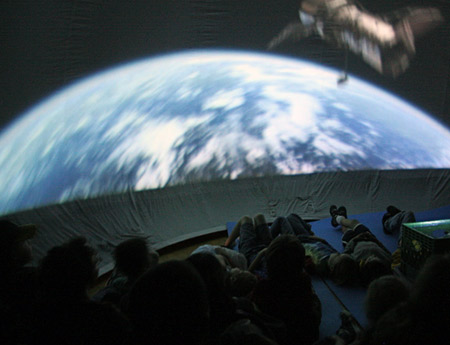
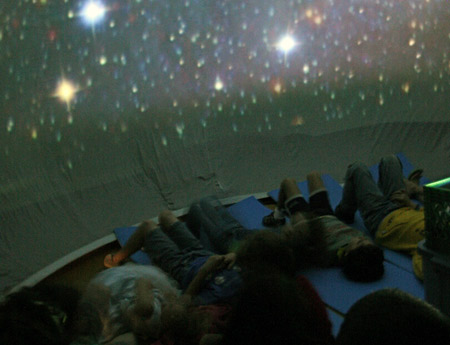
Kids and adults ponder the mysteries of space within an inflatable planetarium at the Montauk School during one of the Montauk Observatory's summer star parties. KYRIL BROMLEY
In 1609, Galileo Galilei peered through a primitive telescope made of wood, paper and copper and discovered the mountains and craters of Mars and the stars that filled the Milky Way. Despite his telescope’s tiny range of view by today’s standards—looking through it, one cannot even see the entirety of the moon—Galileo was able to understand the celestial wonders he was seeing with his own eyes.
Springs resident Dava Sobel, the author of the bestselling historic memoir “Galileo’s Daughter,” will discuss Galileo’s discoveries on their 400th anniversary on Sunday, July 5 at one of the Montauk Observatory’s summer star parties. She will also talk about the International Year of Astronomy 2009, a global effort led by the International Astronomical Union and UNESCO and endorsed by the United Nations to help citizens around the world reconnect with their place in the universe.
Ms. Sobel’s lecture and a planetarium show will start the night at the Montauk School at 7:30 p.m. and be followed by a trip to the Theodore Roosevelt County Park to look at the starry skies with the Montauk Observatory’s 900-pound professional telescope and some professional and amateur astronomers as guides.
Ms. Sobel said she first became interested in astronomy when she was in her 20s when she attended lecture given by one of the country’s most popular and esteemed astronomers, the late Carl Sagan. It was 1974, before Dr. Sagan was famous, and he was talking about the likelihood of discovering planets around other stars, which later happened in the early 1990s.
“I remember that as a transformative moment, feeling that it was the most interesting material that I’d ever heard,” Ms. Sobel said in an interview last week.
She has since written three books, “Longitude,” “Galileo’s Daughter,” both best-sellers, and “The Planets,” and traveled the world chasing total solar eclipses. She went to Russia and Siberia in pursuit of the rare phenomenon and is headed to China soon on an invitation to view a solar eclipse on July 22.
The past couple of years she also has been working on a play about Copernicus and the young man who convinced him to publish his revolutionary book on Earth’s motion around the sun.
Through her work, besides trying to enter the mind of two of history’s greatest astronomers, Ms. Sobel also has met many astronomers from all over the world and described them as “extremely generous” people.
“They really like bringing people in,” Ms. Sobel said. “Getting those who have never looked through a telescope excited about it. I don’t know another field where people go out of their way to do that.”
At the same time, she said that these days, the average person probably pays much less attention to the night sky than people used to, whether in Galileo’s day or even just a century ago. The reason is obvious: the average person lives in a city. Ms. Sobel said she has talked to school groups in New York City, and most kids said they had never seen the Milky Way.
“This is probably true the world over,” she said. “That’s why the importance of dark skies is such a big part of the International Year of Astronomy,” she said. “To lose the live view of it,” the Milky Way, “would be terrible.”
Ms. Sobel is a member of the International Dark Sky Association, which works with municipalities and lighting manufacturers to try eliminate light pollution from the night sky. Ms. Sobel introduced her neighbor, Susan Harder, a Montauk Observatory board member, to the organization, and Ms. Harder went on to found the local Dark Sky Society that works on dark sky legislation for New York City and Long Island.
Ms. Harder pushed the legislation, with the help of Suffolk County Legislator Jay Schneiderman, for Montauk’s Theodore Roosevelt County Park to become the first dark sky park in New York. The designation means that the park will be used for astronomical observation and excessive lighting will not be allowed in the park. Once the Montauk Observatory board obtains the necessary permits from Suffolk County—a slow, painstaking process—it plans to build an observatory structure in the park to permanently house its hefty telescope, according to Terry Bienstock, the board president who purchased the telescope for Montauk with David Larkin back in 2006. Currently the telescope is kept in a storage unit and wheeled out for the star parties.
Montauk is the darkest place on Long Island, and one of the few places where the Milky Way that Galileo contemplated is clearly visible, crossing from horizon to horizon like a white belt, full of “dark dust patches, globular clusters and bright nebulous areas,” said David Cohn, one of the astronomers on the Montauk Observatory board.
He said the reason for having such a large telescope in Montauk was because the sky is so dark. “You can see much dimmer and further objects like distant galaxies and star forming regions and distant nebulas,” he said. Other visible wonders through the telescope are the divisions between the rings of Saturn, atmospheric detail, like cloud patterns, around Saturn and Jupiter, and the four moons of Jupiter. On Mars, polar ice caps and some dark patches on the surface are visible.
Mr. Cohn is the man behind an inflatable planetarium that fit about 38 people inside it while set up at the Montauk School two weeks ago. It projected a show called “Two Small Pieces of Glass,” about, what else, but the history of the telescope.
“It’s also about the history of cosmology and basically how our perspective on the extent of the universe has grown as our technology has grown,” Mr. Cohn said.
He will be bringing his planetarium back to Montauk later in the summer with shows on the origin of life, the possibility of life in outer space and the dawn of the space age. On July 5, though, Springs resident Andi Pisacano, of Wish Upon a Star Lab, will be giving the planetarium show for the star party. Her specialty is younger audiences and she tells stories of sky lore and the mythologies of the constellations.
The Montauk Observatory board, made up of those eager astronomer types that Ms. Sobel described, is hopeful that many people will take part in its educational programs and come share in the wonder of the cosmos.
“You have to feel connected to the universe,” Ms. Sobel said. “It’s the landscape of home.”


