


 1 Photo
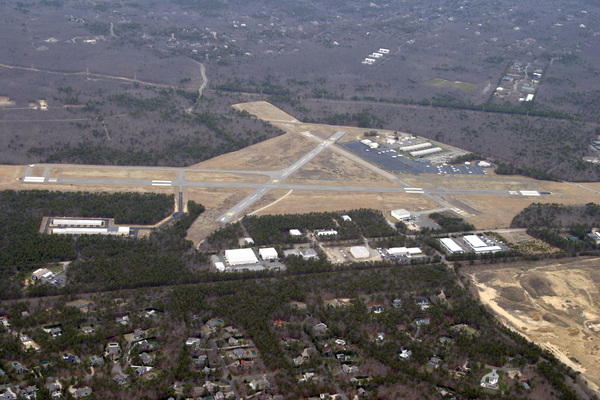
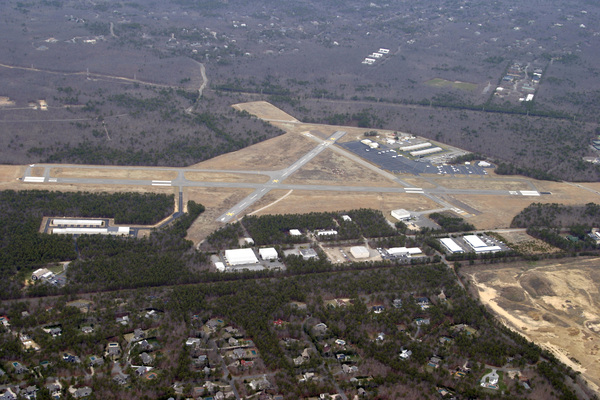
The Federal Aviation Administration accepted East Hampton Town’s Airport Layout Plan last week, a development that comes after years of gridlock that has spurred officials to renew plans for a seasonal control tower and increased regulation of airspace around East Hampton Airport.
The FAA sent a letter of approval to Supervisor Bill Wilkinson last Tuesday, prompting him and Councilman Dominick Stanzione, the Town Board’s liaison to the airport, to say they would seek further approval for the tower and the designation of up to 10 miles of federally-controlled airspace around the airport in Wainscott.
Mr. Wilkinson and Mr. Stanzione said the tower and airspace would result in stricter regulation of incoming and outgoing aircraft and better mitigation of noise, which has long plagued residents with homes near the airport and under flight paths.
“This fulfills a campaign promise—to get our airport into a more safe and secure position within professional aviation and just as important, to be a better neighbor,” Mr. Wilkinson said in a press release last week. “Now we can move on a seasonal control tower.”
The approval of the layout plan also allows the town to seek federal grants for capital improvements to the airport—a prospect that is anathema to a group of residents who claim that allowing FAA grant restrictions to expire would mean greater local control of flights.
This week, Mr. Stanzione said he would seek a federal grant to fund repairs of a fence at the airport, which he said is broken and allows deer to enter the property.
The Airport Layout Plan is a blueprint of existing infrastructure and potential additions to the airport. For much of its history, it has been tied to another document, the Airport Master Plan, which outlines potential improvements to the airport. The current Town Board approved both documents last year. In February, at Mr. Stanzione’s request, the Town Board untethered the layout plan from the master plan, and submitted them separately to the FAA.
The FAA has not yet issued a ruling on the master plan, which is the subject of a pending lawsuit. Six residents who live near the airport sued the town last year, claiming an environmental analysis of the master plan did not adequately address the topic of noise.
The last Airport Layout Plan was approved in 1989, officials said, and efforts to update it since then have been mired in debates about the facility’s future. The layout plan, which expired in 2009, was stalled largely due to controversy surrounding the master plan, Mr. Stanzione said, until he moved to separate the two documents. “Here we are in this complex of circular logic that no one wanted to deal with until I did,” he said.
The FAA has deemed its approval of the layout plan “conditional,” meaning that the town would have to conduct environmental analyses of any proposed work, and demonstrate that any changes would not make the airport more dangerous.
Mr. Wilkinson, a Republican, hailed the approval last week as a “milestone achievement” that is a step toward better noise mitigation and new FAA grants.
“I think the airport is an asset,” Mr. Wilkinson said in an interview. “We had run on the platform that it was an asset, that it was something that needed to be preserved and maintained. There was never a need on our part for expansion. It was fine the way it was. And I think with this step, we can start to bring in more controls over airspace as well as air traffic.”
Councilman Pete Hammerle, a Democrat and former liaison to the airport, also said he was happy the plan was approved and “over with,” but said he was concerned it would spark renewed debate about whether the town should accept federal grants.
An approved layout plan is necessary for the town to use a temporary control tower, but the FAA is not likely to fund the installation or staffing of the tower, according to Jim Peters, an agency spokesman. The town would also have to conduct an environmental review of the project, he said.
In 2009, the Town Board approved a bid by Robinson Aviation Inc. to install and staff a control tower during the summer, at a cost of $164,580 per year, although the plan never went forward.
Airport Manager Jim Brundige said the town is looking to contract with Robinson Aviation again. The tower, he said, will upgrade the airspace around East Hampton Airport to Class D, which will allow flight controllers to guide approaches and takeoffs, from its current rating of Class G, which is largely uncontrolled.
“It’s like the old days, when there was no radar, no control tower, so airplanes use their own radio protocols to separate themselves for approaches and landings,” he said of the airport’s current status. “As the airport has grown and we’ve had more operations over the years, there’s a safety factor.”
The Class D airspace will have a 10-mile diameter and will extend to an altitude of 2,500 feet, Mr. Brundige said.
Kathleen Cunningham, the former chairwoman of the now-defunct Airport Noise Abatement Advisory Committee, said members of her group opposed the layout plan and master plan submitted by the Town Board because, members maintained, the master plan downplayed noise levels and because both documents pave the way for more federal grants.
“We’re not happy about it,” she said. “It’s the first step toward taking more FAA funds. It’s really important to understand that the FAA does not support the airport. Not taking FAA funding does not mean the airport can’t run. It supports itself, from a variety of revenue streams.”
A majority of the committee, which the town disbanded this year, maintained that if the town rejects FAA grants and allows existing grant restrictions to expire, local officials would be able to set flight routes, impose curfews, restrict certain aircraft from landing and close the airport on certain days. Members of the current Town Board have rejected that approach.
Ms. Cunningham said her group did support the use of a seasonal control tower, although she cautioned that it would not automatically solve noise problems.
“That’s just putting a traffic cop on the beat,” she said. “There is no requirement that the air traffic controller route the helicopters and the planes to the route we’d like them to use,” which follows the south shore and crosses over Georgica Pond.
Mr. Stanzione has been lobbying the FAA to route helicopters over the south shore, rather than allowing them to travel along the north shore and cross over populated parts of East Hampton and Southampton towns.


 Will James on Sep 9, 2011