


 4 Photos
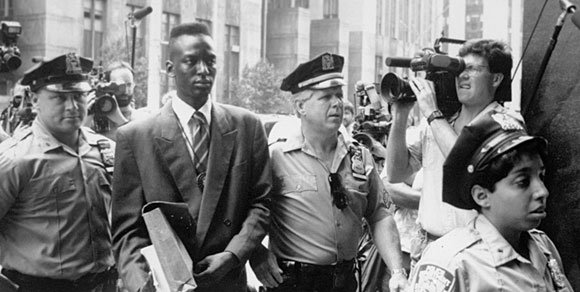
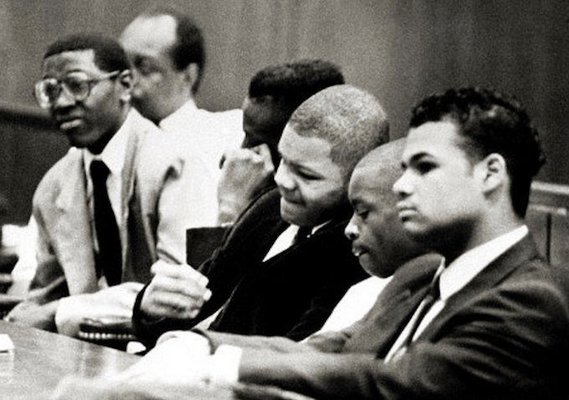
At age 15, Yusef Salaam was an average black kid, with one exception. At almost 6-foot-4-inches, and rocking a flat top, he was hard to miss.
That did not bode well for him when he quickly became one of the most hated men in the country.
He couldn’t go anywhere in Manhattan without points and whispers—the store, the train, the courtrooms. He was innocent, he insisted. He didn’t do it, he pleaded. But no one believed him. Not the newspapers, not the general public, not a jury of his peers, not the judge.
As far as they were concerned, a white woman had been raped and brutally assaulted in Central Park. And he—along with four other boys—had done it.
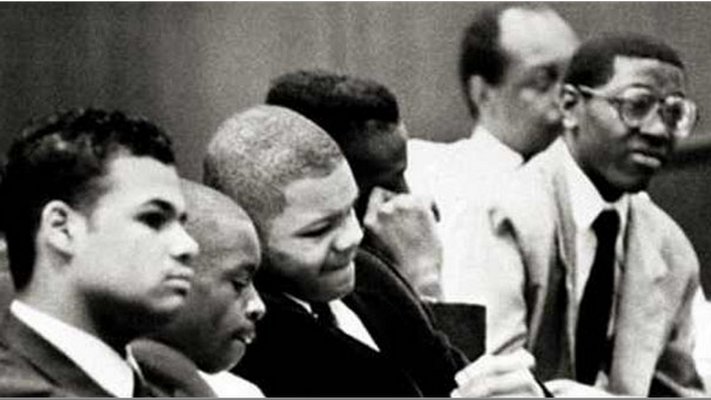
The five were convicted and sent to maximum security prison for seven years. The only problem was, not one of them was actually guilty.
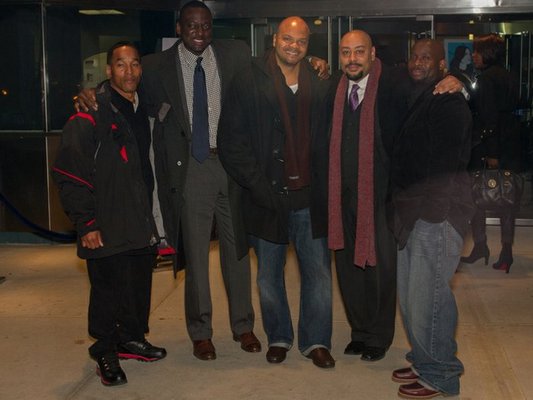
Twenty-four years later, they told their story to documentarians Ken and Sarah Burns, whose father-daughter film “The Central Park Five” will open the eighth annual Black Film Festival on Thursday, November 7, at the Southampton Cultural Center.
Finally, they are being heard.
On the night of April 19, 1989, several attacks, assaults and robberies occurred in Manhattan’s Central Park. One of the victims was 28-year-old Trisha Meili, the daughter of a Westinghouse executive and a Phi Beta Kappa economics major at Wellesley College. She lived on the Upper East Side and worked at the Wall Street investment bank Salomon Brothers.
At 1:30 a.m. on April 20, she was found raped and beaten almost to death, suffering from severe hypothermia and blood loss from multiple lacerations and internal bleeding. Her skull had been fractured so badly that her left eye was removed from the socket.
She would die, the medical prognosis said, or at the very best, remain in a permanent coma due to her injuries. A gang of teens was responsible, the police said. Their names—Raymond Santana, Antron McCray, Kevin Richardson, Kharey Wise and Yusef Salaam—were released before any indictment or DNA evidence. Mr. Santana was Latino. The other four were African American.
Their faces were printed on the front pages of every major newspaper.
“I heard the police officers were looking for me, specifically, because people had said, ‘There was a tall guy with a flat top,’ and I happen to be a tall guy with a flat top,’” Mr. Salaam recalled last week during a telephone interview. “So I went down to the precinct thinking, ‘I’m going to tell them I didn’t do anything, that I don’t know half the guys,’ and they were going to believe me and that was going to be that.”
He hesitated and continued, “I didn’t come home until seven years later.”
From 1990 on, Mr. Salaam was shuffled between three New York-based facilities before he turned 21.
The first was Spofford Juvenile Center in the Bronx, where he first met Mr. McCray and Mr. Santana. His sentence there was interrupted by a short stay at Rikers Island, Manhattan’s main jail complex. Next, he was shipped to Harlem Valley, a maximum A security juvenile prison, where he was imprisoned for about five years, until he turned 21.
“They said, ‘Happy birthday, now please go to the big house,’” Mr. Salaam laughed.
He served the rest of his time, from 1995 to 1997, at Clinton Correctional Facility, another maximum A security prison—this one about 20 miles from the Canadian border and reserved solely for adults.
He will never forget the sound of the massive doors closing at Clinton, he said.
“Prison, I think, was the scariest thing that I had ever experienced in my life,” he said. “The worst thing that could happen in the youth facility was that you get beat up. You go to the adult facility, the worst thing that could happen is you lose your life. People were dying. So that, coupled with the fact that I knew I was innocent, I knew if this whole place decided to get me, I would be dead.”
On March 21, 1997, the 23-year-old thought this chapter in his life was finally over when he walked out the prison doors. He paused and stood there for a few minutes, he reminisced, taking it all in.
“I was trying to realize whether this was real or not,” he said. “That was surreal, to be released. If you go to prison and you’re not an adult, a lot of stuff is taken away from you that you will never be able to experience. It’s almost like you look normal, and then people realize there’s something missing. We were eaten up by the system, spat out and asked to survive.”
It wasn’t over, Mr. Salaam said—not then when he was released, not in 2002 when the real culprit confessed and the Central Park Five were exonerated, and certainly not now.
Several years ago, Sarah Burns, a Yale college student and daughter of one of America’s most well known documentary filmmakers, approached the Central Park Five. She was working on her senior essay about 20th-century African American history and wanted to hear their story firsthand.
It was the first time anyone had asked them, Mr. Salaam said, and they were skeptical.
“No one had really invested in us,” he said. “Until her.”
In 2011, she published their story. And a year later, her father adapted it as a film.
“Sarah is the best thing that ever happened,” Mr. Salaam said. “In the early days, we didn’t know who she was in the realm of who her dad is. And then, to find out that her dad is a number-one documentarian in America, we were just blown away by that. Who better to make a film about this particular case?”
When the 119-minute documentary was released in theaters and, eventually, aired on PBS, the five innocent men didn’t know how it would be received. Mr. Salaam was nervous he’d be recognized in his everyday life—reliving his days as a scared 15-year-old convict navigating the streets of Manhattan.
“Those days were very, very scary,” he said. “But after the fact, I said, ‘I have to own this.’”
He has. Now unafraid, he walks into screenings with his head held high, ready to face his audiences and, more often than not, standing ovations.
“We have gone from being the most hated people ever to being the most loved people,” he said. “We’ll come into a room and people will come up to us, hugging us, crying on our shoulders. Someone once said, ‘We can’t take back what happened to you, but this is our way of saying sorry.’”
In 2003, Mr. Richardson, Mr. Santana and Mr. McCray sued the city for malicious prosecution, racial discrimination and emotional distress. The suit is yet to be settled, Mr. Salaam said. To date, none of the Central Park Five has received restitution from the State of New York.
Mr. Salaam added that he has not seen Ms. Meili since the first trail. Remarkably, she largely recovered, though disabilities related to balance and loss of vision remain. As a result of the severe trauma, she has no memory of the attack nor an hour prior, and has since become an inspirational speaker.
“I always say, ‘Positive history is still being written,’” Mr. Salaam said. “And this is where we’re at right now. We’re definitely waiting for this case to be finished. The Central Park Five doesn’t just represent the Central Park Five. It actually represents the greater reality of what’s happening in our community—and how it happens. People always ask us, ‘Can something like this happen again?’ The reality is that it’s happening right now.”
“Central Park Five” will kick off the eighth annual Black Film Festival on Thursday, November 7, starting at 6 p.m. at the Southampton Cultural Center. A panel with Yusef Salaam, Dr. Anael Alston, Rev. Kirk Lyons, Kyle Braunskill and Audrey Gaines will follow. Admission is free. For more information, call 873-7362 or email info@aamee.org.


 Michelle Trauring on Nov 4, 2013