


 1 Photo
Despite having been the Shinnecock Indian Nation’s most public face and the longtime field marshal of its casino development campaign, Lance Gumbs, who lost his bid to be reelected as a Tribal Trustee in March, has been forced into an increasingly marginal role with the tribe.
With Mr. Gumbs on the sidelines, Tribal Trustee Fred Bess has become the most visible representative of the Shinnecock casino effort—making him a target of barbs from some within the tribe who say casino developer and financial backer Michael Malik is using Mr. Bess to exert his own influence in tribal decision-making.
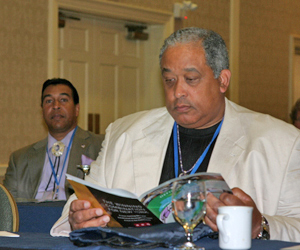
Mr. Bess, like Mr. Gumbs, has been intimately involved in the tribe’s casino plans since their inception. He was the only one of the three Tribal Trustees to attend a two-day gaming conference in Saratoga Springs in late June. Mr. Malik and the five members of the tribal Gaming Authority were at the conference as well.
Mr. Gumbs was there too, though clearly not as part of the official tribal contingent, which traveled together by private plane. Mr. Gumbs drove to the conference separately and said he paid his own registration fee.
He remained at the conference for several hours after the rest of the Shinnecock delegation had departed—rather abruptly, during a lunchtime keynote speech in which state Racing and Wagering Board Director John Sabini said it was unlikely the tribe would be opening a casino anytime soon—to hear a panel discussion that included G. Michael Brown, the attorney who shepherded the Mohegan and Mashantucket Pequot casino campaigns through the approval process.
As the strong-willed Mr. Gumbs has been pushed to the background and Mr. Bess has moved to the foreground, some of the focus of the tribe’s casino efforts has shifted as well.
Mr. Gumbs has long been a proponent of the tribe sticking to original plans for a casino in Suffolk County, preferably eastern Suffolk County. He was appointed last year to a Suffolk County Legislature subcommittee formed specifically to explore the possibility, and the economic benefits, of a casino located somewhere in the county.
But tribal leaders have more recently indicated a preference for a location closer to the New York City metropolitan area, possibly at the Belmont Racetrack near the Queens-Nassau border, or even across the Hudson River in the Catskills region. At the conference in Saratoga Springs, Mr. Bess said that “anywhere in New York State” would satisfy the tribe’s casino needs.
Mr. Gumbs said he was shocked to hear that kind of admission from his counterpart. “Location has always been a concern to me, from the time we started working on this project,” he said. “I don’t want to get into a battle with Fred and them, but we need it to be close to home.”
Although both speak of the casino as an eventuality, Mr. Gumbs and Mr. Bess expressed drastically different views on what the ultimate benefit to the Shinnecock community would be from a casino.
Mr. Bess said recently that employment was not an important consideration as long as the profits from the casino were going to bolster the tribe financially. But Mr. Gumbs said he has always seen a gaming and entertainment facility as a potential place of long-term employment for tribal members—making it a necessity that the facility be relatively close to the Shinnecock Reservation just outside Southampton Village. He said unfettered financial handouts are a quagmire that have torn apart other tribes around the country.
“We started this for jobs for our people,” Mr. Gumbs said. “It was supposed to be a place where Shinnecock people could work and have good-paying jobs. There are some real bad examples out there of what just giving handouts to tribe members will do.”
He also nodded to recent drops in revenues at other major casinos amid the national economic downturn and said revenues alone cannot be relied on to support the tribe, or the larger Suffolk County community. The draw of major entertainment beyond the gaming offerings would be an important economic boost for the tribe well into the future, but only if the benefits came from paychecks, not paydays, he said.
Mr. Bess downplayed any disagreements between himself and Mr. Gumbs and said his longtime partner was still an important player in the tribe’s casino effort.
“We’re all family,” Mr. Bess said during the June convention, while waiting for a shuttle that would take him and the five Gaming Authority members to Mr. Malik’s private plane. “Right now, he’s not a legal representative of the tribe. But he and I started this thing together years ago, and we’ll finish it together. We’re fine.”
Mr. Gumbs missed reelection once before since the tribe’s casino plans became public in 2001, but was not as obviously relegated to the fringe of the casino effort that time around. Tribal Trustees are elected every year, with the top three vote-getters winning Tribal Trustee seats.
Mr. Gumbs said he plans to run for election again next year.


