


 1 Photo
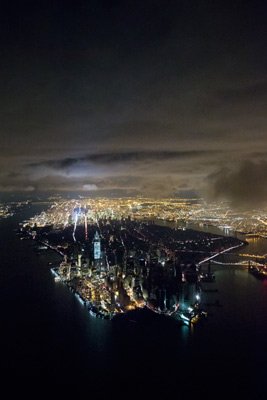
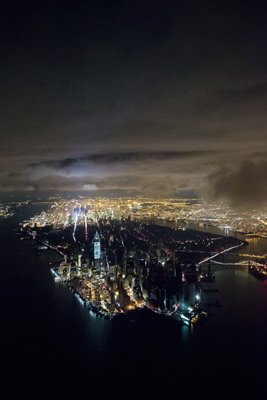
"The City and the Storm," 2012, a chromegenic print by photographer Iwan Baan. COURTESY THE ARTIST AND MOSKOWITZ BAYSE, LOS ANGELES
The architect Louis Sullivan observed, “Once you learn to look upon architecture not merely as an art more or less well, or more or less badly done, but as a social manifestation, the critical eye becomes clairvoyant and obscure unnoted phenomena become illumined.”
With its new exhibition, “Image Building: How Photography Transforms Architecture,” the Parrish Art Museum is addressing the issue of how representative, staged or digitally manipulated photographs can lend themselves to an independent view of reality or even unreality. The exhibition specifically informs our perception of how “unnoted phenomena” are revealed both in the thoughtfully curated images presented and in the accompanying catalog.
Representation, in myriad forms, is about abstraction, and this show explores the connection between architecture, the observer and photography. Distinct periods in the history of building imagery are revealed in the works of 21 documentary and architectural photographers with 57 images spanning the period between 1930 and current day.
Guest curator Therese Lichtenstein culled together the works of three generations of photographers for the exhibition. The early era of modern architecture is represented by Bernice Abbot, Samuel H. Gottscho, Balthazar Korab, Julius Shulman and Ezra Stoller followed in the later generation by Robert Adams, Stephen Shore, Lewis Baltz and Luigi Ghirri. Present-day photographers include Hélène Binnet, James Casebere, Thomas Demand, Iwan Baan, Thomas Struth and Hiroshi Sugimoto.
The exhibition opening, held this past Saturday, also featured a talk with the museum’s director, Terrie Sultan, Ms. Lichtenstein and Marvin Heiferman, a curator and writer who has focused extensively on the influence of photography on the arts, culture, and history.
Ms. Sultan spoke about how Iwan Baan came to photograph the Parrish Art Museum in Water Mill for its opening shortly after Hurricane Sandy. The photographs he took left Ms. Sultan with a realization of how the building sits on the land and the ways in which the interior and exterior echo the surrounding landscape while also shaping the interaction with patrons—making the museum “a unique, transformational space for art.”
Mr. Heiferman spoke about transformation and how photographs function in a culture of artists and commercial photographers. For example, the photos like those taken by Julius Shulman in the 1940s, ’50s and ’60s and used to promote Case Study houses in California now depict those same buildings as artifacts of a bygone era. The photographer can look at an object with a particular point of view and the architectural photos themselves can be seen as landscapes, portraits and moments frozen in time or even a still life.
According to Mr. Heiferman, photographs used by architects, builders, developers, historians, and the architectural media also capture both an aura and iconicity, which work together to form ingrained memory. There’s always that famous picture for which a building will be known. Those shots very often have nothing to do with the way the man on the street perceives the building. Ezra Stoller’s iconic 1958 photograph of Mies Van der Rohe’s Seagram Building is seen diagonally across Park Avenue many stories up above the street in order to reveal the full height of the structure and the capacious plaza below.
Ms. Lichtenstein’s concept for the show is thematically driven and organized into categories of Cityscape, Domestic Spaces and Public Places. The show weaves back and forth in time with contemporary photos of buildings juxtaposed against their iconic forebears.
In 1997, Hiroshi Sugimoto photographed the Seagram Building, dead on, at dusk. The blurred image of the darkened Seagram Building symbolizes its diminishment as other, newer skyscrapers have closed in on what was once a stand-alone structure.
Cityscapes are dramatically illustrated in the work of Bernice Abbot and Samuel Gottscho, who photographed night views of the city from the Empire State and RCA buildings, respectively, in 1934. Iwan Baan’s 2012 photograph, “The City and the Storm,” memorialized the impact of Hurricane Sandy and the blackout of lower Manhattan. The photo, taken from a helicopter with a high-resolution digital camera, was featured on the cover of New York Magazine. According to the catalog, it alludes to the haves and have-nots. On a larger scale, it also portends the potential for a disaster of biblical proportions in the future.
James Casabere didn’t just photograph the landscape of sprawl, he created one. Casabere built a subdivision of McMansion models in 2009 and photographed them in a birds-eye view, perhaps alluding to the mortgage crisis during the Great Recession. His is a landscape of colorful houses without people or cars and also serves as a commentary on the sterility of Post-War suburbia.
One of the most evocative photographs in the show is “TWA Flight Center in JFK International Airport (Queens, New York)” 1964, by Balthazar Korab. Eero Saarinen designed this mid-century modern classic in homage to movement and flight. The outside of the building appears as an avian-like creature setting itself on the ground. Korab’s picture, taken at night, communicated the quiet of an empty space normally visited by thousands of travelers on a daily basis. A lone traveler walks across the lobby and a luggage bag sits on the floor next to the baggage rack. The lighting, the source of which is never seen, is used to delineate the structural elements—the curvilinear lines of the interior and the plasticity of its concrete shell. Korab, who was trained as an architect at the École des Beaux-Arts in Paris, had worked with Saarinen on many commissions. The photograph communicates the breadth of the space, the essential elements of the architecture and most importantly, the architect’s intent.
While there’s no substitute for experiencing architecture in the flesh, “Image Building” is an ambitious undertaking delivering observations that challenge our understanding of how photography informs the way we view landscape and the built environment. This is an exhibition not to be missed.


 on Mar 19, 2018