


 1 Photo
By the time Hurricane Irene reached Long Island, she had largely blown herself out. The outer bands of her clouds that swept across the East End spared the region the bulk of her destructive winds and soaking rains.
Yet more than a half million Long Islanders were left without power in the wake of the storm, many for a week or more. All of the customers affected by the storm had power as of Sunday, although 500 were in the dark on Wednesday for other reasons.
Many critics have blasted the Long Island Power Authority for its handling of the recovery. Criticisms have not focused on the long recovery, which has been widely seen as understandable considering the extent of damage, but, rather, on its failure to keep residents updated about repair crews’ progress. But the extent of damage tells another about the next time: Those looking critically at what was and what could have been are seeing a dark future—literally.
“We barely got a tropical storm this time. If we’d had the rain they got up north with it, that would have compounded the problem. Imagine if it was a real hurricane,” Southampton Town Highway Superintendant Alex Gregor said. “Next time, it could be a lot worse. We need to be more prepared for these storms.”
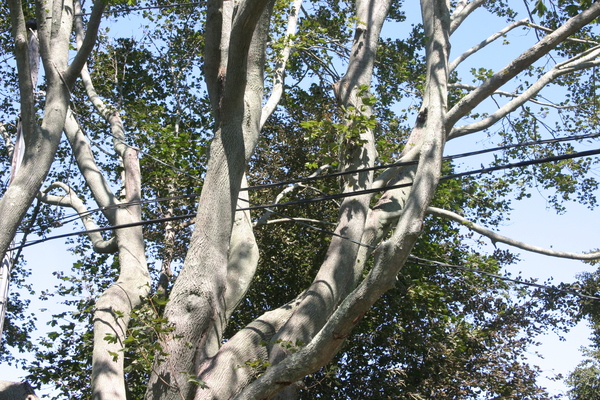
That the broad power outages on the South Fork were almost entirely caused by trees and tree limbs falling on power lines was plainly evident to even the casual observer over the last week. What is almost equally as evident: There remains a large number of very big trees with their limbs looming over or intertwined with LIPA power lines throughout the region. Officials from the power company acknowledged this week that another stronger, or wetter, storm likely could be expected to wreak even more havoc, possibly leaving the region without power for much longer periods.
“Clearly, it could be a matter of multiple weeks,” said LIPA Chief Operating Officer Michael Hervey on Tuesday, acknowledging that the Long Island power grid is inherently vulnerable to falling trees. “This storm just gives us a taste of what it could be. A Category 1 or 2 storm? It could be three, upward of three weeks into four weeks.”
The problem is twofold: the vast majority of LIPA’s electrical transmission lines are hung from utility poles 20 feet above the ground; and in the 20 years since the last time hurricane-force winds buffeted the South Fork, many of the region’s trees have grown over and around those lines.
Utility poles and lines are traditionally designed to withstand 90-mph winds, but since LIPA officials visited Louisiana after Hurricane Katrina hit in 2005, the company has undertaken an effort to “harden” its infrastructure, Mr. Hervey said, and all new transmission lines and equipment have been upgraded to withstand 135-mph winds.
“Our lines are built to withstand 90-mph winds. The problem is, trees are not,” Mr. Hervey said on Tuesday.
When it rains and the wind blows, the ground softens, the leaves of trees grab the wind like sails, stressing limbs and root systems.
“I’ve seen more tree damage in storms that were maybe a little more severe than this one, just as a result of rainfall, which didn’t occur with this storm,” East Hampton Village Administrator Larry Cantwell said this week. He noted that most of the damage to power lines during Irene was from broken limbs, not uprooted trees.
There are ways to avoid the menace from trees, of course. All power lines that are run to new developments are placed underground, away from the threat of falling trees. Since this week’s storms, many have called for all lines to be buried.
According to a recent study conducted by LIPA, burying the entire LIPA system would cost in the neighborhood of $30 billion—as much as $4 million per linear mile. Additionally, maintaining underground power lines is three to four times more expensive than overhead lines, and the underground lines, Mr. Hervey said, have actually been found to be less reliable in the long run and take much longer to repair when there are small, localized outages.
Another consideration for preventing outages is managing trees. Mr. Gregor, the Southampton Town highway superintendent, said that the towns have stopped planting the English and Dutch elms that were popular adornments to local roads in the early part of the 20th century because their large leafy limbs and root systems are poorly suited for withstanding storms.
The elms remain the predominant trees in many of the coastal areas of South Fork hamlets and villages, however, and LIPA protocols call for regular pruning of branches of trees that have grown around power lines and for removing trees that have started to die and will fall easily.
“Limbs, limbs, limbs—it’s all about the limbs,” East Hampton Town Supervisor Bill Wilkinson said this week. “There were a lot of limbs up on wires that LIPA had to get tree surgeons to remove.”
Mr. Hervey said that the company has a standard schedule for maintaining trees near their lines and credits the program with having prevented even more outages during Irene.
But in some areas, even basic maintenance by LIPA or local municipalities in the past have been met with cries of aesthetic degradation by residents.
“There is always the conflict that the utility right-of-ways are not maintained to the extent needed,” Mr. Gregor said. “But people love the trees. I love trees, but they need to be maintained, or they become a problem when you get storms.”
Improvements to power line systems have made repairing them much easier. The slowest part of the job, Mr. Hervey said, is replacing downed utility poles, which can take a four-man crew nearly a full day to replace. LIPA had to replace nearly 1,200 poles after Irene, along with more than 900 transformers and 225 miles’ worth of power lines. Mr. Hervey said National Grid and contracted crews from out of state did a good job getting Long Island customers back on the grid as quickly as they did—in Connecticut nearly 6,000 households were still without electricity on Tuesday, according to the New Haven Register newspaper.
“I thought the guys on the ground did an outstanding job,” State Assemblyman Fred W. Thiele Jr. agreed, though he added that there were a number of issues with LIPA’s response.
Mr. Thiele said he would like to see several changes at the power company, including a review of its management contract with National Grid and making seats on its board of directors elected positions, as was intended when LIPA was formed in 1988.
While burying all of LIPA’s power lines is not feasible, Mr. Thiele acknowledged, a capital program of strategically burying select lines in highly vulnerable places or of critical transmission connections would be wise, he said. A major transmission line between Southampton and Bridgehampton was buried in 2007 after residents along the new line’s proposed route objected to the aesthetics of installing the line on special 48-foot-high poles and agreed to a special surtax to cover the $3 million-per-mile additional cost of burying the lines. Mr. Thiele said that he’s been asking for years to get main power supply lines between East Hampton and Montauk buried.
Such specific fixes could ease issues the next time a severe hurricane strikes the area, but most involved acknowledge that extended power outages are simply going to be a fact of life. Mr. Hervey said he is hopeful that after such a long drought of severe storms, the impacts of Irene will awaken Long Islanders to the sort of inconveniences that will be faced if there is a strong hurricane in the future and spur residents to prepare better.
Mr. Wilkinson, the East Hampton supervisor, said that preparation can ease the burden of power outages only just so much.
“People are dependent on power—for communication, for health, for safety,” he said. “You don’t realize how non-discretionary power is until your power is off. Everything revolves around it.”


