


 1 Photo
A new Suffolk County Health Department study for the first time links groundwater contamination with mulching and composting facilities on Long Island.
The report, released last month, is based on groundwater samples taken at 11 different sites across Suffolk County, including two on the South Fork—in Speonk and Eastport. Elevated concentrations of various metals, including manganese, arsenic, cobalt and titanium, were detected at most of the sites, as well as from private wells near the Speonk property.
Additionally, 19 different pesticides were found “at relatively low concentrations at a majority of the sites,” the report notes, though the study also states that not all of those contaminants originated from the composting operations.
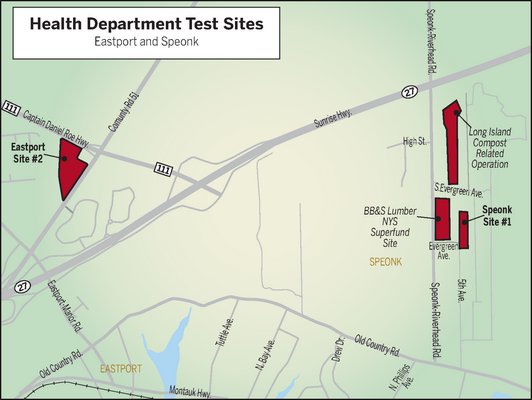
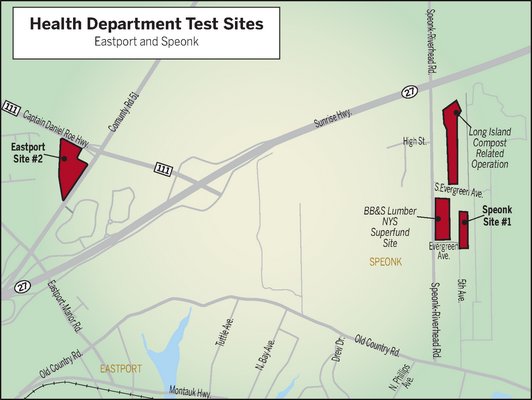
Perhaps most alarming, at least locally, is that a mulching and composting operation nestled between Speonk-Riverhead Road and Fifth Avenue in Speonk was the only one directly linked with the contamination of private wells located down-gradient of the operation. The report notes that water from four of 10 private wells in the area—a roughly 9-acre tract of land dubbed simply as “Site No. 1” in the study—are “exhibiting impacts consistent with those from groundwater impacted at other vegetative organic waste management sites in Suffolk County.”
Additionally, it continues, “Recent sampling in all four of these private wells shows a general increasing trend in metal concentrations when compared with the older samples.”
The study, for which groundwater samples were collected from July 2011 through October 2014, was conducted after a prior county investigation found that the Long Island Compost Corporation, a mulch supplier based in Yaphank, was responsible for groundwater contamination down-gradient of its operation there. In that case, elevated traces of various metals were also found in nearby groundwater, according to the document. That realization prompted the newer study that focused on 11 different sites across the county.
Suffolk officials, however, said they did not target specific operations with their study, though corresponding maps show that, at least with Speonk, they installed monitoring wells south and east of a mulching operation also run by Long Island Compost Corporation. The Eastport location, dubbed by the county simply as “Site No. 2,” sits on the southwest corner of the intersection of County Road 51 and Route 111, and totals about 27 acres.
Monitoring wells at that site, which sits near a farm, found elevated levels of metals—including manganese, magnesium, sodium and nitrate—in the groundwater, and at concentrations that exceeded the county’s drinking water standards. The county study does not identify a specific business that ran the former mulching facility that was in operation for eight years, from 1999 until 2006, according to the report. The land falls in the Brookhaven Town side of Eastport.
Suffolk County officials said their study did not target specific companies and, therefore, they were unable to say what business operated from the Eastport site over that eight-year span. Andrew Rapiejko, associate hydrologist with the Suffolk County Department of Health Services’ Office of Water Resources, explained in an email that the county selected its 11 sites based on information provided by the State Department of Environmental Conservation. The sites were picked, he said, from looking at aerial photographs of former and current mulching and composting operations, to ensure that engineers in his department could install monitoring wells in the area.
At the Eastport site, Health Department officials installed three monitoring wells that stretched 95 feet under ground, according to the study. Officials analyzed 17 samples of water from this site and found high levels of manganese, sodium, magnesium and nitrate in them.
Similarly, at the Speonk site, Health Department officials installed three monitoring wells to test the groundwater. The study notes that the wells were installed in the wrong place, however. The mistake was made because officials thought the groundwater was moving in a south-southwest direction—the direction most groundwater moves in the region, according to Mr. Rapiejko. After installing the three wells, officials realized that the groundwater was actually flowing in a more south-southeast direction, which made those samples unusable.
“A consequence of the slight shift in groundwater flow direction is that the three temporary profile wells do not appear to be located down-gradient of the target site,” Mr. Rapiejko said in an email. “Therefore, the results from the three profile wells are not indicative of the water quality down-gradient of this facility, and cannot be used to assess potential impacts of the site related activity on groundwater quality.”
The Health Department then tested the groundwater in 10 private wells in the area, and four of those are the ones that showed elevated levels of manganese, zinc, iron and copper, according to the report.
The study also examined similar sites near mulching facilities in Manorville, Yaphank, Farmingdale and Ronkonkoma. All of the sites showed traces of metals, though the levels varied, according to the study. At all 11 sites, manganese was the most common metal found in the groundwater samples, the document notes.
The county study did not attempt to explain why certain metals, as well as other contaminants, were found downgradient of the mulching operations. “The exact mechanisms responsible for the cause of the elevated contaminant concentrations were not evaluated as a part of this investigation,” Mr. Rapiejko said in an email.
He did offer a “theory” that when rain breaks down mulch, a reaction could take place that alters the composition of the mulch. That activity, Mr. Rapiejko said, could prompt metals that are already in the soil to more freely enter the groundwater.
Suffolk County Health Department officials are recommending that the DEC tighten its rules and regulations for mulching and composting facilities, starting with keeping closer tabs on what enters and exits those businesses. Mulching facilities are currently exempt from the state’s solid waste management regulations law, explained Aphrodite Montalvo, a DEC spokesperson, meaning that Albany does not regulate what is routinely being transported in and out of mulching and composting facilities.
The Health Department brought this issue to the DEC’s attention before publishing its study, Ms. Montalvo said, while also urging to DEC to update its regulations for such operations. In a letter sent in December by Ajay Shah, regional director of the DEC, to Dr. James Tomarken, commissioner of the Suffolk County Health Department, Mr. Shah said the state agency is now reviewing its rules and considering modifying its regulations for mulching operations.
“DEC is currently revising the State’s Solid Waste Management Facilities Regulations (Part 360) to include criteria for mulch processing facilities, which are currently exempt from these regulations, and is on track to issue the proposed regulations for public comment by February 28,” Mr. Shah wrote.
Bob DeLuca, president and CEO of the Group for the East End, said he and other environmentalists have long suspected that mulching and composting facilities have been slowly contaminating the groundwater around them. He also commended the county for taking the initiative and for urging DEC officials to close the loophole that allows mulching and composting businesses to operate with little oversight.
“I think, in some ways, it’s a positive development, because there is a chemical fingerprint with these [operations],” Mr. DeLuca said this week. “It tells [us] that there is a regional problem.”
While traces of metal were found in most of groundwater samples taken as part of the county study, Mr. Rapiejko explained that homeowners connected to a public water supply should not worry. He noted that their water typically comes from “very deep” wells that are less susceptible to contamination.
“Also, the public water suppliers constantly test their water that must meet drinking water standards,” he said. “The Suffolk County Department of Health Services also independently tests the public water supply. If a public supply well is impacted by contamination, the public water supplier must install treatment before that well can be used.”
At the same time, he urges homeowners still using private wells, including those who live close to composting and mulching facilities, to contact the Suffolk County Health Department at (631) 852-5810 to arrange for their well water to be tested. He added that those homeowners should make it a practice of testing their well water annually.


 Amanda Bernocco on Feb 23, 2016