


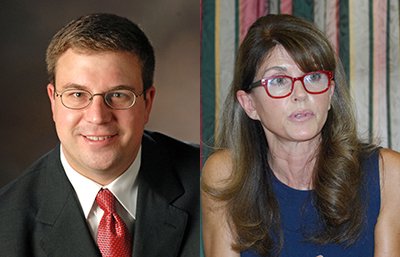
 7 Photos
Dave Calone and Anna Throne-Holst
Democratic Congressional candidate Anna Throne-Holst votes at the Community Bible Church in Noyac on Tuesday morning. DANA SHAW
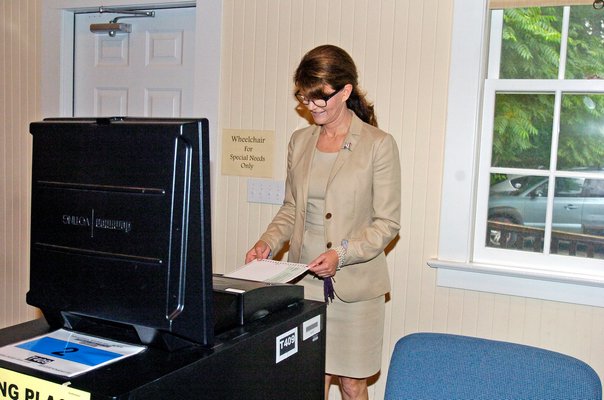
Democratic Congressional candidate Anna Throne-Holst votes at the Community Bible Church in Noyac on Tuesday morning. DANA SHAW
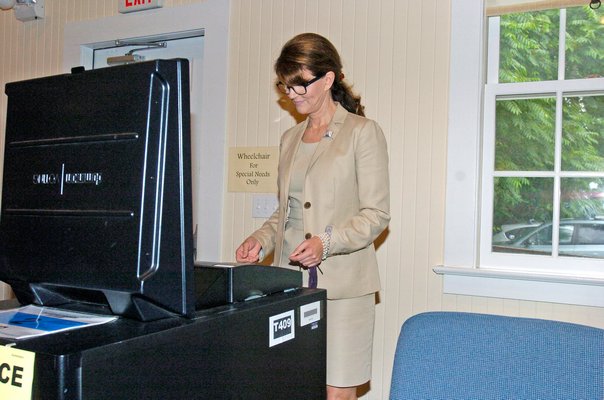
Democratic Congressional candidate Anna Throne-Holst votes at the Community Bible Church in Noyac on Tuesday morning. DANA SHAW
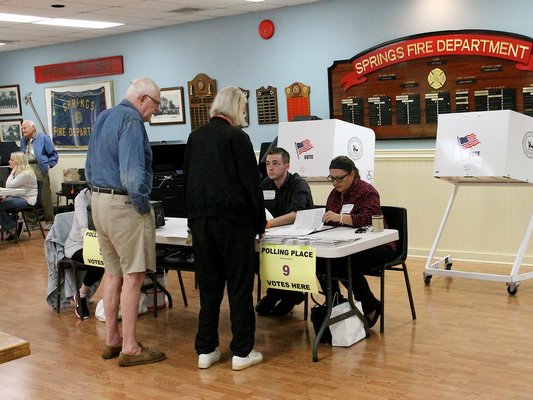
Registered Democrats in Springs cast their ballots in Tuesday’s Congressional primary. KYRIL BROMLEY
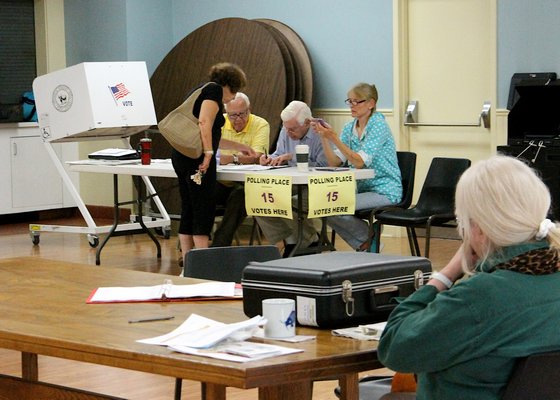
Registered Democrats in Springs cast their ballots in Tuesday’s Congressional primary. KYRIL BROMLEY
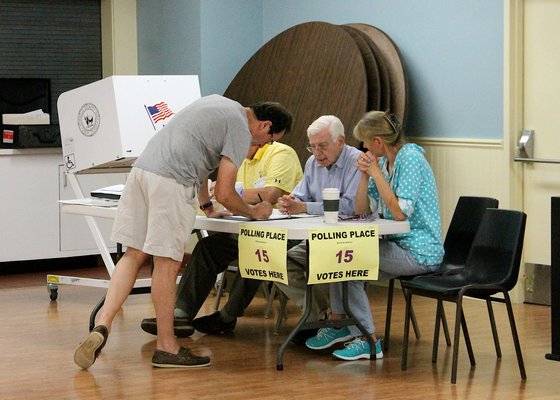
Registered Democrats in Springs cast their ballots in Tuesday’s Congressional primary. KYRIL BROMLEY
The Democratic primary for the 1st District seat in the U.S. House of Representatives remains too close to call after the ballots cast at polls across the East End on Tuesday were counted, leaving the race in limbo until more than 1,600 absentee ballots are counted sometime after the July 4 holiday.
With all of the district’s 473 polling places reporting in at 11 p.m. on Tuesday night, former Southampton Town Supervisor Anna Throne-Holst was leading Brookhaven businessman David Calone by just 29 votes, 5,446-5,417.
The winner will challenge U.S. Representative Lee Zeldin, who is running his first reelection campaign after unseating six-term Democratic Congressman Tim Bishop in 2014.
The Suffolk County Board of Elections has received 1,661 absentee ballots for the race—which make up more than 10 percent of the total votes cast. Until July 5, the Board of Elections will continue to accept ballots that were postmarked by June 27. After that date, it will open all the mailed-in ballots and begin counting—a process that could take two days or more.
With the vote as tight as it is, the possibility of a subsequent recount of the ballots cast on Tuesday also looms.
There are 137,000 registered Democrats in the 1st Congressional District, which encompasses all of the five East End towns, plus Brookhaven Town and portions of Smithtown Town.
Primary elections in the district typically have drawn only about 10 to 12 percent of eligible voters to the polls. Tuesday’s primary vote appears in line to be on par with that average, or perhaps slightly ahead.
The race is the first Democratic primary in the district since an unusual contest in 2000, when Regina Seltzer beat incumbent U.S. Representative Michael P. Forbes by just 35 votes to win the Democratic line. About 13 percent of eligible Democrats cast ballots in that vote.
There have been several Republican Party primaries over the years between would-be challengers in the years Mr. Bishop held the 1st Congressional District seat. None drew more than 10 percent participation in the primary vote.
Some of those involved in the campaigns had wondered aloud in recent weeks whether a June primary, the week after school let out, would mean depressed voter turnout.
The election has also been a costly one. Both candidates had already spent more than $1 million on the race with three weeks left before the vote. A surge of spending on television ads by both sides in the closing weeks could well have pushed the total cost of the primary toward $3 million.
In congressional primaries, the candidate who raises more money, be it by a margin of $1 or $1 million, wins the election 86 percent of the time, according to the U.S. Public Interest Research Group, a nonprofit group that compiles statistics about campaign fundraising. Ms. Throne-Holst had raised more than $1.7 million in her most recent disclosure filings, while Mr. Calone reported about $1.3 million.
The race was widely seen to be a tight one throughout. Ms. Throne-Holst announced her candidacy last summer, just a few months after having pledged to run for a fourth and final term as Southampton Town supervisor, a seat she had won easily in previous tries.
She has said she was recruited to run for the seat by state and national party leaders and quickly received the pledged support of Mr. Bishop, who held the 1st District seat for six terms, and U.S. Senator Kirsten Gillibrand.
Ms. Throne-Holst came out of the gate with a battery of big names and large unions in her corner. But it was Mr. Calone who made news with his endorsements when all of the elected Democrats in Southampton and East Hampton towns—including County Legislator Bridget Fleming, who served for five years on the Town Board alongside Ms. Throne-Holst—came out in support of him.
Whoever the eventual winner is will next take on Mr. Zeldin who is marching into his first reelection campaign with some $2.8 million in his war chest, even before the expected influx of dollars from the national party offices and PACs, which see the 1st District as a seat that is “in play” in nearly every election cycle because of tight party registration splits and high numbers of voters with no political party affiliation.
Mr. Zeldin has also been approaching the coming race, thus far, firmly hand in hand with presumptive Republican presidential nominee Donald Trump. Mr. Zeldin has pointed to Mr. Trump’s soaring 75-percent victory in the presidential primary among Republican voters in the 1st District as an encouraging sign to where his support will be, while both of the Democratic contenders to oppose him have gleefully reminded their supporters of the congressman’s support for the bombastic presidential hopeful as a rallying cry.


 Michael Wright on Jun 28, 2016