


 3 Photos
Sometimes the teacher ends up being the pupil, and sometimes it takes years for the seed of an idea planted in a teaching moment to fully bear fruit.
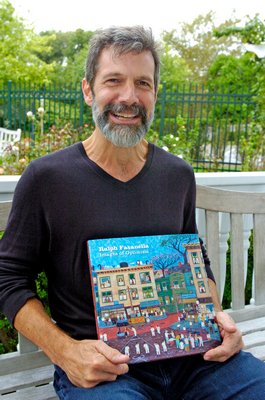
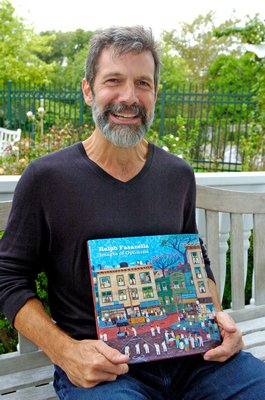
Marc Fasanella, an educator who taught at both Southampton College and Stony Brook University, traces the roots of his new book, “Ralph Fasanella: Images of Optimism,” a study of the work of his father, painter Ralph Fasanella, to a comment made by a student many years ago.
The class was discussing “News from Nowhere,” a classic tome on utopian socialism written by William Morris in 1890. “We were having a conversation about utopia, and this student said, ‘You have to understand that my generation has no image of a utopia. All we have are dystopias—all the video games, novels, everything, are dystopias. There is no vision of a utopia.’”
“That really affected me as an educator,” Mr. Fasanella recalled. “I was teaching in an environmental design policy and planning major, and I developed a lot of curriculum that was about exposing college students to things people are doing around the world that are the kinds of things we should be doing in the 21st century. There are all these models of what communities are doing to adapt to the kind of things we have to adapt to, and that became a big part of my course.”
When Pomegranate Press asked him to write a book on his father’s work, he took some time to ponder the direction it should take, his student’s comment on utopia still in the back of his mind. “My father was best known for his big political canvases, where he chronicled the important changes that happened, the big activities of the 20th century, like the Kennedy assassination, the civil rights movement, the Rosenberg execution. He painted these large, encyclopedic canvases, with invented perspectives where there would be a lot of different angles and views, and walls are opened up. It’s almost like those MTV videos, where they’re in layers, and he somehow managed to get all those layers resolved into one composition.”
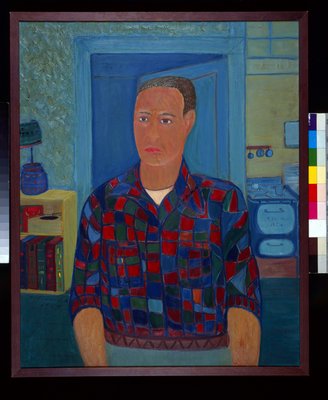
Born in Manhattan’s Little Italy in 1914, Ralph Fasanella was a gas station attendant who used his self-taught talent for painting to champion the rights of workers and to illuminate the complexities of some of our most challenging moments as a society. Marc Fasanella notes that both his parents were social activists. “My mother was actually a part of the American Negro Theater back in the 1940s, and she was very involved in Cesar Chavez’s grape boycott and the farm workers’ movement. Cesar Chavez came to my house when I was growing up, and my parents were friendly with Pete Seeger, so I grew up with this knowledge that if society is to improve, there have to be citizen activists who are working to improve it.”
While his father may be best known for his artistic commentary on the darker aspects of 20th century America, Mr. Fasanella said there is another, equally important subtext to the work that scholars have generally overlooked.
“There’s the idea that those canvases are all dystopias. But in looking at his work, I realized that he also made a kind of prescription for what are the best things we should carry forward from the 19th and 20th centuries.
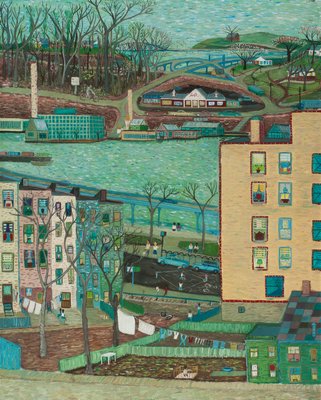
“In his painting ‘Across the River,’ one of my favorites, you really see that. There’s the rural countryside, and you see all these urban contexts, and then there are these old wood-frame houses from the Bronx, where his family moved. They’re utopian images of things. He always saw things in such a positive light. Where most people would see the dirt and the poverty, he was able to capture the positive aspects. You see it in the colors, how vibrant they were.
“He was really a city guy, and that painting shows the best aspects of the city—the communal nature, people looking out for each other’s kids, and kids being able to play stickball in the street, the lack of isolation. That’s what he liked about it.
“There’s another image, when he painted the textile strike in Lawrence, Massachusetts. You can see it’s painted with this tremendous hope. The light and the energy; there’s something about the people that’s positive and uplifting. Those are the things I thought were important to write about, because they hadn’t been written about.
“So I sat down with some of his best paintings that weren’t those dystopian images, and that’s where the title, ‘Images of Optimism,’ came from.”
Mr. Fasanella added that many people feel like they are living in very dystopian times. “We have been in this continuous state of undeclared wars, with short periods of declared war, and people have this underlying notion of a very dark world out there, and they’re living inside this bubble of economic prosperity and certainly consumer prosperity. I thought it was important to understand that there’s another positive image of society that’s not based in consumer prosperity, that’s not based in selfies and shopping.”
He carries his father’s ideals into his own work leading the Ecological Culture Initiative in Hampton Bays. “I was teaching all these concepts of how we can create a better built environment, a better community fabric, and I was teaching how they’re doing it in Staten Island, and how they’re doing it in the Netherlands, and some work that’s being done in China. And people kept saying, ‘Isn’t there a town we can look to as a model of what could be done?’ And I realized if we, in the town of Hampton Bays—with a train station in the middle of town, walking distance to all three schools and the post office, the library, a movie theater, a grocery store, a pharmacy, and a community center—if we can’t serve as that model, as that economic engine, then who can?
“The whole idea is that what you perceive, you can create. In my father’s time, they were trying to create a more just and egalitarian world for human beings. Now, I think we can see in the 21st century that if we want to have a just and egalitarian world for human beings, we also have to open our understanding to other species, because ultimately, if we’re only concerned about our own species and our own consumption habits, we’re going to consume ourselves off the planet.
“Ecology didn’t exist in my parents’ day. Ecology is a relatively new term, and it’s still not something that we’re practicing. Like we don’t look at plants for the way they function together, we look at what they can bring to us. And if we want to have fewer ticks, we need more opossums—and more habitat for opossums. That’s looking at things in an ecosystem way.”
Despite the challenges, the author and teacher said he follows in his father’s optimistic footsteps. “Every day some little thing happens that is positive and that moves us in the right direction. When the next generation and the generation after that looks back and says, ‘Why weren’t they doing anything to solve this problem? It was so obvious that their consumption practices and the way they were creating the built environment was damaging to the ecosystem,’ we are going to be able to say we were doing something. And that in itself is motivation.”
Marc Fasanella will appear at Southampton Books, 16 Hampton Road, Southampton Village, on Saturday, September 30, at 7 p.m. to talk about “Ralph Fasanella: Images of Optimism.”


 on Sep 25, 2017