


 3 Photos
In the ongoing quest to restore polluted water bodies, oysters are rightfully viewed as knights in shining armor.
Their qualities are legendary: A single adult can filter up to 2.5 gallons of saltwater every hour, for an average of 50 gallons a day. And the reefs on which they settle—some experts say the best ones are composed of dead and dried out ancestors of the bivalves—serve as coastal buffers that also attract other marine life and allow it to flourish.
Still, it was only within the past two decades that groups on Long Island have looked to grow their own oysters at shellfish hatcheries and farms, and much more recently that they’ve attempted to install and re-grow once-prevalent oyster reefs, even though both have proven largely successful in other parts of the country, including the Chesapeake Bay watershed and coastal South Carolina.
A combination of factors, from cooler water temperatures and low reproduction rates to impaired waterways and the risk of fast-moving diseases that can wipe out established colonies, can be blamed for the shared reluctance among locals to dive into the oyster reef creation pool.
Adam Starke, a marine scientist with The Nature Conservancy, said his organization experimented with growing oysters at the Mashomack Preserve on Shelter Island about a decade ago but pulled back after reproduction rates were unexpectedly lower than anticipated.
“We had a couple of sites where we had a monitoring project … where we were keeping an eye on a new settlement in a fairly enclosed saltwater pond with a small inlet,” he said. “It was pretty ideal water quality. Salinity was good.”
Yet the reproduction of the shellfish, known as “recruiting,” was too low to justify any additional investment of time and resources toward the creation of an oyster reef, said Mr. Starke. He is now focused on the Great South Bay to the west, where hardier hard clams are the shellfish of choice when it comes to restoring water quality.
Studies like the one undertaken by The Nature Conservancy appear to have scared off others in the field, or at least delayed their attempts to re-create natural reefs locally.
Organizations and municipalities instead invested in smaller shellfish farms that can host a few thousand oysters at a time and, more recently, enclosed systems that in some instances permit tens of thousands juvenile oysters, known as oyster spat, to grow in cages that protect them from predators and provide a steady flow of food and oxygen.
Fast-forward to today, and there is a renewed and growing interest in the creation of oyster reefs in the bays of Long Island and nearby New York City, in spite of the inherent risks that still come with their creation and their largely unproven track records locally.
They have found success to the south. The Oyster Recovery Partnership, a nonprofit focusing on shellfish restoration initiatives between Maryland and the Carolinas, notes that roughly 400 reefs have been installed along 200 miles of coastline in South Carolina since 2001. But similar results have not yet been repeated in New York.
Those southern success stories have emboldened some local marine scientists, however, as well as those interested in helping restore impaired waterways.
“Oyster restoration is a bit of a gamble compared to, say hard clams, for several reasons,” said Dr. Chris Gobler, a marine science professor and chair of Stony Brook University’s School of Marine and Atmospheric Sciences. “First, there is a large natural reproducing population of clams making them a surer bet for rebuilding the population. Not so for oysters. Second, oysters are more prone to disease than clams.
“So, while reefs have many benefits (habitat, improved water quality, filtration), there is some risk,” he continued.
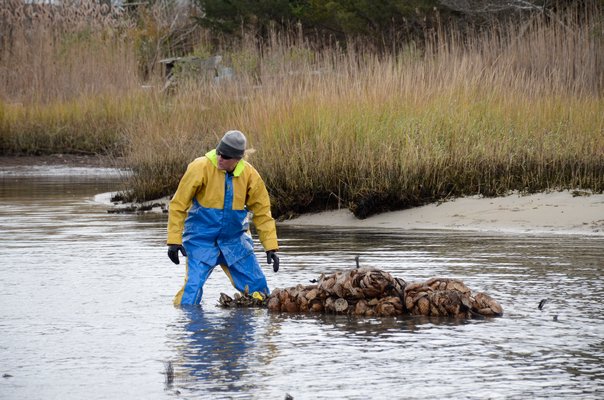
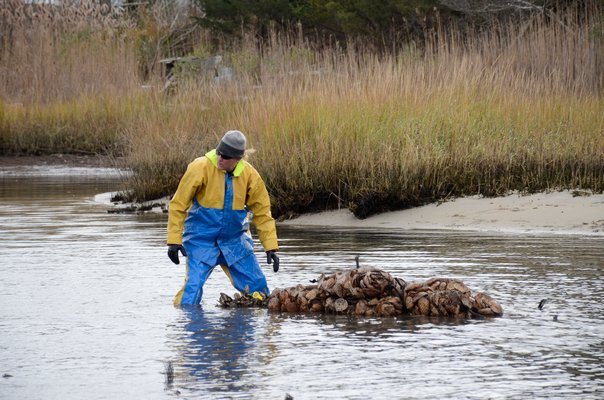
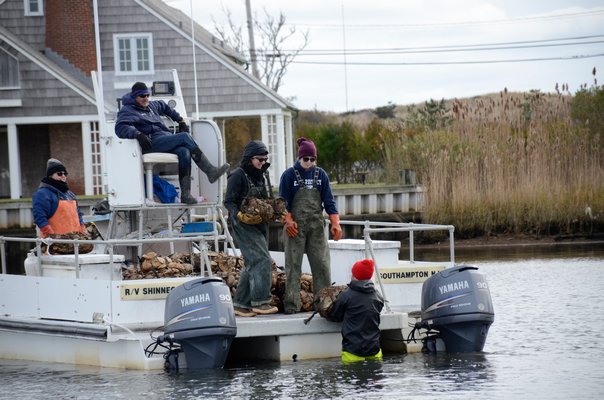
Officials with Stony Brook University’s School of Marine and Atmospheric Sciences installed the first of four oyster reefs in western Shinnecock Bay in the fall. The school secured State Department of Environmental Conservation permission for the pilot program only after agreeing to closely monitor reproduction rates and the overall health of the reefs.
Farther to the west, the New York Harbor Foundation already has installed five oyster reefs—with plans for another six now in the works—since the 2014 launching of the Billion Oyster Project, an initiative that seeks to introduce 1 billion oysters, with the goal of creating 100 acres of new reefs in New York Harbor by 2025.
And, just last month, the Moriches Bay Project, a not-for-profit based in West Hampton Dunes dedicated to restoring Moriches Bay through the introduction of nitrate-filtering shellfish, revealed plans to create an oyster reef in Harts Cove in East Moriches, possibly as soon as this summer, if the required permits can be secured in time.
Most of those now investing in the reefs have established oyster farms and, in some instances, floating upweller systems—called FLUPSYs—that provide a protective environment in which juvenile oysters can grow. For those individuals, the move to oyster reefs is the next logical step when it comes to the restoration of locally impaired bays and harbors.
“They have been on our radar for some time,” said Laura Fabrizio, co-founder of the Moriches Bay Project, which also operates four oyster farms—three of which are on Dune Road in Southampton Town—and four FLUPSYs, including one each in Quogue and Remsenburg.
She explained that her group is working with Brookhaven Town and Cornell Cooperative Extension, the latter of which would be responsible for monitoring the health of the reef that would measure roughly 25 feet wide and 50 feet long, and feature 20,000 live oysters to start. The DEC made the monitoring a requirement prior to approving permits for the four reefs that will eventually be installed in western Shinnecock Bay by Dr. Gobler’s team at Stony Brook this coming summer or fall.
Ms. Fabrizio noted that navigating the state’s permitting process is also tricky, explaining during a recent interview that her organization had not yet secured the documentation for the estimated $20,000 project. She added that her group started to seriously investigate the option after Brookhaven Town Supervisor Ed Romaine inquired if she’d be interested in taking on such an initiative.
If the Harts Cove reef proves itself as a fruitful reproduction ground for oysters, Mr. Romaine said the plan is to keep expanding it—so long as Cornell scientists, who will be monitoring the reef for the next two years, find evidence that life is thriving there. The supervisor added that the plan is to find additional areas of Moriches Bay that could accommodate future oyster bars, explaining that the ideal sites feature sandy bottoms and minimal wave action.
Dr. Gobler, who noted that he has been discussing oyster reefs with Brookhaven Town officials as well, said they are an important part of multi-pronged solution to combat elevated nitrogen levels that can be attributed to recent brown and red tides.
“All are and will be important means for building oyster populations and filtration,” said Dr. Gobler, who lives in East Quogue and near Shinnecock Bay, which has seen its water quality decline in recent years. “Reefs and farms consist of adult oysters with significant filtration capacity, whereas the FLUPSYs are designed to grow out seed oysters to a larger size and, thus, [are] a smaller part of the filtration equation.”
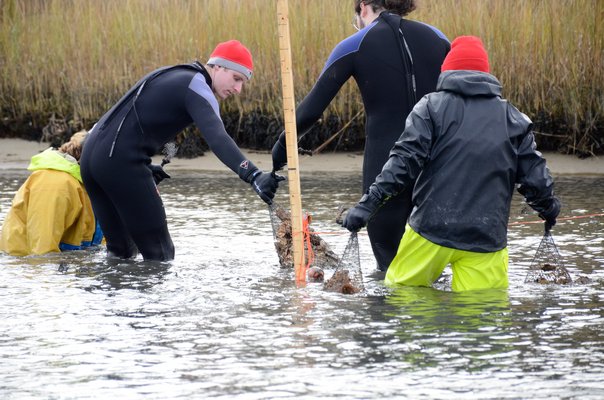
The reef installed late last year in the water off Quogue Village measures roughly 10 meters by 5 meters and was constructed from hundreds of bags filled with dried-out shells covered with juvenile oysters. The reef, which initially boasted roughly 600,000 oysters, was the first of its kind permitted by the DEC on Long Island, according to Dr. Gobler.
Though it is still early to know if the reef is thriving—Dr. Gobler notes that it has not changed in size since late November, though its oysters are growing and survival rates are promising—Stony Brook University is already making plans to install a second similar size reef just to the west. That will be followed by the installation of two additional oyster reefs in the western extremities of Shinnecock Bay, as long as things go according to plan. The three additional reefs will be around the same size as the original to start.
“Over the next few years, we will examine the growth and survival of the oysters, as well as use of the reefs by other animals, as well as changes in water quality associated with the reefs,” Dr. Gobler said.
He and others note that New York’s waters were once home to vast oyster reefs—reports note that New York Harbor was difficult to navigate by ship in the 1600s due to the presence of some 220,000 acres of them—so there is no reason to think that they cannot rebound if given enough time and opportunity to do so.
“When the first colonist came to New York, they found New York Harbor lined with oyster reefs, as reefs are the natural habitat built by oysters to exist and proliferate,” Dr. Gobler said. “Over time, the oyster fishery was over-exploited and reefs disappeared. Hence, we are bringing back a very old habitat and idea.”
Julie Rose, a research ecologist with the National Oceanic and Atmospheric Administration’s Northeast Fisheries Science Center Milford Laboratory in Connecticut, agreed with that assessment in a prepared statement.
“Oyster reefs used to be very common in bays and coves all over the East Coast, but are much rarer now because of problems such as overharvesting and disease,” she said. “Oyster reef restoration programs and aquaculture are both important tools to help increase oyster abundance and restore the important filtration function that large natural reefs of oysters used to provide.”
At the same time, Dr. Gobler acknowledges that less is known about the old oyster reefs that he and others presume once inhabited Shinnecock and Moriches bays, noting that locals did not do a good job documenting them. However, he added that one of his colleagues found evidence of old reefs in Peconic Bay to the north.
As to their value, Dr. Gobler notes that oyster reefs are a complete package.
“They represent a complete bottom habitat,” he said. “Animals live in and around the reef and the shell on the reef is capable of improving water chemistry, making seawater less acidified. These attributes are significantly more pronounced in the reefs.”
But not everyone is completely convinced that oysters, which are prone to an assortment of diseases and tend to thrive in areas where the ocean temperature tends to be warmer year-round, are going to be the answer to New York’s water woes.
Mr. Starke noted that New York’s once-famed oyster reefs took hundreds and perhaps thousands of years to develop, pointing to their slower reproduction rates. In addition to enjoying warmer water—he noted that Long Island’s oysters typically grow at the greatest rates in June and July before slowing down in August—oysters are quite finicky about their environment, preferring to adhere to permanent structures, including those made from old shells.
While he supports all ongoing efforts to restore shellfish populations and improve water quality, Mr. Starke said most would benefit if they kept their oyster reef expectations in check.
“It’s one of many tools in the toolbox toward achieving better water quality,” he said. “But I always feel like it’s not the oysters’ obligation to fix our mess.”


 Frank S. Costanza on Jun 4, 2018