


 1 Photo
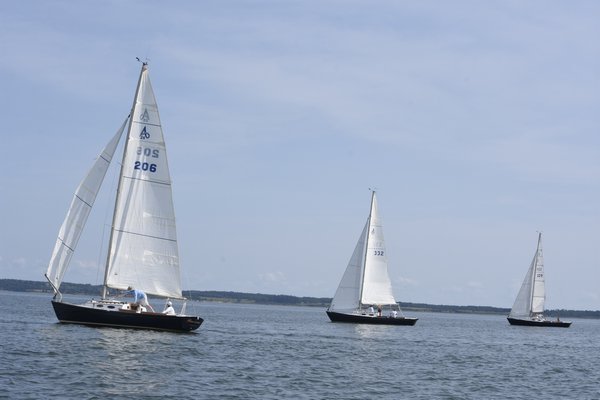
Boats from the Devon Yacht Club sailing in Napeague Bay during the club's annual race around Gardiners Island. The club has said that oyster-growing cages suspended from floats in the bay pose a hazard to sailing and other watersports. Drew Budd
Boaters and residents of Amagansett last week pleaded with officials from Suffolk County to put new limits on the types of equipment shellfish growers can use in areas of local bays that they lease from the county for growing oysters.
Just one day after the Devon Yacht Club confirmed it had settled a lawsuit against the county over the leasing of a new plot of bay bottom just outside the club’s boat basin, boaters who use the stretch of Napeague Bay that is home to the only designated aquaculture lease areas in East Hampton waters said that floating oyster cages pose a hazard to a variety of increasingly popular recreational water activities.
“We have no problem with oysters cultivated in cages that sit on the bottom, but the floating gear makes the surface of our bays unusable for others,” Curtis Schade, the commodore of the Devon Yacht Club, said at a January 9 meeting with Suffolk County officials at East Hampton Town Hall. “It is a taking of a public resource for the benefit of a private individual.”
Suffolk County has created hundreds of potential 10-acre lease areas in the Peconic Estuary. Just 22 of the lease areas are in East Hampton waters, all clustered along the southwestern shoreline of Gardiners Bay in the area known as Napeague Bay.
But that area is also a Mecca for sailors, kayakers, paddleboarders and other water sports enthusiasts, because of the yacht club and because of its calm waters, which are sheltered from summertime’s prevailing westerly winds.
The yacht club sued the county last winter, saying that it had failed to consider the impact of the program on recreational uses in the area.
The suit was spurred by the county’s approval of a new lease just over 1,000 feet offshore of the club’s boat basin. Last week, the club’s attorney said, the suit was settled by an agreement in which the county would abandon the lease area closest to the club and allow the lessor, Amagansett Oyster Company, to lease a different area farther to the east.
The county is in the midst of its 10-year review of the oyster leasing program, which will inform decisions about how to tailor the program going forward, including considerations of whether to expand the number of acres it offers for leases, restrict the types of equipment that may be used by growers or lift limits on the number of plots a given grower may have.
The program was created in 2009 to give those who wish to earn a living on the water new options in the face of greatly reduced wild shellfish stocks in the era of harmful algae blooms. Since the program began, the county has leased a little over 600 acres of bottomlands for oyster growing, mostly in Great Peconic Bay. Just seven of the 22 sites in Napeague Bay have been leased, and only two are currently being actively used—but there are 12 applications pending.
In recent years, more growers have turned to the use of cages that are suspended from floats, rather than resting on the bottom. The floating “gear” has drawn complaints from boaters and from residents who say they are an unsightly addition to vistas across open water.
Some of those who use the county program to grow oysters said that advances in the equipment are a necessary evolution.
“We’re moving to new technologies,” said Chuck Westfall, the president of the Long Island Oyster Growers Association. “If we’re worth having, those realities have to be accepted.”
Robert Valenti, who owns Multi-Aquaculture Systems fish farm in Napeague and one of the two active oyster leases in Napeague Bay, said that his cages are sunk to the bottom in winter and suspended from floats in summer because the phytoplankton that oysters feed on is more abundant near the surface of the water in summer. Mr. Valenti said that the cages that are sitting on the bottom run the risk of being overturned in stormy weather, which can cause the oysters to become buried in sand and suffocate.
Most of those who spoke at Wednesday’s discussion said they want the oyster program to continue, and expand, but warned that if the floating gear is not eliminated or restricted only to areas where other uses are not as common, the county runs the risk of losing support, or worse.
“Suffolk County cannot abdicate its liability,” East Hampton marina owner Peter Mendelman said. “You are responsible, and you better make sure these tenants have insurance. In today’s litigious society, when there’s an accident … people are going to be suing everybody. Please put the gear on the bottom.”


 Michael Wright on Jan 15, 2019