


 11 Photos
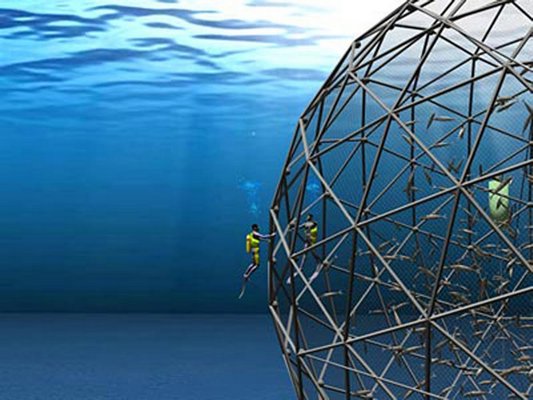
An artistis rendering of one of the Aquapod geodesic fish cages that an East Quogue group is hoping to deploy in the ocean off the South Fork to raise striped bass in. COURTESY MANNA FISH FARM
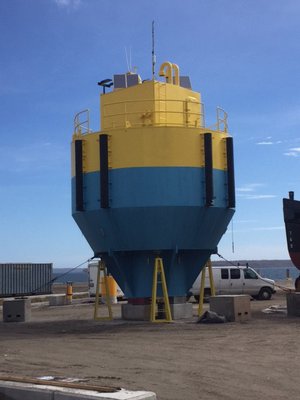
The Manna Fish Farm buoy after being overhauled. COURTESY DONNA LANZETTA

The Manna Fish Farm buoy before being overhauled. COURTESY DONNA LANZETTA
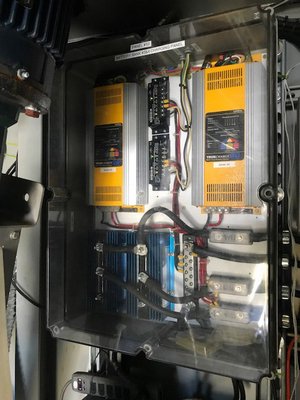
The interior of the fish feeder. COURTESY DONNA LANZETTA
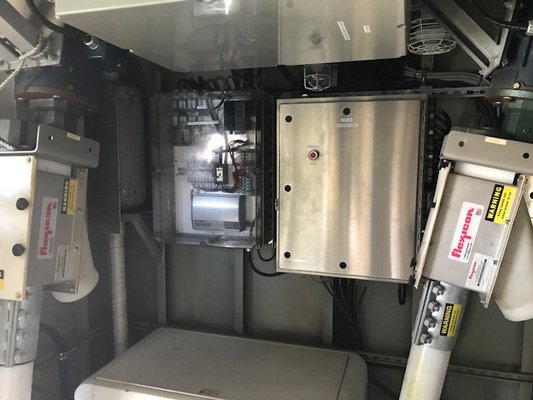
The interior of the fish feeder. COURTESY DONNA LANZETTA
The Manna Fish Farms buoy in Hampton Bays. DANA SHAW

The Manna Fish Farms buoy in Hampton Bays. DANA SHAW

Donna Lanzetta
CEO of Manna Fish Farms
at the buoy in Hampton Bays. DANA SHAW

Donna Lanzetta
The bright yellow buoy bobs gently in the waves off Jackson’s Marina in Hampton Bays, emblazoned with a white fish above the legend “Manna Fish Farms,” and drawing eyes amid the fleet of white yachts and brown fishing vessels.
The recent arrival, towed by boat from New Castle, New Hampshire, late last month and tipping the scales at 60 tons, will one day serve as the nerve center of Manna Fish Farms, the ambitious vision of Donna Lanzetta, a real estate agent from East Quogue who has been working for years to establish the first open-sea fish farm on the East End.
If successful, Ms. Lanzetta said the enormous feeder buoy—which can hold up to 20 tons of food—would be moored about eight miles offshore and outfitted with a dozen 200-foot-wide cages called “Aquapods.” The pods would be submerged some 60 feet below the surface and house an assortment of different fish species that Ms. Lanzetta’s company would farm in the open water.
Her firm’s ambitious project, if successful, will help assuage the environmental damage inflicted by destructive commercial fishing practices, as well as to ensure a dependable and natural food supply for the future.
With public hearings on the project set to start in the fall, Ms. Lanzetta said this week that she remains hopeful that her company will be able to complete the requisite environmental testing of the seabed and ocean by December at the latest, and obtain all the necessary permits to start setting up the system by the end of the year.
If all of that goes according to plan, officials intend to deploy the feeder buoy in March and install the grid—the apparatus that would hold the first four Aquapods that would make up the fish farm—in April. Then they would be ready to put the baby fish into the cages by next May.
“We’ve requested striped bass for our start,” Ms. Lanzetta said this week, while standing beside the feeder buoy. “We’re also looking at steelhead trout … another indigenous species that is tasty and wonderful. We also have tuna on our list, and we’re looking at integrating kelp and sea scallops.”
She explained that using indigenous species should offset concerns that some farmed fish might escape from their confines and mate with other fish, tainting wild livestocks. Though no final decisions have been made, Ms. Lanzetta said she is considering purchasing these baby fish from local universities and hatcheries in Amagansett and Cold Spring Harbor.
Ms. Lanzetta said she recently acquired the prototypical buoy from the University of New Hampshire for $500,000, the cost of which was covered by her startup company and funded by its founders. The university boasts a robust School of Marine Science and Ocean Engineering whose students and faculty spent eight years, from 2000 until 2008, developing the model.
Dr. Michael Chambers, a scientist working with the School of Marine Science who is connected to this project, was not immediately available for comment.
The feeder buoy will hold 20 tons of pellets that, thrust with the power of hydraulics through hoses, will be shot down into the Aquapods below. The device will be remotely activated, allowing operators to control the food release without journeying out into the ocean.
The buoy is just the first piece of infrastructure that Ms. Lanzetta has secured for her proposed system. She has recently ordered her first Aquapod, which cost approximately $250,000 each, and intends to use a $50,000 grant from the Empire State Development Corporation to help offset that expenditure. According to Ms. Lanzetta, Manna Fish Farms has already reapplied for the grant and hopes to use it to help pay for their second, third and fourth Aquapods next summer. She explained that the plan is to obtain four Aquapods annually until her company has 12 at its disposal.
The feeder buoy—which has already drawn the attention of marina visitors and curious passersby—can provide enough food for the fully installed system, according to Ms. Lanzetta.
“We’ve taken a lot of calls from people curious about [the buoy],” said Bill Burrows, a purchasing manager at Jackson’s Marina, where the feeder buoy will remain until it is ready to be towed out to sea next year. “Even people from the other side of the [Shinnecock] canal have come by to check it out.”
Marina General Manager Rob Grau added that the reactions from curious onlookers are generally positive—as soon as they understand its ultimate purpose.
“This is new technology, this is the age to explore,” he said on Tuesday. “We all love fishing and eating seafood, so I just try to explain what’s what.”
Now that most of the required machinery is planned for, Ms. Lanzetta said she will now focus on what goes inside the feeder buoy. She said the plan is to develop a feed made with fish food trim that’s usually thrown away and combining it with ingredients like fly larvae, algae, kelp and a plant called camelina.
When the farming begins, Ms. Lanzetta plans to use Zeigler Bros Inc., an animal feed company based in Gardners, Pennsylvania, to produce the pellets until Manna Fish Farms gets large enough to produce its own food. Looking ahead to that time, Ms. Lanzetta is scouting a site between Southampton and Brookhaven towns, perhaps off the coast of Moriches, to set up the operation.
In the immediate future, Ms. Lanzetta is focusing on getting her dozens of required permits from multiple federal and state agencies, with the U.S. Army Corpse of Engineers taking the lead—no easy task given the newness of the field and the multitude of interests involved.
“It just takes time,” she said. “There’s a lot of bureaucracy when you’re talking about federal waters and common property, and leasing water columns, and 37 federal and state agencies involved who want to know what’s happening.”
Despite the bureaucratic red tape that must be trimmed and the significant up-front investment required, Dr. Konstantine Rountos, an assistant biology professor at St. Joseph’s College in New York who was hired by Manna Fish Farms to help with the environmental testing, views the endeavor as trailblazing and critical.
“Locally, this could mean a resurgence of our working waterfront communities and the establishment of Long Island as a leader of the offshore U.S. aquaculture industry,” he said in an email on Tuesday. “Based on global population growth, anticipated seafood demands, and generally stagnant wild fisheries yields, there is little doubt of the importance of aquaculture in our future.”
Ms. Lanzetta agrees with that assessment, noting that the United Nations has stated that the United States must double its aquaculture production by 2030 to meet growing demands.
And “2030 is almost here,” she added. “And how are we going to double it? Where are we going to get it so we have enough food? The amount of coastal area to farm is finite.”


 Kate Riga on Sep 6, 2017