


 2 Photos
The managers of the East Hampton Town Shellfish Hatchery in Montauk are battling a deadly disease that kills millions of young oysters every year—they’re using a little genetic shepherding in hopes of creating a population that simply doesn’t get the disease, or suffers the ill effects far less.
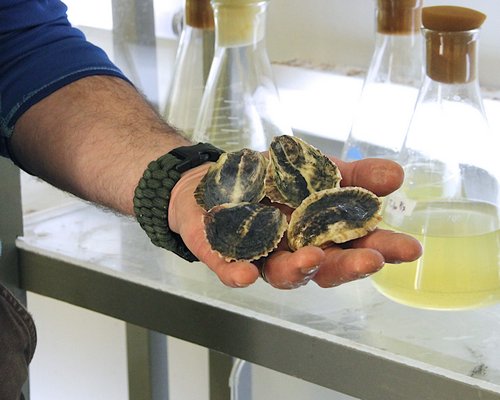
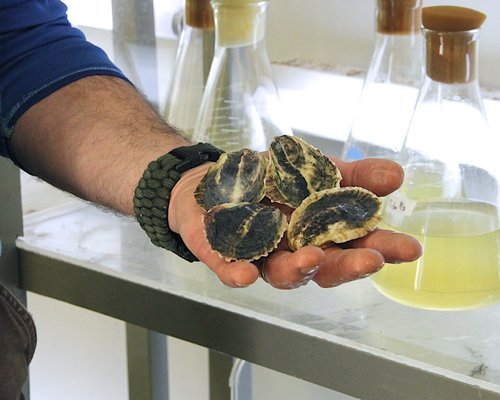
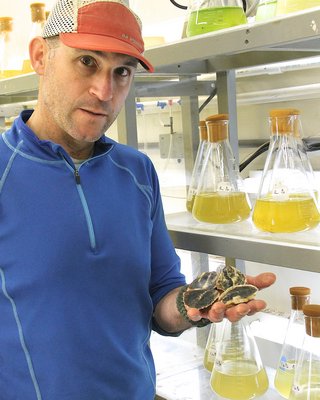
Starting in the late winter and spring of 2015, the hatchery scientists started seeing millions of their young oysters, as much as 30 percent of the total, developing brown, curled shells as they grew in cages in Three Mile Harbor and Napeague Harbor. Those that developed the deformed shells uniformly died long before they reached the size when the hatchery broadcasts their brood into local harbors to grow to a size in the wild where they can be legally harvested.
The affliction, the scientists determined, was a bout of Roseobacter oyster disease, or ROD, a bacterial infection that has beset the growing number of oyster hatcheries throughout the Northeast in the last decade and has, in some places, killed off as many as 90 percent of farmed oysters.
“When we get the disease, we lose probably one million to two million, maybe 25 or 30 percent,” said John “Barley” Dunne, the hatchery’s manager. “But it doesn’t get everybody, thankfully. So what we can do is take the survivors and spawn them and, hopefully, we can develop a disease-resistant strain. It’s similar to what they’ve been doing with plants since the late 1880s.”
Starting last spring and again this year, the hatchery staff started selecting their spawner stock—the group of oysters that are used to create the next year’s brood—from among those oysters that were mixed in with other oysters that got the disease the year before but did not develop the ill effects. By doing so, the hatchery hopes to eventually have a genetically favorable race of oysters that can resist the onslaughts of the bacteria as they grow.
The hatchery uses fewer than 100 oysters to create the five million to six million larval shellfish in the hatchery’s spawning tanks that are then placed in plastic cages suspended in tidal waterways to grow until they are large enough to be released into the wild.
The deaths from ROD seem to come only in the first season of the oyster’s life. Once the shellfish have reached an inch they appear able to fend off the bacteria.
The hatchery begins conditioning the spawner stock in January, tinkering with water temperatures and light in the spawning tanks to trigger various developmental stages of the oysters. At three-week intervals in March and April the hatchery’s staff will create just the right conditions to trigger different batches into spawning.
This year’s first brood are just starting to appear in their microscopic form in the hatchery’s plastic spawning tanks, and this summer, the second since the selective spawning effort began, will hopefully show signs of whether the tactic is paying off.
“It will take a couple more years,” Mr. Dunne said. “Hopefully it will click one of these years and we’ll be golden again.”


 on Mar 20, 2017