


 2 Photos
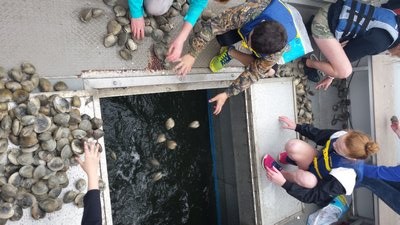
Local students help plant clams while they learn about their importance to the region from the Shinnecock Bay Restoration Program. COURTESY SHINNECOCK BAY RESORATION PROGRAM
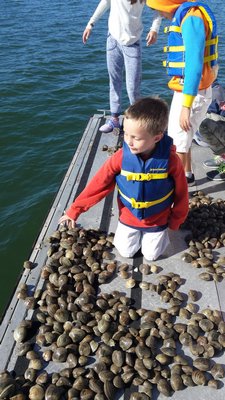
The Shinnecock Bay Restoration Program works with local schools to show them the importance of shellfish in the region by planting clams in the Shinnecock Bay. COURTESY SHINNECOCK BAY RESTORATION PROGRAM
Those behind the Shinnecock Bay Restoration Program, an initiative that seeks to cleanse the water in the western side of the bay through the introduction of shellfish, recently celebrated a milestone: the seeding of its one millionth clam.
Led by Christopher Gobler, Ph.D, a professor at Stony Brook Southampton, the program now boasts 20 hard clam sanctuaries in the bay, each containing 50,000 clams. The sanctuaries cover roughly a half acre of the bay, he said.
Though one million is an impressive number, Dr. Gobler said the goal continues to be to reseed Shinnecock Bay with 33 million clams and other types of shellfish, with the next million clams being in place by late 2016 or early 2017.
Clams are natural filters, helping cleanse water that has too much nitrogen—a common problem in the western regions of the bay.
“We put them in regions that have been declared by the Southampton Town Trustees as ‘no-take zones,’ so they can’t be harvested,” Dr. Gobler said. “We choose areas where clams will survive and areas that, when they propagate young, the offspring stay in the Shinnecock Bay.”
According to Dr. Gobler, clams can start to reproduce when they reach 2 to 3 years of age, and do so by spitting gametes into the water. One they are released, they require adult clams to be in the area, to ensure the completion of the reproduction process. Also assisting with the success rate is that clams, if not harvested, can live for decades.
When he first started researching the issue nearly 10 years ago, Dr. Gobler noticed that the few clams inhabiting Shinnecock Bay were spread too far apart, reducing their chances for successful reproduction. That research inspired him, with the help of Dr. Brad Peterson, to start the current program in 2012.
A professor at Stony Brook since 2006, Dr. Peterson explained that he and Dr. Gobler figured they could immediately start addressing the issue of nitrogen-loading in the bay through their clam restoration program.
“We believe that every clam we planted has survived since we began the effort,” Dr. Gobler said. “We now see signs of successful reproduction. If we can saturate the system with clams, we think the adults can get us to 33 million much faster than we initially thought.”
If his team must seed all of the clams, Dr. Gobler estimates that it would take about a decade to hit the 33 million mark. That time could be cut down considerably if the adult clams start to successfully reproduce. He noted that 33 millions clams could filter all the water in Shinnecock Bay in about three days.
Over the past few decades, the water quality in the bay has been on the decline. The continued reappearance of brown and red tides, according to Dr. Gobler, continue to wreak havoc in the bay and all forms of life that call it home. He pointed out that, earlier this year, the shellfish fishery was closed off due to the presence of red tide. It was the third such closure in the past five years.
“Nitrogen runoff is one of the ultimate causes,” Dr. Gobler said of the damaging tides, caused by algae blooms. “Another cause is the fact that we know in that region there use to be a much more abundant hard clam population. Those clams served as a filter for the bay.”
Another important aspect to ensure the ongoing success of the program is to continue to raise awareness, Dr. Gobler said. The East Quogue resident said he works with students at all levels, from elementary school to graduate school, to help foster education. In the fall, students from Hampton Bays and Southampton high schools helped stock one of the sanctuaries by planting 50,000 clams.
Dr. Stephanie Forsberg, a science teacher at the Hampton Bays High School, took 18 students on that field trip. She recalled the students being fascinated while learning how clams, as well as other shellfish, serve as filters and help clean bay water. Some of the students wanted to dissect clams to learn more about the process.
“This is a research program that I would encourage all educators to get involved with,” Dr. Forsberg said. “It’s something that benefits the community and the students as well.”


 Greg Wehner on Dec 22, 2015