


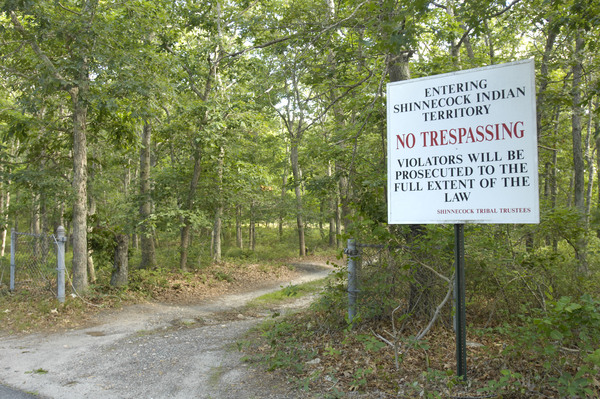
 2 Photos
The entrance to the Westwoods property in Hampton Bays.
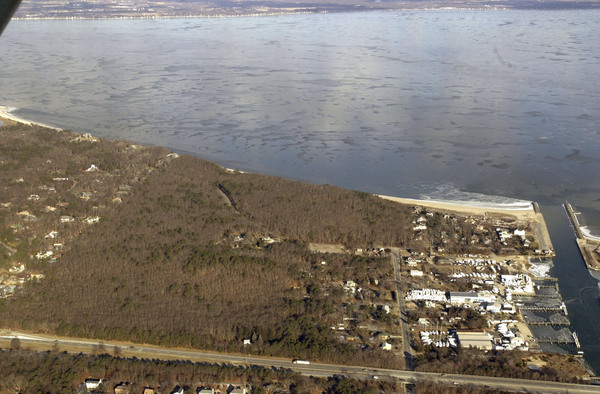
The Westwoods property in Hampton Bays. DANA SHAW
A federal appeals court on Monday threw out a lower court ruling that had prevented the Shinnecock Indian Nation from using the tribe-owned Hampton Bays property known as Westwoods for a casino development, as the tribe proposed in 2003.
The ruling, however, did not overturn the 2008 ruling by Judge Joseph Bianco, which rejected the tribe’s argument that the 79-acre Westwoods property must be considered sovereign tribal lands, making it eligible for a casino development under federal regulations. The tribe’s attorneys appealed Judge Bianco’s ruling but stated in their arguments that the tribe has no intention of pursuing a gaming facility at Westwoods anymore.
The ruling instead said that the case should never have been argued in a federal court in the first place, because the issues that sparked the complaint by Southampton Town and New York State—zoning regulations, environmental protection and the state’s ban on gambling—were not subjects of federal jurisdiction. The court ruled that the case, which was the subject of a nearly five-year legal battle between the tribe, state and town, should have been heard in state court rather than federal court. The case will be remanded back to a state court, though it is unclear whether either side will pick up the fight again.
Nonetheless, the tribe immediately seized on the ruling—which, at least in theory, brings the Westwoods property back into play—as an opportunity to renew pressure on Governor Andrew Cuomo to discuss the tribe’s desire to build a casino elsewhere on Long Island or in the outskirts of New York City. The governor has been dismissive of the tribe’s plans and its need to negotiate a compact with the state before it could open a casino, saying that the Shinnecocks must wait until a state constitutional amendment expanding legalized gambling in the state has been approved, and then, potentially, submit their casino plans for consideration alongside private entities.
“Now that the Nation has been federally recognized as an Indian tribe and has been freed from the effects of that judgment and injunction, we again ask Governor Cuomo to sit down with the Nation to discuss how the Nation and the state can move forward together,” a statement released by the tribe on Monday afternoon reads.
Tribal Trustee Lance Gumbs said later that getting the injunction lifted was perhaps most important as a psychological win for the tribe, even if the practical impacts of the victory are lessened by the tribe’s new direction regarding gaming, which targets properties elsewhere in Suffolk County and farther west. The ruling said that the case should be re-argued—if the two sides see fit—in a state court, where it started out almost a decade ago.
“It takes the injunction off the land, and that was one of the important things to the tribe,” said Mr. Gumbs, who was the voice and face of the tribe when the battle over Westwoods started with the rumbling of bulldozers on Newtown Road. “It’s not about the casino, it’s about having the freedom to do things over there we’ve always done. His ruling was dead wrong.”
On a sweltering Saturday morning in June 2003—six months after the tribe and developer Ivy K. Ong began an attempted end run around federal regulations leading to construction of a casino at Westwoods, on the basis of the tribe’s centuries of dealings with New York State—bulldozers started clearing trees at Westwoods, a broad swath of woods bisected by Sunrise Highway and bounded by residential neighborhoods and towering sand bluffs overlooking Peconic Bay.
By the time Judge Bianco ruled that Westwoods was off the table as a possible casino site five years later, tribal leaders had admitted that they had never wanted to build at their cherished retreat, used for camping, picnics and ceremonies by tribe members. But, at the time, the tribe and Mr. Ong had sketches in hand of a 60,000-square-foot casino on the land, and designs for a Sunrise Highway exit leading to the property. With large men in shirts emblazoned with “Tribal Security” blocking the entrance to Westwoods, the bulldozers ultimately cleared almost 12 acres of woods before attorneys for the town and state got a temporary restraining order and State Police halted the bulldozers.
The lawsuit that followed pitted the town and state against the tribe in a convoluted morass of legal wrangling that had lawyers crawling through the cramped storage rooms of Southampton Town Hall in search of centuries-old documents from the earliest days of the pre-Colonial settlement.
The town and state’s stance was that the tribe had no right to build a casino at Westwoods, because the property was owned by the tribe but was not recognized sovereign tribal land, like the tribe’s 800-acre Shinnecock Neck reservation, and was therefore subject to restrictions of zoning and environmental regulation like any property would be.
The tribe claimed that the land was, in fact, aboriginal lands that they had always maintained as a tribal outpost separate from the reservation and should therefore be immune from local jurisdictions under the tribe’s sovereignty. The case grew to sprawling dimensions, including everything from 17th century letters to weekend traffic studies, and eventually bringing in the issue of the tribe’s status in the eyes of the federal government, which led to an unprecedented declaration by Judge Thomas C. Platt granting the tribe federal recognition outright.
Though the federal Bureau of Indian Affairs refused to apply the ruling by Judge Platt—who abruptly removed himself from the case shortly afterward—it led Judge Bianco to give the BIA an accelerated deadline to address the Nation’s status. The tribe received federal recognition, the crucial step to being able to operate a casino under the rules of the Indian Gaming Regulatory Act, in 2010.
But the judge also ruled that the tribe’s aboriginal rights on the Westwoods property had been extinguished by various transfers of the land that had taken place centuries ago between tribal leaders and European settlers—though the tribe’s attorneys argued that many of those were illegitimate deals made by charlatans or through trickery.
The lawsuit went to trial in 2007, lasted more than 30 days, and ultimately cost Southampton Town more than $5 million in legal fees. The tribe appealed Judge Bianco’s ruling in 2008, but the appeal was put on hold for years as the tribe negotiated the federal recognition process. The two sides finally argued the appeal before a three-judge panel in the federal 2nd Circuit Court of Appeals in Manhattan in March 2011.
The two sides presented their conflicting stances on the sovereignty issue, but both agreed that the federal court where the original case was held—at the insistence of the tribe’s attorneys—was the proper jurisdiction. But thanks to legal process, which requires that the appeals court consider whether they even have jurisdiction to rule on a case, the ruling this week never reached the point of examining the sovereignty issue. The judges simply voted 2-1 that the case should have been left in state court.
“Our view in the appeal was that the case does involve an inherently federal question: an Indian tribe’s use of its land—and the tribe agreed,” attorney Michael Cohen, who handled Southampton Town’s portion of the case, said from the outset. “The tribe said that the judgment should be overturned for a number of reasons … but they agreed that the lower court should have jurisdiction.”
Mr. Cohen said that town officials have not yet discussed how it would proceed from here. There are a number of options the town and state could pursue: including asking a larger panel of judges in the 2nd Circuit to hear the arguments again, appealing to the U.S. Supreme Court, or starting from square one in state court. He said the latter was unlikely, because the tribe had dropped plans to develop Westwoods.


