


 3 Photos

Two developers are putting their money behind a new strategy for treating polluted groundwater, a low-tech technology that has been around for nearly two decades but, up until recently, had never been proposed for such a use—at least not on Long Island.
The technology: permeable reactive barriers, or PRBs. The main component of the technology: old-fashioned wood chips.
The partners behind the approved Canoe Place Inn maritime planned development district and the company pushing to construct a high-end golf resort community in East Quogue are both intending to incorporate this method of groundwater filtration as part of their respective projects. It is one that relies on carbon-based organic material—such as mulch, wood chips or even vegetable oil—as means for filtering and removing harmful nitrates from the soil.
Plainview-based R Squared LLC has committed to the technology as a tool for filtering nitrates from the groundwater nearest to the soon-to-be-renovated Canoe Place Inn in Hampton Bays. Meanwhile, the Discovery Land Company of Arizona is considering using the same technology as part of its proposed development, another planned development district dubbed “The Hills at Southampton” that, if approved, would boast 118 residences and an 18-hole golf course.
While local environmental scientists agree that the technology is promising, its potential effectiveness in these instances remains to be seen.
The technology has not yet been utilized anywhere on Long Island, though representatives of Massachusetts-based Lombardo Associates—the company that will install the PRB on the Canoe Place Inn property—is confident in their product’s effectiveness. They’ve stated that in addition to whatever nitrates are already in the soil due to the former inn and nightclub, their barrier will also capture the nitrates produced from the redeveloped property, which also will boast a restaurant, catering hall and rental cottages, as well as the septic runoff from 33 nearby homes that sit closest to the western bank of the Shinnecock Canal, according to data on file with the Southampton Town Planning Department.
Originally used to filter toxic materials from hazardous waste sites, PRBs date back to mid-1990s and have been used at more than 30 federally designated “Superfund” sites across the country, according to the Environmental Protection Agency. In those instances, however, iron, limestone and carbon—and not wood chips—were utilized to create the barriers.
However, the utilization of PRBs on commercial and residential properties, as a means of mitigating pollution from septic leaching, is a relatively new phenomenon and, thus far, has been confined primarily to New England, with Lombardo Associates also pioneering those installations.
Pio Lombardo, the owner of Lombardo Associates, said the technology replicates the natural filtration processes of wetlands by introducing carbon material that sparks the denitrification process, in which bacteria consumes the nitrogen from the groundwater and releases it as nitrogen gas.
“Once the water gets saturated with nitrogen gas, it’ll bubble out because the water can’t contain it anymore,” Mr. Lombardo said. “Then it’ll go into the soil, where there’s more room, and eventually make its way to the surface.”
A permeable reactive barrier, or biobarrier, as they are sometimes referred to, is built by digging a trench between a contaminated groundwater plume and the body of water that it is flowing toward. That trench is then filled with organic material, which the groundwater will flow through, allowing the filtration to take place.
The cost of installing a PRB varies based on its length and depth. For example, the PRB at the Canoe Place Inn property will be 950 feet long and 6 feet deep, and it will come with a price tag of $330,000, according to the R Squared application. The Hills PRB, in contrast, would likely be much more expensive as it would have to go down roughly 30 feet to 50 feet below the surface, and encompass a much larger area to be effective. Currently, The Hills application does not list the proposed PRB as a public benefit.
A more cost-effective way to complete work on a PRB is to inject carbon in the form of a liquid, such as vegetable oil, into the ground. While this is cheaper up front, the liquids must be replaced every few years, while the solid barriers can continue filtering groundwater for several decades before requiring maintenance or replacement. Either way, the groundwater around PRBs must be tested frequently, Mr. Lombardo noted.
While the science behind such barriers is sound, the practice might not be ironclad, according to Dr. Chris Gobler, a professor at Stony Brook University’s School of Atmospheric and Marine Sciences. In order to be effective, the barrier must extend down to the deepest depths and intercept groundwater, otherwise nitrogen-rich water could flow underneath the barriers, unfiltered.
Likewise, the barrier is only as useful as it is long. If a nitrate plume diffuses and moves laterally—which they are known to do—instead of straight forward, it is possible for nitrogen-laden water to circumvent the barrier and still end up in nearby creeks, rivers and bays.
“The problem there is, once you hit that water underground, continuing to dig deep gets to be a challenge,” said Dr. Gobler, who lives in East Quogue. “There’s also the width issue: If it’s just at the shoreline, you’ll capture nitrogen the length of the barrier, but if you go along either side of the barrier, it stops being effective.
“Unless you’re going to build a barrier along the entire island, there are going to be issues,” he continued.
Dr. Gobler emphasized that the technology is relatively new when it comes to mitigating septic pollution, pointing out that many states that are dealing with nitrogen loading, including Florida, New Jersey, Maryland and Virginia, have yet to even explore PRBs.
“This is still is something we don’t know a lot about and, obviously, since there’s never been one on Long Island we can’t be sure how effective it will be,” he said. “But when it comes to looking at ways of handling wastewater, it should be in the mix.”
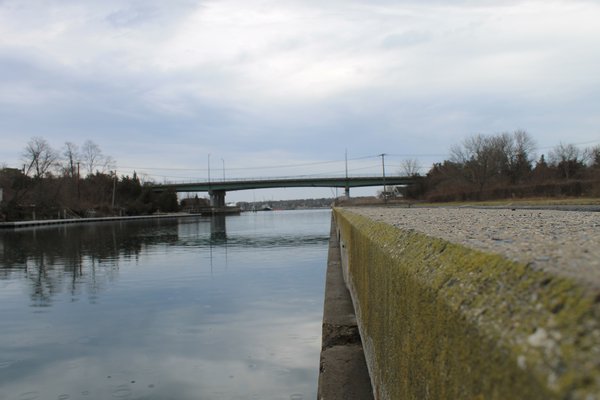
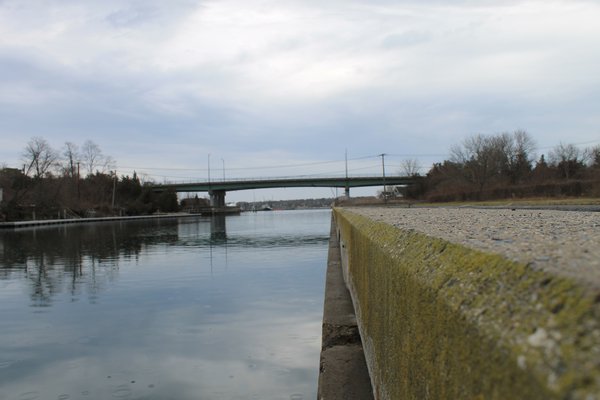
Dr. Gobler said some situations would seem better suited for a PRB than others. For example, he said the PRB that would border the Canoe Place Inn property along Newtown Road and Montauk Highway should be effective because it will be installed right in between the property’s cesspools and the Shinnecock Canal, where much of the groundwater would flow to, meaning there’s little room for nitrogen to disperse elsewhere.
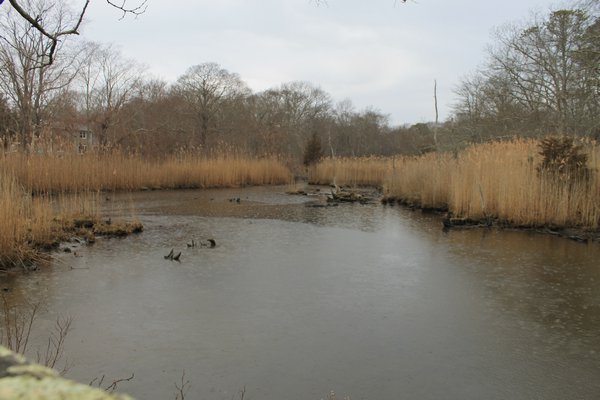
On the other hand, Dr. Gobler said, The Hills project would be less suited for a PRB because the community is a considerable distance from the nearest body of water, nitrogen-laden Weesuck Creek.
The engineers behind The Hills project also recognize that this is the case. Rusty Schmidt, a landscape ecologist with Nelson, Pope and Voorhis, the Melville-based engineering firm hired by Discovery Land to assist in its planned development district application that’s now being reviewed by the Southampton Town Board, said the proposed location of the development along Spinney Road, just east of Lewis Road, could be problematic in terms of installing a PRB.
In order for a PRB to be most effective, Mr. Schmidt said, it would have to be installed right along Weesuck Creek; however, all the land along the creek is owned, most of it privately. Because of this obstacle, it is unclear if Discovery Land would ultimately include a PRB in its list of public benefits, which it must provide the Town Board in order to be granted the necessary change of zone to construct the 118 residences and golf course.
Aside from a higher risk of diffusion, constructing a PRB so far from surface water means a higher cost for the developer, Mr. Schmidt said.
“The deeper the depth to groundwater, the more expensive and harder to manage it is than if its shallower,” he said.
It has also been noted that the removal of nitrogen from groundwater is a slow process when utilizing PRBs, as groundwater typically moves as a slow rate and usually only a few inches per day. As a result, Mr. Schmidt noted that Discovery Land is also investigating other methods that could help improve the quality of water in Weesuck Creek, such as the refurbishing of wetlands, and possibly subsidizing the cost for homeowners who live near the creek to upgrade their cesspool systems.


 Kyle Campbell on Apr 14, 2015