


 5 Photos
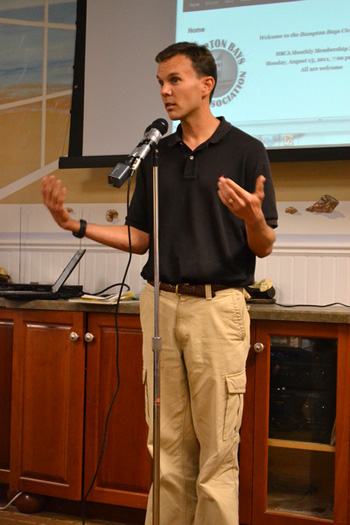
Stony Brook University Christopher Gobler discusses wastewater algal blooms in western Shinnecock Bay.
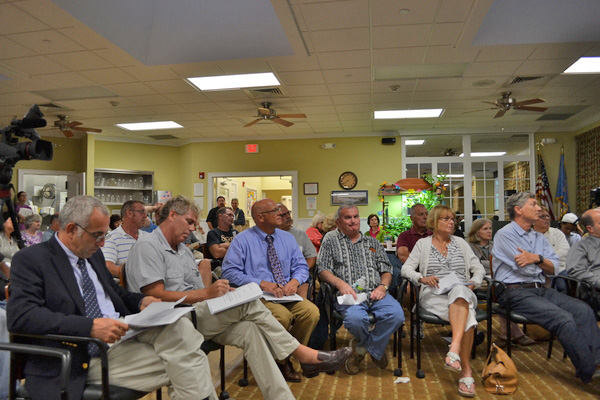
Legislator Jay Schneiderman and Peconic Baykeeper Kevin McAllister take notes at the Hampton Bays Civic Association's environmental forum on Monday.
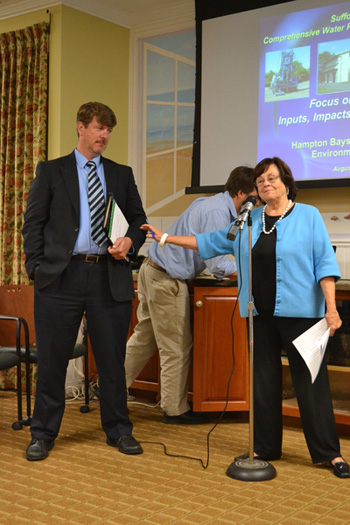
Hampton Bays Civic Association board member Mary Jean Green introduces Walter Dawydiak
the environmental director for the Suffolk County Health Department.
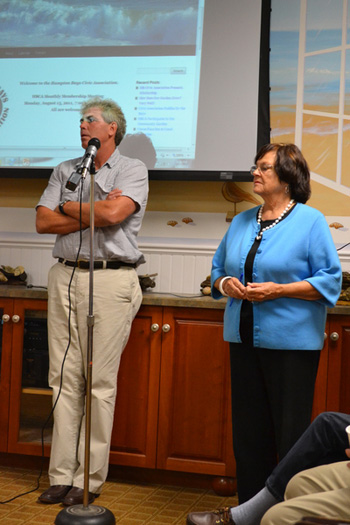
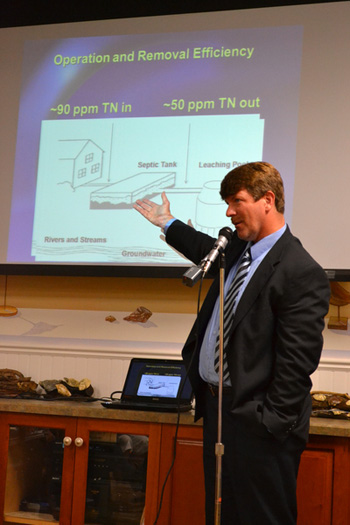
Walter Dawydiak
Swimming in Shinnecock Bay could be dangerous, following a weekend of heavy rain, a Suffolk County Department of Health official warned on Monday night.
After a weekend marked by torrential rain that soaked much of the East End, Environmental Quality Director Walter Dawydiak warned Hampton Bays residents not to swim in Shinnecock Bay for the next few days until the bay completes two tide cycles.
The water, he said, could be full of pathogens that run from stormwater drains on roadways, directly into the bay. These pathogens have the potential to make those who bathe in the water sick.
As one of the 60 people who packed the Southampton Town Senior Center in Hampton Bays for a Hampton Bays Civic Association environmental forum—dubbed “Can Shinnecock Bay Be Saved?”—later pointed out, the fact that bathers cannot enjoy the bay following a rainstorm just illustrates the point that the waterways surrounding the hamlet are sick and at risk at becoming terminally ill.
If the pollution in the waterways is not remedied, the hamlet’s maritime tourism industry and baymen heritage could both become casualties, officials said at the forum.
At the event, a large crowd of concerned residents and local officials—including Suffolk County Legislator Jay Schneiderman and Town Councilwoman Bridget Fleming—listened as three local experts described a gloomy prognosis for Shinnecock Bay, part of the South Shore Estuary that was declared an impaired waterway by the state’s Department of Environmental Conservation last year. The impaired status stretches from the East End west to bays along the south shore in Hempstead.
This new designation, according to Peconic Baykeeper Kevin McAllister, is one that should galvanize residents to consider the amount of harmful nitrogen being released from septic tanks and cesspools near the bay and into the water. The harmful nitrogens, or nitrates, occur naturally when human waste breaks down and is eventually processed into ammonia. The nitrates that have entered the bays, creeks and tributaries have killed eelgrass in western Shinnecock Bay and, as a result, many shellfish and scallops can no longer live and reproduce there.
“I saw eels and crabs coming out of the water trying to breathe,” Mr. McAllister said of a recent trip in Peconic Bay, another bay suffering from red and brown tides—harmful algal blooms that can kill maritime organisms.
Stony Brook University researcher Dr. Chris Gobler told those in attendance that regions of Shinnecock Bay west of Ponquogue Bridge are being most severely affected by algal blooms that are caused by nitrates seeping into the water from pesticides, stormwater runoff and, most of all, cesspool and septic systems that slowly leak into the ground and surface water.
“Shinnecock Bay has the worst algal bloom in the world,” Dr. Gobler said, pointing out that overdevelopment is to blame for the impaired waterways. “It’s killing juvenile clams and scallops,” he added.
Septic systems can impact the waterways, even those installed as far as a mile away from the bays. “Homes closest to the water have the biggest impact,” Dr. Gobler said. “Lawn fertilizer does affect the waterway, but it’s a small impact compared to septic tanks.”
Pointing out that Shinnecock Bay was closed to shellfishing on Monday following heavy rains, Dr. Gobler said that stormwater runoff is harmful because it increases the amount of nitrogen in the water, along with pathogens from roadways.
Mr. Dawydiak told the crowd that there are a number of different residential waste systems that could be used that would produce less nitrogen, but he noted some could cost as much as $30,000 to install per household and cost about $1,000 to service each year.
The Suffolk County Department of Health recently completed a Water Resources plan, according to Mr. Dawydiak, which focuses on reducing nitrate pollution in certain target areas. The areas of major concern, according to the report, are the North Fork and western Suffolk County—which are more overdeveloped.
If East End officials aren’t careful, the South Fork could be heading in the same direction. Density has long been an issue in Hampton Bays, where many lots have been subdivided and accessory apartments are regularly added onto homes.
“One of the recommendations is that land be zoned to make sure the densities aren’t too tight,” Mr. Dawydiak said of the report. “We have to make sure we meet the drinking water standard.”
While Mr. Dawydiak stressed that the drinking water in Hampton Bays is not in danger, he said that density and the amount of nitrates seeping into local waterways—due to an excess of waterfront properties—is hurting surface waters. In addition to pushing for changes in zoning, the report suggests more open space purchases so that the surface waters won’t be further stressed by new development.
Though the East End does not currently have a sewer system—which would help to alleviate the issue but not cure surface waters completely—Mr. Dawydiak said both Flanders and Riverside are being considered for a sewer project due to the impaired waters in that area. He also noted that Peconic Bay near Flanders is one of the area’s most prone bays.
Methods to lower the amount of nitrogen released, including updated septic systems and cesspools, are expensive. The least expensive system, one that removes about 40 percent of nitrates from wastewater, is known as a leaching pool. They cost between $5,000 and $8,000 to install. Other sewage treatment plants include the Cromaglass system, which is often used in large developments to treat wastewater. Mr. Dawydiak said the county is considering examining the Nitrex system, but currently does not permit them to be installed in large developments. These treatment plants can cost up to $30,000, he said.
Still, Mr. McAllister stressed, state-of-the-art technologies are the only way to reduce the amount of nitrates in the water. If homeowners do not consider replacing or upgrading their septic systems, he said the bays in which many Hampton Bays residents swim, kayak and splash around in might not be a safe place for them to dip their toes.
“What price do you put on Shinnecock Bay? We’re going down a slippery slide,” he said. “We’re at a crisis stage.”


