


 2 Photos
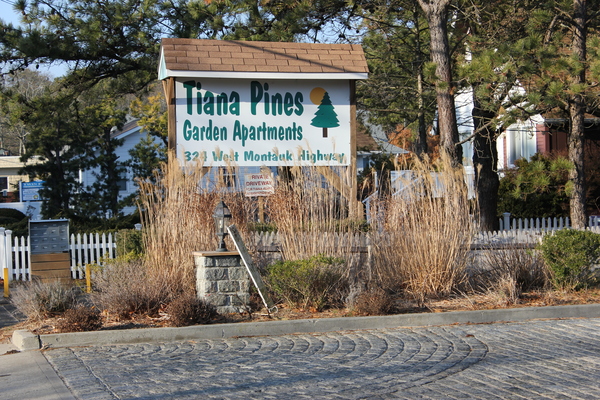
The owners of the Tiana Pines Garden Apartments in Hampton Bays are seeking the legal conversion from a motel to apartments. CAROL MORAN
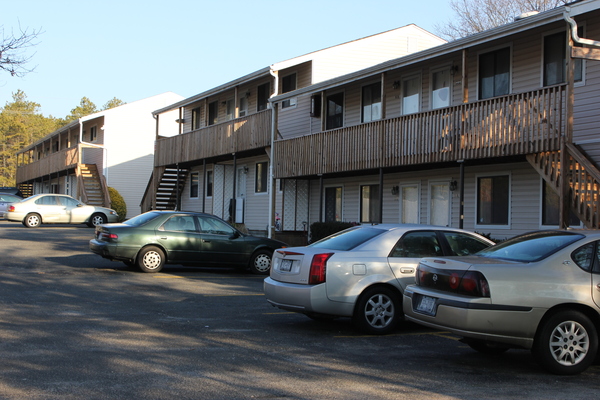
The owners of the Tiana Pines Garden Apartments in Hampton Bays are seeking the legal conversion from a motel to apartments. CAROL MORAN
The attorney representing the owners of the Tiana Pines Garden Apartments, a motel in Hampton Bays that has been operating illegally as an apartment complex for decades, is urging the Southampton Town Zoning Board of Appeals to grant a variance that would finally legalize the conversion.
John Bennett, who is representing Domenico and Vincenza Iadevaia of Carle Place, told zoning board members last week that Joseph A. Paige, the prior owner of the property at 324 West Montauk Highway, was issued a building permit to construct the 16 motel units in 1971—before the town code placed restrictions on lengths of stay and kitchens. The property was zoned “E” Business Zoning District at the time, according to the rider Mr. Bennett submitted to the board.
In 1972, the town amended the code, adding the word “transient” to the definition of motel and prohibiting kitchens in motel rooms, according to a copy of the code. At that time the property was also rezoned Highway Business, which does not allow for apartments or motels, but allows for a number of commercial uses.
Over the next five years, the ZBA extended that original building permit on six separate occasions, allowing Mr. Paige to continue construction on the motel units. The town also issued multiple certificates of occupancy for the nonconforming motel use, most recently in 1988.
Mr. Bennett argued during last Thursday evening’s ZBA meeting that the actions of town officials over the years—particularly, the renewing of building permits and the issuing of COs—gives his client the right to continue renting the motel units as apartments without being fined by the town. He also said there should not be limits on the length of stays, as with motel rooms, and that the town should grant his clients new COs for the nonconforming apartments.
“There is no functional difference between using the buildings as motel units with preexisting rights for a kitchen and no restriction on transiency versus using the buildings as apartments,” the rider to the ZBA application states. “The use and impact stay the same.”
Mr. Bennett also submitted a letter from an engineer and contractors stating that it would cost his clients approximately $165,000 in order to renovate the buildings at Tiana Pines so that they can be leased as commercial buildings.
“You don’t have to take the applicant’s word for this—it has been laid out,” he said, citing a number of zoning board decisions and a Suffolk County Supreme Court case that support his position.
The Iadevaias were cited multiple times by the town in 2010 for illegally operating the 16 motel units as apartments, according to town records. Domenico Iadevaia faces a total of 15 charges, all filed that year, and is due back in Southampton Town Justice Court on Friday, February 1, according to the court clerk. He has not been fined yet, according to town officials.
It was not immediately clear why the town began citing the Iadevaias; officials have said that the conversion from motel to apartment complex took place more than 20 years ago.
Mr. Bennett, meanwhile, dismissed those violations as inaccurate. “The violations were wrong,” he said. “They didn’t have all the information.”
Eric Bregman, an attorney with the Bridgehampton firm Farrell Fritz, P.C., and who is representing the Concerned Citizens of Hampton Bays, a new civic group that opposes the motel conversion, declined to share his argument with the board during last week’s meeting, stating that he needed additional time to organize. Kevin Tureski, a member of the civic group, owns land adjacent to the apartments, he said.
The board will again hear the variance application at its meeting on Thursday, February 7.
Though Mr. Bregman declined to offer any insight regarding what his argument would be when reached on Monday, a letter he submitted to the zoning board in May states that the conversion would be “extremely detrimental to the general neighborhood” because of the financial burden it would place on the Hampton Bays School District and the possibility of pollution to the groundwater due to the outdated septic system. Mr. Bregman also states in the letter that the Suffolk County Health Department told Mr. Tureski to “immediately stop drinking his well water.”
Though Mr. Bennett submitted a letter from the Hampton Bays School District stating that three children from Tiana Pines were enrolled there as of October, records Mr. Bregman submitted showed that that number peaked in 2002, 2003 and 2004 at seven children. Mr. Bennett also pointed out that the units are assessed by the town as apartments, and the property owners pay their share in school taxes. Town records show that they paid about $18,000 in school taxes in 2012. Mr. Bregman stated that, as of last May, he was told that it costs the school district about $94,500 to educate the four children who were enrolled in the district and living in the apartments.
Lisa Goree, the acting town assessor, did not immediately return calls seeking information about the town’s decision to assess the units as apartments.
Mr. Bennett also submitted a letter to the zoning board stating that the development’s septic system can accommodate year-round tenants in the apartments. The letter, from the Suffolk County Office of Pollution Control, states that “all environmental concerns regarding the existing sanitary system” have been addressed. He also included plans to install a new sanitary system approved by the Department of Health.
In his letter to the board, Mr. Bregman stressed that the motel use was abandoned “long ago.” Once a nonconforming use is abandoned for a certain length of time, the letter states, it cannot be reinstated, according to the town code. The letter also states that the apartments were never an approved use for the property.
“The current apartment use is illegal—it is neither a lawful pre-existing nonconforming use, nor a use allowed under the Code in the HB Zone,” Mr. Bregman’s letter states.
Robert Liner, a founding member of the Concerned Citizens of Hampton Bays, could not be immediately reached for comment.
Adam Grossman, the vice chairman of the zoning board, said he cannot make a decision on the variance request until he receives a detailed response from Mr. Bregman countering Mr. Bennett’s argument.
“What I can tell you is that I listened and I’m looking forward to hearing testimony from Mr. Bregman, or any other interested parties,” he said, adding that the matter is complex and the board’s decision will not be easy. “I suspect that he will have a different take on whether they did things correctly. I’ll wait and see.”


