


 5 Photos
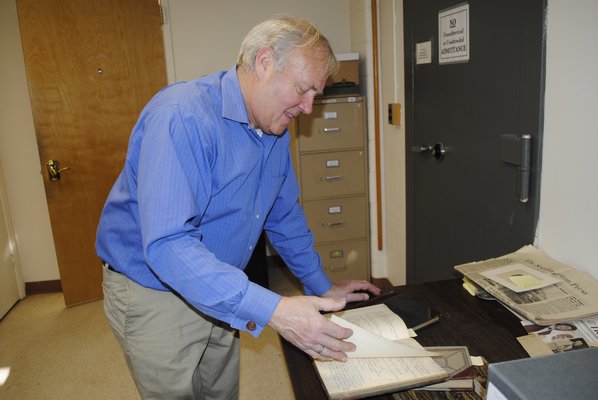
Southampton Town Historian Zach Studenroth flips through a book of handwritten Hampton Bays minutes from the early 1900s. AMANDA BERNOCCO
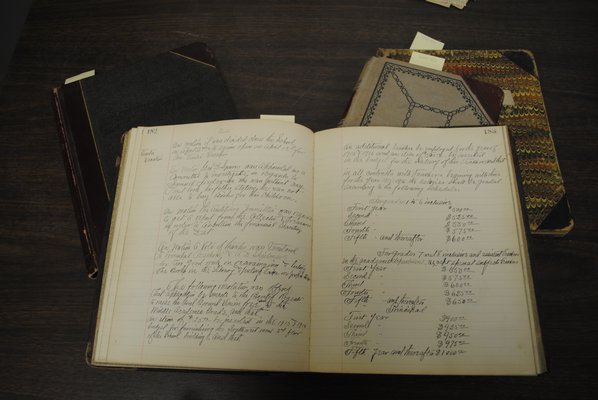
A book of handwritten Hampton Bays Board of Education minutes from the early 1900s. AMANDA BERNOCCO
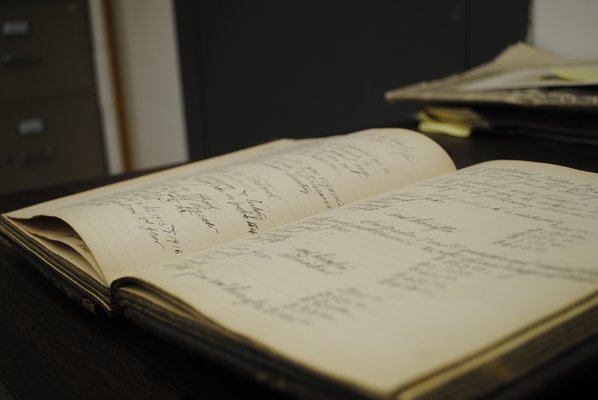
A book of handwritten Hampton Bays Board of Education minutes from the early 1900s. AMANDA BERNOCCO
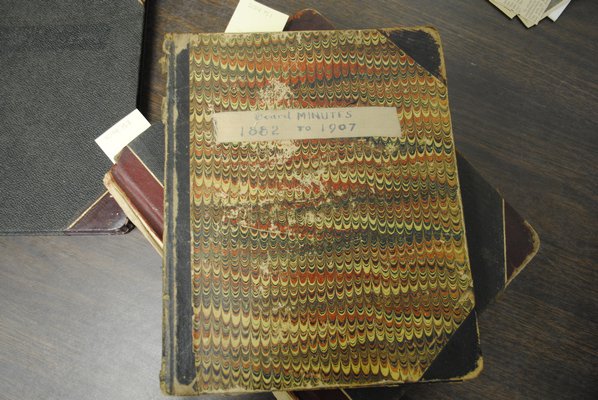
A book of handwritten Hampton Bays minutes from 1882-1907. AMANDA BERNOCCO
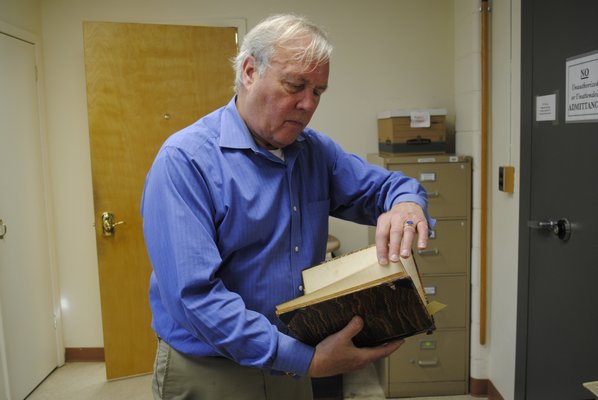
Southampton Town Historian Zach Studenroth flips through a book of handwritten Hampton Bays minutes from the early 1900s. AMANDA BERNOCCO
When Hampton Bays Board of Education members sat down to create the budget for the 1918-19 school year, the conversation sounded a little different from today’s exchanges. Rather than fret about teacher contracts or debate the pros and cons of piercing a state-mandated cap on the tax levy, the five elected board representatives had more immediate issues to address—such as whether they should set aside funds to finance the installation of the district’s first indoor toilet.
Board members opted to install the toilet, according to the nearly century-old handwritten minutes found inside one of four record-keeping notebooks that recently fell into the hands of the Southampton Town Historian Zach Studenroth. The minutes, written in cursive and black ink, show that the board allocated $1,050 of that year’s $10,548.55 operating budget to cover the installation.
The decision was a significant one for the school community, as many families did not yet have indoor plumbing at home at the time, as noted by Mr. Studenroth. He explained that such a luxury was not typically found in private homes in the area until the 1930s.
The board members—who included two members of the Squires family though their first names, as well as the full names of the other three members, are illegible—then revisited the topic at their meeting on April 28, 1919, and called to order at 8:47 p.m., to discuss installing a cesspool to accommodate the indoor toilet, according to the same document.
“Cesspool to be not less than 100 feet from the school building … ” according to the meeting minutes documented in the yellowing and faded pages of the beige notebook that features a gray pattern on its cover. The record goes on the document the size of the cesspool, noting that it must be at least 9 feet deep with a circumference of at least 8 feet.
The four journals, which include the minutes from School Board meetings spanning from 1882 to 1932, were recently donated to the town’s historic division by Richard Casabianca of Hampton Bays. The old notebooks had belonged to Alvin Penny, a former Hampton Bays Board of Education president and an avid collector of local memorabilia—and also the cousin of Mr. Casabianca’s grandmother, Hope Lester of Southampton.
After Mr. Penny died in 2011, his daughter, Kathy Karzenski of Hampton Bays, started cleaning out her father’s house when she found four dog-eared journals. She showed the books, each of which contains a few hundred pages, to Mr. Casabianca who then shared them with Mr. Studenroth.
“[I] told Zach that he could have them, and he was thrilled, but under one condition: that was that he had to digitize the books for me and give me a CD copy, as I wanted to share with [the Hampton Bays] School District and Historical Society,” Mr. Casabianca said in a recent email. “[I] didn’t want the only copy to be in the vault in Town Hall—figured it wouldn’t get seen much there.”
Mr. Studenroth agreed, transferring all 984 pages of the minutes onto a single disc for Mr. Casabianca to keep and share. The hard copies of the notebooks are now safely stored in the historic division’s vault, tucked in the lower level of Southampton Town Hall.
The historian pointed out that he loves when community members bring in old records, like the century-old Board of Education meeting minutes, because they help piece together the history of the town.
The minutes are now the oldest ones on file for the Hampton Bays School District. Schools Superintendent Lars Clemensen explained that before Mr. Casabianca’s find, the district’s minutes only dated back to 1908—the year his district officially became the Hampton Bays Union Free School District.
Prior to 1908, Hampton Bays had three different schools: the Red Creek schoolhouse that sat north of Flanders Road; Good Ground School, which was located on Montauk Highway directly across from where the Capital One Bank now stands; and Springville School, also referred to as Bay Avenue School, situated on the north side of Bay Avenue. Those three buildings closed once the Ponquogue Avenue School, a wooden building located on the site of the current elementary school, was built in 1907, according to Mr. Clemensen.
Twenty years later, a brick addition was added and it housed the district’s K-12 program until 1971. The wooden structure was demolished in 1968 and replaced with a new kindergarten wing.
“We are called ‘union free’ because we became a unified district of free schools,” Mr. Clemensen explained in a recent email. “Lots of people think it has to do with teachers unions.”
Though the town has similar records for a few other school districts, Mr. Studenroth pointed out that it is not very often that such notebooks are found in such good condition.
“These are very rare,” Mr. Studenroth said of the minutes. “Because, particularly in this period, the person who keeps this comes to the meeting, and it’s probably at someone’s house. They sit down around the dining room table in someone’s house, and he or she would keep the minutes—then off it goes. So when this person retires, or dies, or moves to Boca Raton, or whatever happens, this good little book often just goes missing.”
Town Clerk Sundy Schermeyer, who collects records for the town, also pointed to the importance of sharing such finds with the municipality’s historic division, and local historic societies, explaining that it helps document the colorful and rich history of the town.
“It’s amazing the type of records we have in our possession,” Ms. Schermeyer said, noting that the town collects everything from school board minutes to war documents and historic maps of the town.
The tricky thing with record-keeping, Mr. Studenroth noted, is that a document’s historical significance is not always immediately clear. That was not the case with the journals shared by Mr. Casabianca as their contents, which include board meeting minutes from a 50-year window spanning two centuries, help fill a significant gap in the history of the Hampton Bays School District.
For example, the beige notebook that contains the 1918-19 school budget breakdown also offers what appears to be the official record of the district between June 12, 1917, and December 15, 1924. Scribbled on the first page of the notebook, in what appears to be pencil, is “Record Unit For School No. 2 Good Ground, East Quogue, Flanders.” Page 42 of the journal offers a list of items budgeted for the 1918-19 school year. That year’s $10,548.55 spending plan carried a tax levy of $9,262.50, with a tax rate of $1.07 per $1,000 of assessed valuation, according to the document. In comparison, the Hampton Bays School District is currently operating on a nearly $50 million budget that carries a $44.2 million tax levy.
At the same time, there are also some similarities to more modern budgets. In the 1918-19 academic year, teacher salaries easily accounted for the largest budget expenditure, accounting for $6,330, or about 60 percent of that year’s total budget. Board members also set aside $250 for school supplies, $30 for the annual telephone bill and $27 to rent a piano for their students.
“They tell the same story as today—keeping costs down, focusing on the details of operating a district,” Mr. Clemensen said of the minutes in an email. “The specifics are a bit different though, like spending $3.95 in 1886 on student furniture and $7 on the care of the district’s horse. We don’t have a horse anymore, of course, and I suspect not since the automobile was invented!”
The minutes also provide a window into the past, allowing those who inspect them to imagine what the school was like to work or study in.
In September 1920, a physical training teacher was authorized by the board to spend up to $15 on equipment. Minutes from February 1921 explain, in detail, the duties of the school janitor: keep the school clean, oil the wooden floors at least three times per year, and mow the lawn. The janitor earned $825 per year.
There was also a meeting later the same year when board members held a lengthy debate on which kind of material they should use to repair the school’s ceilings: plaster board of metal panels. The board ultimately agreed to go with the latter even though “the cost would be somewhat more,” according to the minutes.
“That would have been an early use of plasterboard,” Mr. Studenroth observed, as he flipped through the journal’s pages.
At another meeting, board members discussed how to punish students who were caught defacing school property. According to the minutes, three boys were caught cutting electric wires, as well as damaging batteries and bells in their classroom. Board members, according to the document, even discussed the possibility of filing criminal charges against the students.
“These were bad boys …” Mr. Studenroth said. “You see, there are always bad boys … these things don’t change. They probably didn’t like their teacher, so they snuck back and they cut all the wires.
“That could have been a teachable moment,” he continued. “Then they could have got someone … and taught them how to install wiring. Like, you fix this, and now you’ll know how to do it. I doubt that happened, though.”
As for Mr. Clemensen, he said the stories found in the meeting minutes help create a narrative for the priorities and concerns of those who oversaw his district a century earlier.
“It’s definitely an interesting read,” Mr. Clemensen said. “Just think, Grover Cleveland was president … the Titanic wasn’t even built yet, and the Statue of Liberty had just been dedicated!”


 Amanda Bernocco on Mar 13, 2017