


 1 Photo

Michelle Murphy Strada
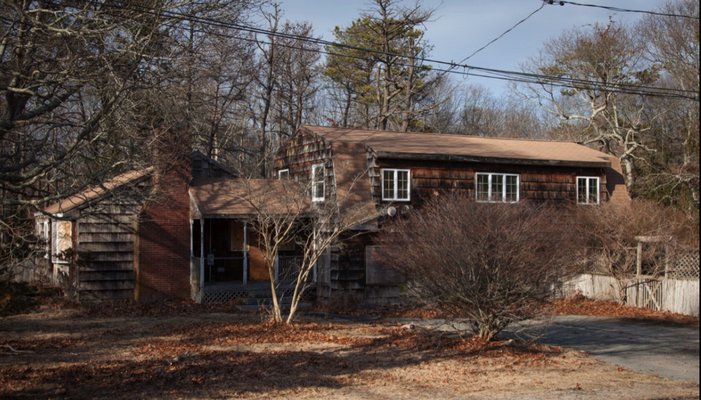
Representatives of a fledgling environmental nonprofit want to transform a boarded-up house that sits off West Landing Road in Squiretown Park in Hampton Bays into their self-sustaining headquarters.
The proposal from the Ecological Culture Initiative, a new nonprofit led by Marc Fasanella of Hampton Bays, calls for transforming the home—formerly the residence of the caretaker for the Girl Scout camp which operated for many decades at the property—into a “green” office, and meeting and educational space for the organization. Although details of the potential arrangement with Southampton Town are still being worked out, the Ecological Culture Initiative, or ECI, would most likely become stewards of the property that is owned by the town.
“We would want to turn it into a model house,” said Mr. Fasanella, noting that his organization would pay for the required renovations. “It would be our base … people could park in Squiretown Park and walk to this house.”
The home, at the southwest corner of the park, was originally purchased by the town in 2006 with the intention of converting it into affordable housing; that idea was never completed due to the deteriorating state of the house.
Some of the “regenerative design” features proposed by the ECI include a system for the collection of rainwater for reuse in the house, the installation of solar panels to power the building, and the establishment of a nearby “food forest”—a gardening technique that mimics a woodland ecosystem and features edible trees, shrubs, perennials and annuals.
The plan also calls for renovating the two-story house, which has sat vacant for years, so it can serve as both a home for the future facility caretaker and as a small classroom for students who will be studying the park’s ecosystem, according to Mr. Fasanella. He said he intends to bring forward an official proposal to the Southampton Town Board within the next few weeks.
Long Island University Center for Sustainability Director Dr. Scott Carlin said he is now working with Mr. Fasanella and the ECI to forge an official partnership so they can develop an educational program in Hampton Bays. Dr. Carlin noted that a local partnership would provide a space for LIU’s ecological and regenerative design students to complete field work on subjects like agroecology education—a focus on making the best use of the local ecosystem for food production without causing damage.
Noting that Good Ground and Red Creek parks are within walking distance of downtown Hampton Bays, and that Squiretown Park is only two miles north of town, Mr. Fasanella said he thinks his education vision would also benefit the hamlet’s downtown business district, explaining that such programming would attract students to the area and help make Hampton Bays a “college” community of sorts, one filled with coffee shops and cafes offering live music.
He noted that alongside green building initiatives like the ones proposed for the former home of the camp caretaker, his organization is also looking into possibly restoring the old lodge building in Squiretown Park and converting it into a living and learning center for educational residency programs in the future. Eventually, he said, such an addition should allow his group’s program to become self-funded.
Town Board members were receptive to the ideas proposed by Mr. Fasanella at the March 2 work session, but asked him to focus on the Squiretown Park house first to show that he could make that vision a reality.


 on Mar 8, 2017