


 3 Photos



Southampton Town Supervisor Jay Schneiderman’s abrupt decision to kill the municipality’s controversial planned development district law—dropping plans to replace it with a revised and updated version, as he previously suggested—is being hailed as a victory by environmentalists, and as a setback by those representing the construction industry.
If things progress as the supervisor plans, the current year-long moratorium on planned development districts, which is special zoning that requires Town Board approval and permits developers to circumvent established zoning in exchange for community benefits, will be extended by three months. That will give board members additional time to erase the legislation that was written into the town code in 1995 and updated dozens of times since then.
Led by Group for the East End President Robert DeLuca and Long Island Pine Barrens Executive Director Richard Amper, local environmentalists have been pushing for the legislation’s repeal since 2015, charging that it mostly benefits would-be developers by allowing them to greatly increase their potential profits in exchange for minimal community benefits—when the system, they’ve argued, should work the other way.
Their push for repeal hit a fever pitch in response to an application filed by Discovery Land Company of Arizona that is seeking a PDD in order to build a 118-unit luxury development featuring an 18-hole golf course on nearly 600 acres in East Quogue, the largest undeveloped tract of land remaining on the South Fork.
“I would say the announcement comes as welcome news … ” Mr. DeLuca said on Tuesday. “This particular tool isn’t doing what we intended it to.”
Mr. DeLuca, who said he has assisted town officials as they’ve attempted to “do surgery” on the law and improve it over the past decade, explained that the original intent of the PDD law—which, he said, has since been lost—is to provide specific benefits to the community that could not be achieved through traditional zoning, such as the construction of a senior center or hospital.
Mr. Amper agreed with that sentiment, adding that the town failed to define what constitutes a community benefit, allowing the developers to control the conversation and, in turn, retain the power.
“PDDs are ‘Let’s make a deal’ zoning,” Mr. Amper said. “They were intended to be used by the government to allow developers to build what the town needed. But it has turned into a tool for developers to build what they want—whether the land is zoned for it or not.”
The supervisor announced his intention to kill the law less than a day after he called for a special meeting on Thursday, June 1, at 1 p.m., at which he intends to ask his fellow Town Board members to extend the current year-long moratorium on PDDs by another three months.
When reached on Friday afternoon, Mr. Schneiderman explained that they need to extend the moratorium that is set to expire on May 31, because otherwise the door would be open for new PDD applications.
He emphasized that the updated plan is to kill the law and not replace it. He noted that a public hearing will be held on Tuesday, June 13, also starting at 1 p.m. at Town Hall, during which he intends to introduce legislation to have the PDD law removed from the books.
“It just can’t be fixed,” Mr. Schneiderman said. “It’s too problematic of a law. It’s not going to be replaced.
“Since the moratorium, no one was able to ask for a PDD, and I want to keep it that way,” he continued. “If the law is passed, no one would be able to ask for one again. The Hills [at Southampton] would be the last PDD to be considered by the town.”
But not everyone is pleased with that decision.
Mitchell Pally, chief executive officer of the Long Island Builders Institute, an Islandia-based organization that represents contractors and developers, said he was disappointed to hear about the pending fate of the PDD law.
“I was involved when the PDD statute was originally enacted by the town,” Mr. Pally said this week. “We believe it’s a very integral part of making sure that a project meets both the economic and environmental needs of the community, as well as provides community benefits … We still are hopeful they keep the PDDs.”
Mr. Pally pointed out that his organization has spoke in support of several PDDs proposed in Southampton Town over the years, including The Hills.
“We think the statute provides more benefits to the town than not having the statute,” he added. “Unfortunately, what happens is that people don’t like decisions proposed by the Town Board, so they attack the legislation … That is clearly what has happened in the town.”
At last Thursday’s work session, Mr. Schneiderman called for a special meeting on June 1 to discuss extending the moratorium on PDDs though, at the time, he did not say the ultimate goal was to kill the law. In his annual “State of the Town” address given in late April, the supervisor stated that town officials intend to repeal and replace the law, suggesting that they have been making headway in completing modifications to the legislation.
At the same work session last week, Mr. Schneiderman stressed that town officials have been working hard on revising the law, stating that they need some additional time to finalize the proposed changes. “I don’t want anyone to think we’ve waited a year and did nothing,” he said at the meeting.
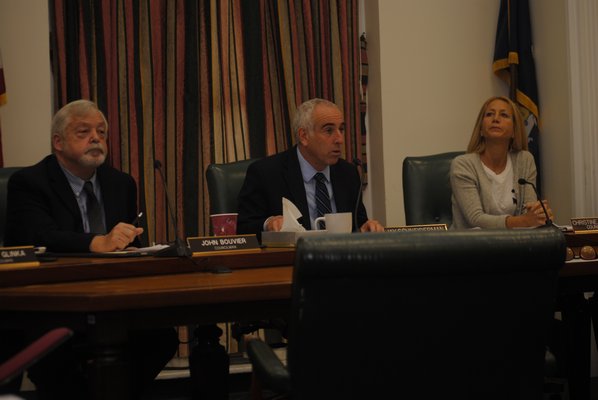
“It’s been exhausting,” added Town Councilman John Bouvier.
If the board agrees to extend it, the moratorium’s expiration date would be pushed back to September 1—though that end date would be moot if the board agrees to eliminate the law, possibly as early as June 13.
Town Planning and Development Administrator Kyle Collins, who sat on the committee charged with reviewing the PDD law, said the biggest issue the public had with the legislation was that it lacked consistency and predictability—both of which, he stressed, are important qualities for all land use decisions.
“There’s not enough predictability in the PDD process,” Mr. Collins said, flatly.
When reached on Friday afternoon, Town Councilman Stan Glinka said he was surprised to learn that the supervisor wants to eliminate the law. “I was a little shocked … that’s why I’m anxious to have the public hearings and I’m anxious to see what they came up with as a committee.”
When asked if he would support repealing the law, Mr. Glinka said he is reserving his opinion for now. “It’s not a matter of what I think, it’s what everyone else thinks,” he said. “That’s the way I’ve always been. Until we have the hearing, I don’t really know. I know there was some grumblings that were positive and were negative.”
Town Councilwoman Christine Scalera said on Friday that she was unaware of the supervisor’s plans to kill the law, explaining that she did not sit on the committee charged with reviewing the legislation.
“I’m looking forward to them putting forward something,” Ms. Scalera said. “I would have hoped we would have gotten more public hearings prior to this.
“I’m looking forward to the public hearing,” she added. “I’m completely open-mined. If the community doesn’t feel this is something we want, I don’t think we should do it.”
Earlier this year, Mr. Schneiderman said the committee currently reviewing the PDD legislation was leaning toward repealing the current version of the law and replacing it with a new one. In addition to the supervisor, Mr. Bouvier, Mr. Collins, Town Attorney Jim Burke, Assistant Town Attorney Carl Benincasa, and the principal planner for the town’s Department of Land Management, Janice Scherer, also serve on the review panel.


 Amanda Bernocco on May 12, 2017