


 1 Photo
Scientists say that a toxic species of algae known as red tide, for the color it stains the water when it blooms, has appeared on the East End in recent weeks throughout the Peconic Bay system as far east as Orient and in eastern Shinnecock Bay. It appears to still be spreading.
The red tide algae cells are toxic and are known to be fatal to both fish and shellfish, killing some species even faster than the devastating algae blooms dubbed the “brown tide,” which wiped out East End shellfish stocks in the 1980s and 1990s. Red tide has been blamed for a massive die-off of soft clams in Flanders Bay in 2005.
“It’s a pretty lethal bug,” said Chris Gobler Ph.D., a marine sciences professor at Stony Brook Southampton. “This thing can kill fish in, like, an hour.”
Natural Resources Department director Larry Penny said no red tide blooms have been seen in East Hampton Town waters and he does not expect to see any, though the presence of the organism in East End waters is disturbing, he said.
“The water coming in from Block Island Sound is probably pretty good for us,” Mr. Penny said. “And we don’t have much farmland or a lot of the things they have on the North Fork or in Southampton that feeds the high nitrates” into the bay system. “But you never know for sure.”
Mr. Penny said that he had some concerns that the municipal sewage treatment plant in Sag Harbor be putting nitrates in Sag Harbor Cove that could feed a bloom in some East Hampton waters. Algae thrive in areas with high nitrate concentrations, which can come from septic system, lawn fertilizers or road runoff. Mr. Penny said that it was probably a good sign that, despite tropical storm Hannah’s heavy rains, which promote runoff and high pollution levels in nearby waters, red tide had not appeared in East Hampton waters.
Since mid-August, when the first red tide blooms appeared in the western Peconics and eastern Shinnecock Bay, Dr. Gobler said blooms have been identified in almost every part of the Peconics from Flanders as far east as Orient as well as in widespread areas of eastern Shinnecock Bay, including Heady Creek and Taylor Creek and in Old Fort Pond. Mr. Gobler said that the death of some shellfish in holding tanks at the SUNY Marine Sciences Center in Southampton recently has been blamed on red tide cells that had been ingested into the internal water system from the bay.
Peconic Baykeeper Kevin McAllister said this week that red tide had been seen on the East End each year since 2004 but has never been as widespread as this year’s blooms appear to be.
“This is the same critter that appeared the last several years but on a much larger scale,” Mr. McAllister said. “It’s not bank to bank, like the brown tide, but it’s large patches, and they’re all over. In prior years, it has been limited mostly to Flanders Bay and eastern Shinnecock.”
He guessed that the widespread blooms could be attributed to the heavy rains in early August, which can flush pollutants and lawn fertilizers into surface waters that feed the algae.
Flanders Bay, which the Peconic River empties into at the western end of the Peconic Estuary, has seen red tide blooms each summer since 2004. In that season, the toxic algae blooms lingered in the bay until mid-October. The summer of 2006 saw densities of red tide blooms similar to this year’s, though not as widespread, and the blooms faded away by early September.
Dr. Gobler said it does not appear that will be the case this year. “It seems to still be gaining momentum,” Dr. Gobler, a leading brown tide researcher, said.
Southampton Town Trustee Ed Warner Jr. said the flourishing blooms are a shock because August was a very cool month and water temperatures have been dropping steadily for some time.
“Usually those algae blooms are when the water is getting warmer but this is kind of like the reverse effect,” he said. “It leaves you scratching your head. No one really seems to have the answer.”
The red tide algae is unique from other algae blooms common on the East End in that the cells are dinoflagellates, meaning they have tails and can swim. They also have a penchant for congregating and clump together.
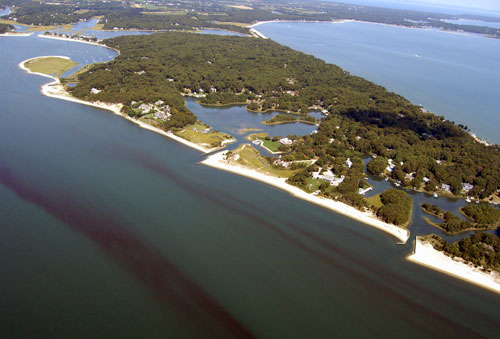
Unlike the brown tide, which stained all the waters of the Peconics and Shinnecock Bay brown during its largest blooms, the red tide algae blooms appear in streaky masses, often compared to tiger stripes, and that move around the bay and up and down in the water column. At night, the blooms slink to the bay bottoms but return to the surface mid-day.
The red tide algae releases a neurotoxin that can kill fish and shellfish startlingly quickly. Dr. Gobler said that in laboratory experiments fish placed in water that had red tide densities similar to what has been seen in local bays died within an hour. Shellfish died overnight.
Dr. Gobler said it is still not clear whether fish can sense the danger posed by the red tide bloom or whether fish that swim into one of the roving toxic blooms would survive even a brief encounter.
“That’s a pretty important question but one that is very hard to answer,” he said. “If a fish swims into one of these patches, is it able to swim out? And will it then live? If not, that could mean big trouble for the fish.”
Mr. Warner said that he had been told by another fisherman that every single fish in one Shinnecock Bay pound trap had died after a red tide passed through it.
Mr. McAllister recalled the 2005 clam die-off in Flanders Bay. The shells of the dead clams, primarily juvenile soft clams, young of the year, washed up in a ribbon more than a foot deep and two feet wide along the entire shore of Flanders Bay.
The densest blooms this year are once again in Flanders Bay, but some very dark streaks of reddish brown water have been seen in the Peconics, particularly in Little Peconic Bay near Robins Island and west of Jessup’s Neck. Other blooms have been reported as far east as the estuaries in Greenport and Orient. Dr. Gobler said it is difficult to predict how far the red tide blooms could spread.
The brown tides that inundated East End bays sporadically between 1985 and 1995, and have been present but less widespread in years since, killed shellfish by forcing out the algae that shellfish feed on—slowly starving them. Fragile bay scallops suffered the worst and their once massive populations have never recovered. The brown tide, which stained almost the entire Peconic Estuary coffee brown in some years, also choked off sunlight to important aquatic plants, the reason many believe for the continuing failure of the scallop population to recover.
Now the struggling scallop and clam stocks that do remain face a new threat. Fishermen noted that this year’s bay scallop set is believed to be a strong one, compared to the anemic numbers that have been the norm for the last 13 years. But as the streaks of red rove around some of the East End’s most productive grounds, particularly the areas near Robins Island and the eastern North Fork, hope for the November fishery is in doubt.
“This definitely puts it all at risk,” Mr. McAllister said.


