


 5 Photos
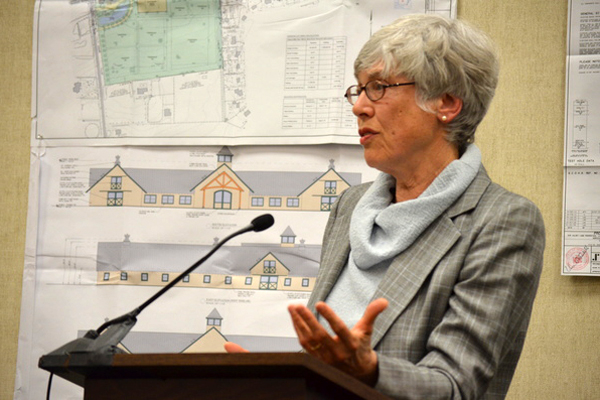
Remsenburg Association President Sally Pope gives her opinion of the Estates at Remsenburg proposal at the Planning Board public hearing last week. ERIN MCKINLEY

KPC Planning Engineer Kyle Collins
a consultant for Mr. Citarelli
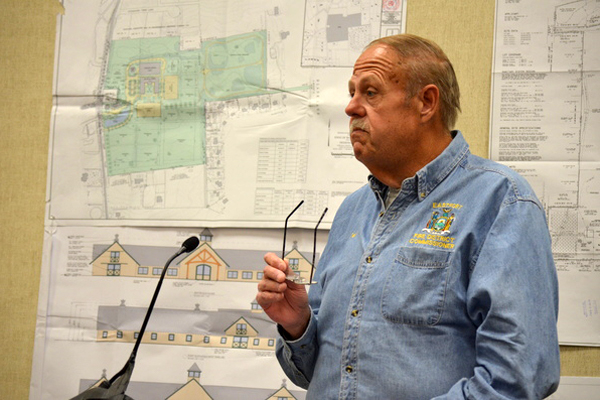
discusses the eight proposals at last week’s Planning Board meeting. ERIN MCKINLEY
Resident Fred Meyer discusses the Remsenburg Estates proposal at last week’s Planning Board meeting. ERIN MCKINLEY
The Southampton Town Planning Board hosted a public hearing last week to discuss eight possible scenarios for a proposed subdivision in Remsenburg that could feature between 19 and 22 houses.
During the hearing on April 26, Kyle Collins of KPC Planning Services in Westhampton Beach, a planning consultant for property owner Lawrence Citarelli, addressed the board and presented the key differences between the different plans for The Estates at Remsenburg. Each proposal, Mr. Collins said, takes into account different suggestions posed by Planning Board members, community members and other consulting boards within the town for the nearly 23-acre property that is located just north and west of the intersection of Nidzyn Avenue and South Country Road. The location of the subdivision entrance also varies in each plan; half of those presented have it along South Country Road, while the other half propose entrances on both South Country Road and Nidzyn Avenue.
“Given the extent of additional subdivision layouts being considered, we thought that it was appropriate that we asked for this public hearing to be reopened,” Mr. Collins said during last week’s hearing. “I do not want to labor on previous plans looked at; rather, I want to focus on the alternatives.”
The original plan remains the preferred choice of both Mr. Citarelli and Mr. Collins. That plan proposes 16 new homes and preserves three historic structures now on the land for a total of 19 houses. It also offers about 6 acres of open space along Nidzyn Avenue. The entrance to the subdivision would be located on South Country Road, and the plan includes two flag lots. Three of the proposed houses would share a common driveway.
Thomas Collins—who is not related to Kyle Collins—the chairman of the Eastport Fire District’s Board of Fire Commissioners, attended the hearing and stated that flag lots can pose problems for firefighters when responding to emergencies. He requested that the Planning Board keep that in mind when evaluating the proposals, several of which called for multiple flag lots with long driveways.
Kyle Collins noted that his client’s preferred plan remains the best option in terms of flag lots.
“Map number one would be the best interest in terms of public safety,” added Thomas Collins. “In the interest of public safety, the flag lots are a joke for us—we oppose every flag lot for this reason.”
The second plan is a standard yield map that calls for the demolition of the three existing structures and the construction of 20 new houses on 1-acre lots. The entrance to the development would still be located on South Country Road, and the developer would agree to create a nearly 1-acre park near the subdivision’s entrance. If he opts not to leave aside land for the park, Mr. Citarelli would have to pay a fee to the town, Mr. Collins said.
Mr. Collins stressed that his client does not support this version of the plan, which features a cul-de-sac like the original proposal, and included it only because a yield map was required by the Planning Board to show how Mr. Citarelli can legally develop his land. That plan does not include any flag lots.
The third plan also is a standard yield map but it includes two units of workforce housing. It also calls for the razing of all three existing structures and the construction of 22 new houses, with two being set aside as affordable housing. Again, the plan sets aside only about 1 acre for a park and it does not include any flag lots. The entrance to the subdivision would still be on South Country Road.
Plan four also includes a workforce housing component and calls for 22 houses on smaller lots; lot sizes range from a third to a full acre. All three historical homes will be renovated and resold, and 6 acres would be designated as open space, though not all in one area. The plan also boasts a half dozen flag lots and a cul-de-sac on the north side of the property.
The biggest difference from the three previous plans is that the subdivision would feature two entrances, one on Nidzyn Avenue and another on South Country Road. Nidzyn Avenue residents have argued that the road is too narrow to accommodate additional traffic generated by the subdivision, while those who live on and near South Country Road have complained that an entrance there will ruin the bucolic nature of the area.
“To me, this is all about our own properties and safety,” said Nidzyn Avenue homeowner Fred Berg while addressing the Planning Board. “The [entrance] road belongs on South Country—it is a wider road and it has shoulders. Nidzyn Avenue is a narrow road. It is very dangerous and you have to be careful. I implore upon you to have the road on South Country.”
Plan five is a cluster development that seeks to build 19 houses on approximately 17 acres. That plan, which proposes one entrance on South Country Road, designates almost 6 acres as open space, part of which would contain a 50-foot-wide walking trail—intersected by the cul-de-sac—that would connect to the east and west portions of the property; the open space would lie mostly in one area along Nidzyn Avenue.
Aside from the walking trail, plan five closely resembles Mr. Citarelli’s preferred plan. It proposes preserving and reselling all three historical houses, and features five flag lots.
The sixth plan is also a cluster development, but with entrances on both Nidzyn Avenue and South Country Road. The plan calls for 19 houses total, including the three historic houses that would be restored and resold, and boasts several areas of open space totaling about 6 acres. The plan proposes six flag lots but no cul-de-sac. Also, a small portion of proposed open space would be near the conservation easement along the west side of the property; the remaining open space would be along the eastern side of the land, nearest Nidzyn Avenue.
Plan seven is an alternative cluster development with entrances on both Nidzyn Avenue and South Country Road. The plan would preserve all three historic houses and calls for the addition of 16 new houses, for a total of 19. It also calls for the preservation of approximately 6 acres of open space that would be scattered throughout the property. The main difference with this plan is that several old trees near the conservation easement on the west side would be left alone.
The eighth and final version resembles the seventh plan, though one of the new house lots would not be along Nidzyn Avenue. It would be moved to preserve more open space and trees along the property’s eastern border. One of the three historical homes, a former blacksmith building, would be razed as part of that plan, though the two remaining structures would still be renovated and resold as residential homes.
Eleven residents addressed the board during last week’s hearing, which lasted about 90 minutes. Most who spoke said they support the project, as long as the entrance to the subdivision is placed along South Country Road.
“Nidzyn is a racetrack,” said hamlet resident Richard Bartel. “It is obvious to me that anything with access to Nidzyn should be disregarded. Either plans one or two should be approved by the board.”
At the close of the hearing, Planning Board Chairman Dennis Finnerty announced that the town will continue to take written comments on the plans for 30 days. At that time, all eight plans will be circulated among various town agencies and all will be discussed again at a future Planning Board meeting. Once a new pre-application report is submitted, Mr. Citarelli can begin work on a formal application.
“I thought the meeting went very, very well,” Mr. Citarelli said when reached earlier this week. Though he attended last week’s hearing, he did not address the Planning Board.
“I felt that it solidified and offered the community the true facts and the micro- and macro-economic potential impacts of our preferred plan versus all of the alternatives,” he added.


