


 4 Photos

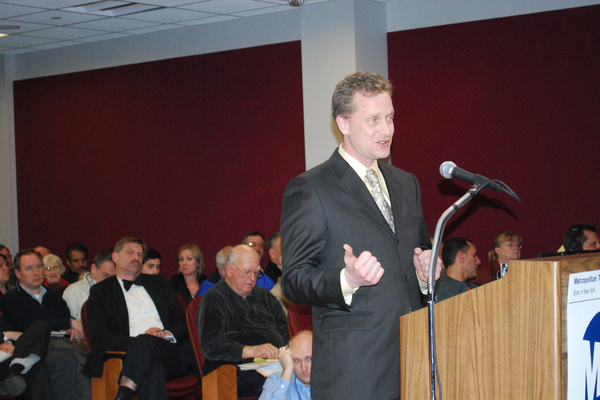
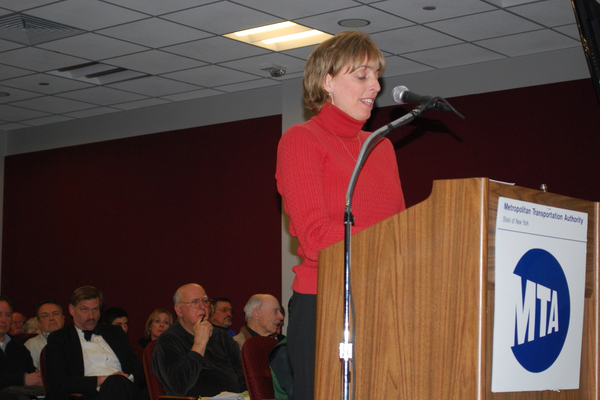
Anger over a plan that will effectively end railroad service to the North Fork starting this fall boiled over at a hearing in Riverhead on Monday night, at which dozens of people lined up to excoriate Metropolitan Transportation Authority officials for three hours.
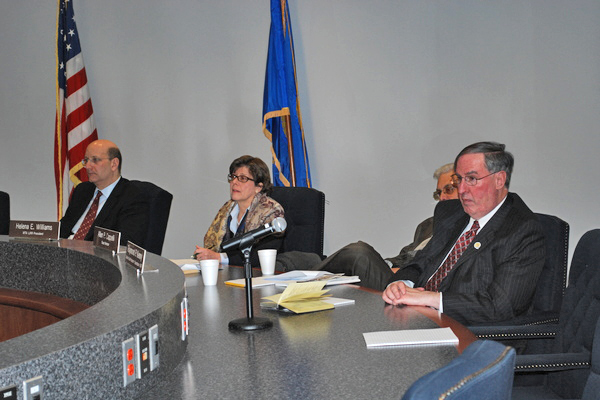
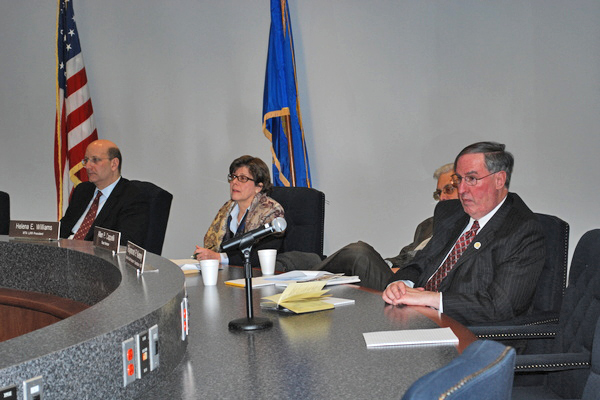
The Suffolk County Legislative Auditorium at the County Center was jammed with more than 100 people on the evening of March 8, with some crowding the back of the room and others turned away at the door. More than 50 East End and Brookhaven Town residents, public officials and business owners stood before a panel of six MTA representatives—including MTA Chairman and CEO Jay Walder, Long Island Rail Road President Helena Williams and MTA Deputy Executive Christopher Boylan—and decried a series of recent decisions by the agency that oversees the LIRR.
Local politicians at all levels of government have been speaking out against the MTA with increasing intensity in recent months, following two recent developments: a new payroll tax passed by Albany last May that was designed to help the MTA close a $400 million budget shortfall, and a January proposal by the MTA to stop virtually all train service on its Greenport line, and cancel one peak train that now runs between Queens and the South Fork
“In my family growing up we had an expression called ‘chutzpah,’” Suffolk County Legislator Jay Schneiderman of Montauk said to MTA officials in attendance Monday night. “You have just raised $100 million in new taxes on our small business, and at the same time you are proposing service cuts. That gives ‘chutzpah’ a whole new meaning.”
The six MTA officials sat at the end of a table located at the front of the auditorium, with security guards separating them from the public. The agency’s representatives did not make themselves available for comment after the three-hour hearing that ended around 9 p.m. MTA representatives did not immediately return calls seeking comment on Tuesday.
Instead, the six MTA officials in attendance Monday looked on, occasionally jotting down notes, as speaker after speaker called for the transportation agency to repeal its new payroll tax and maintain—or even increase—train service on the East End.
The payroll tax, which went into effect in September, now requires that employers operating in the 12 counties near New York City, including Suffolk County, pay 34 cents on every $100 in employee wages, with the revenues supporting the MTA. In February, Governor David Paterson announced that he will seek to decrease the payroll tax to 17 cents per $100 for employers outside New York City, including those in Suffolk County, while raising it to 54 cents per $100 for employers within the five boroughs. That proposal would require the approval of the State Legislature sometime this spring, along with the rest of the 2010-11 state budget.
In a statement made at the hearing Monday night, Suffolk County Legislator Edward Romaine charged that the MTA has disregarded suggestions and plans by Suffolk politicians in recent years to increase ridership in their districts.
“You did everything you could to suppress ridership on the East End,” he said. “And now you come to us and you say despite the fact that Suffolk County pays $525 million in fees and taxes each and every year, you are about to take a saw and cut off the middle branch, the main line, from Ronkonkoma east.
“Stop taxing us for transportation you do not provide,” Mr. Romaine concluded, to cheers and applause. “It has to end. You have failed as a public agency.”
The proposed closing of the Greenport line will save the MTA an estimated $991,000 in 2011, according to the transportation agency. That cut, combined with other reductions of services to the west, are expected to save the agency $6.3 million in 2010 and $11 million in 2011.
The MTA also estimates that it will save $396,000 a year by canceling, also starting this fall, a 4:30 p.m. peak train that runs from Hunters Point Avenue in Queens to Montauk. That train would be made available again on Fridays during the summer months, according to the MTA. It is the only train serving the South Fork that will be eliminated under the proposal.
The Riverhead public hearing almost did not occur. In January, when the MTA first unveiled its plan to eliminate trains throughout the greater New York City area, the nearest public hearing to the East End was slated to be held in Carle Place, Nassau County. But the agency answered calls by elected officials from throughout Suffolk County for a hearing to be held closer to the East End.
State Assemblyman Marc Alessi, who represents the North Fork, also appeared in person at the hearing. Suffolk County Executive Steve Levy sent a representative, while New York State Senator Kenneth P. LaValle and Assemblyman Fred W. Thiele Jr., both of whom represent the South Fork, also sent representatives from their respective offices.
“The MTA has only learned one song—moving people to Manhattan in the morning and back to Long Island at night,” said Rebecca Molinaro, and aide to Mr. Thiele. “Even there, they are often off-key. They have never adapted to our changing demographics and economy.”
In February, Mr. Thiele and Mr. Alessi co-sponsored a bill that would authorize a non-binding public referendum on the idea of creating a new transportation authority in eastern Long Island. Mr. LaValle introduced an identical bill in his chamber that same day.
If the legislation becomes law, a question would appear on the ballot this November, asking East End residents whether or not they support the formation of a Peconic Bay Regional Transportation Authority to replace the MTA in their region.
“The paradigm has shifted,” said Riverhead Town Supervisor Sean Walter, who also attended Monday night’s public hearing. “We are no longer a suburb of New York City.”
Mr. Walter went on to call the proposed Peconic Bay Regional Transportation Authority “the beginning of the end of the MTA.”
Stacey Epifane, a deputy chief of staff for Brookhaven Town who spoke on behalf of Town Supervisor Mark Lesko, suggested that her town might seek to become part of the initiative, which has previously involved only the five East End towns of Southampton, East Hampton, Riverhead, Shelter Island and Southold.
“In light of the recent developments at the MTA, I am intrigued by the idea of Brookhaven joining a Peconic Bay Transportation Authority to best serve the transportation needs of the town,” Ms. Epifane said.
But aside from political leaders, a stream of regular commuters also marched up to the podium throughout the evening to describe how train service cuts would affect their everyday lives.
Jim Ryan, who lives in Center Moriches, told the MTA officials that he has been riding the peak train that runs from Queens to Montauk, “since it was steam-powered.” That train would be cut as per the MTA’s current cost-saving proposal.
Mr. Ryan expressed a sentiment that was echoed throughout the evening: that the MTA should seek to climb out of its financial hole by increasing ridership and expanding service to generate revenue, rather than cutting back.
“I would say let’s keep this train,” Mr. Ryan said.


 Will James on Mar 10, 2010