


 3 Photos
In any other part of Southampton Town, the multimillion-dollar preservation of environmentally sensitive land would have elicited cheers.
But in the commercial business-barren hamlets of Flanders, Riverside and Northampton, where much of the tax burden falls on private homeowners because a large chunk of land is already preserved and removed from the tax rolls, recent news that Suffolk County plans to buy 20 acres in Riverside—land overlooking the Peconic River and once slated for a 98-room hotel and conference center—elicited jeers.
That’s because the pending $3.5 million purchase, which still must be authorized by Suffolk County Executive Steve Levy, will mean that the hotel project—viewed by many locals as their last hope for what has been an elusive economic boost for their communities—will effectively kill their hopes for tax relief.
And the agreement, which many in Flanders, Riverside and Northampton claim was completed behind closed doors and without their input, has refueled bitter claims that the three hamlets will forever remain the most neglected corner of the town.
“The Town of Southampton should have bent over backward to make this happen, and they helped kill it,” said Northampton resident Chris Sheldon, referring to plans, dating back nearly a decade, to build a hotel and conference center on land that sits about 450 feet east of the Riverside traffic circle.
In recent interviews, Dede Gotthelf, the current owner of the property, repeated allegations that Southampton Town officials deliberately stalled her hotel project, dubbed the Rivercatwalk, for more than a decade. She said those allegations, which are laid out in a federal civil rights lawsuit that she filed in 2008, in which she is seeking $25 million in damages, essentially forced her to sell the land to the county.
In her lawsuit, Ms. Gotthelf is claiming that she was a victim of gender discrimination by town officials. She also charged that those officials purposely delayed her project so they could push a town-backed project, the Riverside Hamlet Center, that was later built across the street from her property. That project’s approval, she said, resulted in traffic and sewer limitations for her proposed hotel.
The thrust of the lawsuit, Ms. Gotthelf said, is proving that town officials treated her application differently from other planned development district applications. A planned development district, or PDD, is a tool that can be used by developers to build projects that would not normally be allowed under existing zoning as long as they offer some sort of public benefit.
“In the purest sense, this was a planned development district working hand-in-hand with the community,” she said.
In spite of the repeated roadblocks, officials at several different governmental levels said it was the proposed density of her hotel and conference center that ultimately killed Ms. Gotthelf’s project.
Bill Fonda, a spokesman for the State Department of Environmental Conservation, explained in several e-mails that Ms. Gotthelf never completed the required tidal wetlands applications for her project. A section of her Riverside property is wetlands and therefore subject to close environmental review.
Mr. Fonda also wrote that Ms. Gotthelf “never seemed to take seriously the state regulations” affecting the property.
In addition to several Southampton Town officials, including former Town Supervisor Patrick Heaney, the lawsuit filed by Ms. Gotthelf originally listed George W. Hammarth, the DEC’s deputy regional permit administrator, as a defendant. He was later dropped from the litigation, according to Mr. Fonda, who received notice in January that Ms. Gotthelf’s attorneys voluntarily removed him. Ms. Gotthelf declined to comment on why the DEC was no longer listed as a defendant, noting that the matter was related to active litigation. “I can’t answer that,” she said.
Town documents show that Ms. Gotthelf filed her original application in 2001, asking that the town rezone her land from a mixture of resort and waterfront business district to PDD. The zoning change was needed for her to construct a four-story, 83,441-square-foot hotel with catering and conference facilities, and other recreational amenities. The application also called for four two-story cottages, a 16,000-square-foot building for either a restaurant, office or retail store, and several access points to the Peconic River.
A hotel is not a permitted use under current zoning, according to town documents. But the documents also state that, with a special exemption, a waterfront business complex, motels, marinas and yacht clubs are allowable uses for the property. Ms. Gotthelf, meanwhile, originally contended that she would have been allowed to build a 25-room hotel on the site under current zoning. When pressed, she later said she could not recall what she could legally build on the site.
Ms. Gotthelf’s Rivercatwalk project, she said, was expected to generate $10 million a year for the local community, according to one estimate. She said that figure includes property taxes that would have been generated by her complex, as well as patronage at other nearby businesses. Also, her project would have created 100 temporary construction jobs and 105 permanent positions, she said.
While many community members supported her project, Ms. Gotthelf alleges in her lawsuit that an inordinate number of obstacles were put up to derail her. In November 2001, the State Department of Transportation claimed 4.5 acres of her property for a recharge basin, causing Ms. Gotthelf to redraw her proposal. Over several years, she said the town altered the boundaries of the wetlands, requiring more changes to the application. Also, Ms. Gotthelf charges that the town stripped her land of economic tax incentives, causing the tax rate on her property to climb.
Last month’s announcement that Suffolk County plans to buy and preserve the Riverside property came as a shock to some of the area’s most passionate community representatives, who were still hopeful that Rivercatwalk would one day be a reality. Their collective anger is directed at the town, county, state and federal governments, they said, for failing to act on the behalf of the best interests of the community.
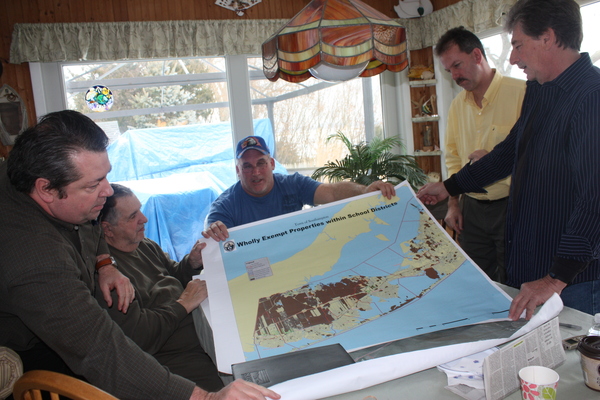
Ms. Gotthelf’s project was desperately needed, they argued, because the three hamlets are special. The amount of land already off the tax rolls in the hamlets of Flanders, Riverside and Northampton stands at about 68 percent, according to Ross Baldwin, the town’s geographic information systems manager. But Mr. Sheldon contends that, if one includes state land that is also tax-exempt, that figure is actually closer to 85 percent.
But Mr. Baldwin countered that the 85 percent figure was not accurate, explaining that state-owned lands are not tax-exempt. He also said that about 15 percent of the land in Flanders, Riverside and Northampton is owned by the state.
Unlike neighboring Riverhead Town, where development along the northern side of the Peconic River has largely been permitted, Mr. Sheldon said that there is next to no development along the Southampton Town side of the river. He said that an estimated 95 percent of the land overlooking the Peconic River in Southampton Town cannot be developed. Mr. Baldwin countered that about 6.8 miles of waterfront property, or 62 percent of the land abutting the Peconic, is wholly tax-exempt.
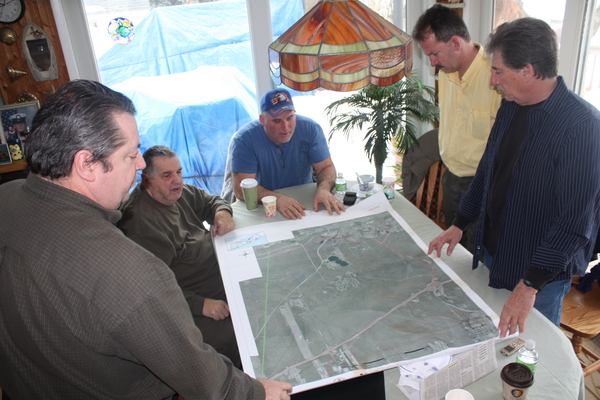
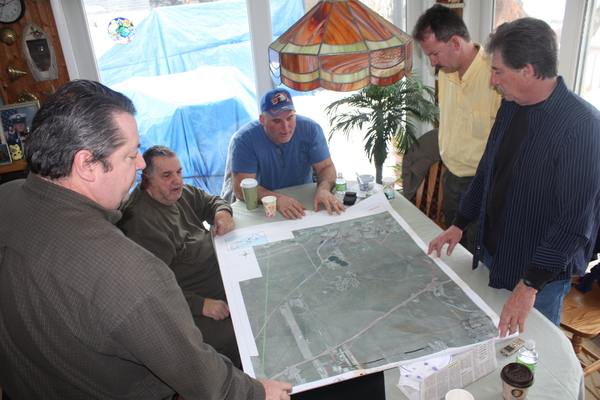
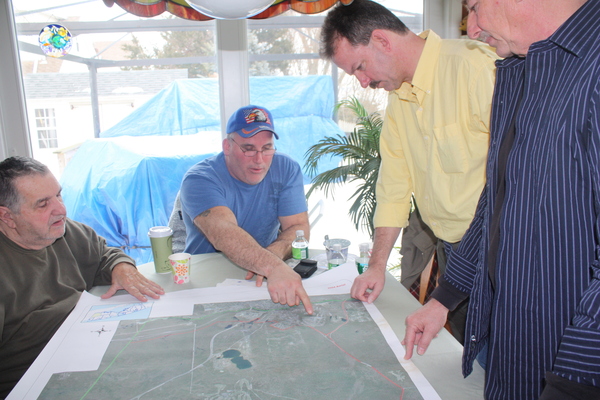
Ms. Gotthelf’s project was designed with significant input from the community, according to Mr. Sheldon and Flanders residents Richard Naso, Michael Brewer, Carl Iacone and Tom Weber, who gathered at Mr. Naso’s house earlier this month for a group interview. They said that Ms. Gotthelf asked them what they wanted to see built on her land—a request that caught them off-guard at the time.
“It was like Christmas all over again,” Mr. Naso recalled.
While sitting around a table in Mr. Naso’s home, which overlooks Reeves Bay, the men spent several hours talking about the issues that, they say, elected officials have failed to address. During the conversation, the men were reminded of another stalled project by a decoration that sits on Mr. Naso’s table: a miniature replica of the Big Duck, Flanders’s most famous landmark, with the numbers 11902 embroidered on it.
Those living in Flanders, Riverside and Northampton share the same zip code (11901) as neighboring Riverhead Town, though they live in Southampton Town. They’ve been lobbying the U.S. Postal Service for their own five-digit zip code for nearly 15 years—to no avail.
“The spirit is gone,” Mr. Naso said in a resigned voice. “The spirit is gone.”
The Rivercatwalk project, Mr. Sheldon pointed out, represented their last great hope. “It was opium for the masses,” he said bitterly, referring to the derailed project.
“And now we all need rehab,” Mr. Weber quipped.
The two town officials still listed as defendants in Ms. Gotthelf’s lawsuit declined to comment on her project, or explain why it never moved forward. The two defendants—Town Planning and Development Administrator Jefferson Murphree and Mr. Heaney—explained that they could not comment because of the federal lawsuit. The Town of Southampton is also listed as a defendant. The other defendants, which included a long list of town elected and planning officials, were dropped from the litigation, according to Ms. Gotthelf.
Ms. Gotthelf declined to discuss the litigation further, noting her attorney, Rick Ostrove, of the Carle Place firm Leeds, Morelli and Brown, was in the process of soliciting depositions for the case. Mr. Ostrove did not return calls seeking comment.
Former Town Supervisor Linda Kabot and current Town Supervisor Anna Throne-Holst were also in the process of being deposed and declined to comment on the lawsuit’s status.
While they could not offer specifics on why her project was never approved, both Ms. Kabot and Mr. Heaney said they were fans of Rivercatwalk. Ms. Kabot pointed out that securing the required permit from the DEC was the largest hurdle that Ms. Gotthelf needed to overcome.
Mr. Fonda pointed out that the project Ms. Gotthelf was pursuing sought a density that was three to four times allowed for the site. He added that instead of working with DEC officials to secure a variance, Ms. Gotthelf and her development company, called Catcove Inc., tried to instead advance her project through the “political, public relations and, finally, the legal route.”
But Ms. Gotthelf said the town delayed sending the appropriate paperwork on her behalf to the DEC. She also said the DEC sent her application back, stating that it could not be processed without the proper town zone change in place.
“That is the most incorrect, blatantly wrong and pretty insulting comment,” Ms. Gotthelf said of Mr. Fonda’s statements.
Brad Bender, the president of the Flanders, Riverside and Northampton Community Association, said he was involved with discussions last year in which Southampton Town tried to buy, and preserve, 12 acres of Ms. Gotthelf’s property. He said the goal of those discussions, which involved Ms. Throne-Holst, was to protect the most environmentally sensitive section of her Riverside property. Money to buy the land would have come from the town’s Community Preservation Fund, Mr. Bender said.
But Ms. Gotthelf was not open to that possibility, he said.
“The chips all didn’t fall into place for her,” Mr. Bender said. “And after eight years, and millions of dollars, she’s looking to recoup her money.”
But Ms. Throne-Holst said the deal fell through because those managing the town’s CPF weren’t interested in preserving only a part of the property. She also said that, at the time, the town did not have the money to acquire the 12 acres. Ms. Throne-Holst also said the town was not aware that the county intended to buy the entire parcel until late fall, and was later advised by her attorneys not to interfere with the deal.
“The horses were out of the barn before we had a chance to get in there,” Southampton Town Councilwoman Bridget Fleming, the town’s liaison to the hamlets of Riverside, Flanders and Northampton, said of the county purchase.
Suffolk County Legislator Jay Schneiderman, who has taken some heat from residents for the pending purchase, said it was Ms. Gotthelf who reached out to the county, asking if officials were interested in buying her land. He said the parcel has been on the county’s acquisition “wish list” since 2005.
In a letter, Mr. Schneiderman said that the land had earned economic credits that would have exempted it from property taxes—if it were ever developed. But Ms. Gotthelf said that those credits would have expired in a few years if a hotel and conference center were built on the site.
As for area residents, they are still coming to terms with the death of Rivercatwalk. But some remain hopeful that Suffolk County officials will consult them before they make any changes to the land, noting that they would like to see public boat ramps and a park built there. Mr. Schneiderman said he is interested in creating a passive park, one that features trails and picnic benches.


 Rohma Abbas on Feb 16, 2011