


 1 Photo
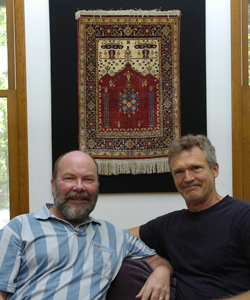
Ken Dorph and Stuart Lowrie in their Sag Harbor home. Behind them is a Turkish Prayer Rug.
For two-thirds of the year, Ken Dorph is in Sag Harbor being a dad and raising his kids.
During the other third, the 56-year-old Mr. Dorph is a worldwide traveler, consulting for the World Bank, International Monetary Fund, private companies and the central banks of nations with emerging economies and financial systems, especially in the Middle East. He is fluent in Arabic and can understand its five major dialects, having spent much of his adult life living abroad.
Home or abroad, Mr. Dorph has also become an advocate for cultural understanding of Middle Eastern countries and their diversity. And he says that the impressions many Americans have of Arabs in the Mideast are flat out wrong and need to be corrected.
“I have never found a more hospitable place on the planet Earth than the Arab world,” he said this week. “Americans are fed all kinds of nonsense about the Middle East.”
In an attempt to combat that nonsense, Mr. Dorph offered a presentation, “Seven Keys to Understanding the Arab Middle East,” at the Rogers Memorial Library in Southampton Village on Monday, and attracted a standing-room-only crowd.
He said Arabs are demonized in America today the way Russians were in the 1950s and Germans were in the 1940s.
“When you don’t study an area, and you just see it on TV news, you come away with the idea that these people are evil,” he said. But in his personal experience, Arabs are vastly different than portrayed. They are extremely kind, non-judgmental, friendly, extroverted and warm, and “you can’t go anywhere without being invited for tea,” he said
And most Muslims are not Arabs, he said. Rather, they might be Indonesian, Pakistani or Chinese.
The treatment of women also varies in Arab nations, he pointed out. “People have this image that all Arab woman wear veils and are slaves,” he said. “It’s much more complicated.”
More than 70 percent of Mr. Dorph’s international trips are to the Middle East—he is contracted to work at least two months a year in Saudi Arabia—but he has been to nearly every continent. He’s also spent much time in the Far East and was in Beijing, China, on September 11, 2001. His friend Rob Deraney was in the North Tower of the World Trade Center and died that day.
Just a month before the 9/11 attacks, Mr. Dorph had given a presentation on Islam to the Unitarian Universalist congregation in Bridgehampton, of which he is a member. “I felt that Islam was getting an unfair picture, and I wanted to give a general sense of the richness of Islam and its people,” he said.
Following the attacks, he was asked by the congregation and many other groups to speak again. His presentation at the library was the first that was open to the public.
He dedicated his presentation to Mr. Deraney and another friend, Tracy Hushin, who died in a car bomb attack in Amman, Jordan.
Mr. Dorph’s personal connections with the Middle East go back to his college days. He grew up in working-class neighborhoods in New York City and spent half his childhood in the Jewish neighborhoods of Brooklyn before his family moved to Irish-dominated Staten Island, he said. He later entered Binghamton University on a pre-med track, but that didn’t last long. “I just realized that I didn’t want to be a doctor,” he said.
The young Mr. Dorph switched to anthropology and studied abroad for a year in Morocco. He fell in love with Morocco and decided to join the Peace Corps so he could return to the Middle East. The Peace Corps sent him to Tunisia, where he taught English and French for three years. Mr. Dorph said they were the best years of his life.
Next, he headed to the University in Michigan for a master’s degree in Middle East studies and spent a year as a Fulbright Scholar at the University of Damascus in Syria.
Not seeing many career opportunities with his first master’s degree, Mr. Dorph enrolled at the Wharton School of the University of Pennsylvania and sought an MBA in international finance with a certificate in Middle East economics. Once he earned his degree, he joined Citibank and worked in Cairo for two years.
Now, Mr. Dorph has his own independent company, Sag Harbor Consulting. Often, other consultants hire him. “A lot of consulting companies will hire contractors,” he said. “It’s actually quite common, especially if they have specialized skill sets”
Mr. Dorph said that when the global financial crisis hit, he thought there wouldn’t be much work out there for him. Instead, it had the opposite effect because of the upheaval of financial systems. But he is still sticking to his self-imposed rule that he’ll spend only one-third of the year outside the country. “That’s kind of my max,” he said.
He has lived in Sag Harbor for 15 years with his spouse, Stuart Lowrie, the director of the Nature Conservancy. They have been together for 28 years and were married in Vancouver, Canada, in 2005. Eight years ago they adopted their children, Leyla and Darius; Leyla is an Arabic name and Darius is a Persian name, Mr. Dorph pointed out.
Mr. Dorph headed to Washington, D.C., on Tuesday to get his security clearances before going on to Iraq, where he will work with the U.S. Department of Defense to consult on Iraq’s public financing of municipal projects, such as petrochemical plants and hospitals, and moving the country toward a more modern financial system.
“I almost never work with the American government, but since [Barack] Obama’s in charge, I feel differently about that,” Mr. Dorph said. He explained that he has not agreed with the Middle East policies of the United States for the past 40 years, labeling them “destructive.”
He was also vehemently against the invasion of Iraq and said it was a terrible mistake. But, “you broke it, you own it,” he said, quoting President Obama. “I want to be part of the solution,” he added.


