



 17 Photos

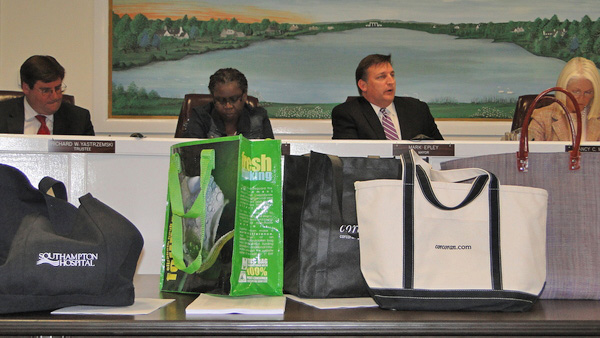












The ubiquitous plastic shopping bag is marked for banishment from Southampton Village checkout counters.
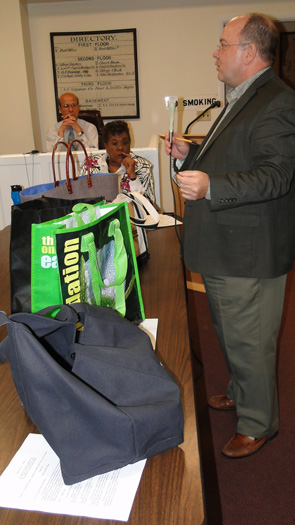
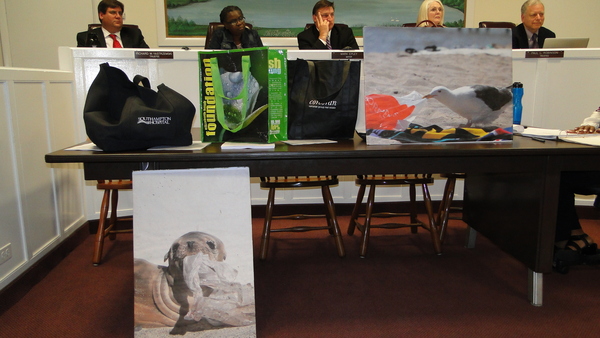
Village Mayor Mark Epley said last Thursday, April 14, that he was ready to pass the “statement” legislation that night banning the bags from village stores, following the longest and liveliest public hearing before the Village Board in more than a year. Proponents and opponents alike turned out—both with props in tow—in attempts to sway the board.
Ultimately, the vote was postponed until Tuesday, April 26, because of a last-minute semantic change—replacing “and” with an “or” in the legislation’s definition of a recyclable paper bag. After the substitution, such a bag should display the words “reusable” or “recyclable” since bags used for storing take-out food, for example, could not be expected to be reused.
Mr. Epley and village trustees Richard Yastrzemski, Nancy McGann and Bonnie Cannon voiced their support for the legislation, while Trustee Paul Robinson was opposed, setting the stage for potentially the first non-unanimous vote by the single-party board in at least a year.
The legislation came about after a strong push by Southampton Advocates for the Environment, also known as SAVE, some of whose members traveled to Westport, Connecticut, another affluent waterfront community where such a ban is in place. Members previously reported positive findings.
If adopted, the ban would apply solely to retail checkout bags. It would not include plastic produce bags or plastic bags larger than 28 inches by 36 inches. The legislation is also limited to retail stores, sidewalk sales, farmers markets, flea markets and restaurants. It does not include yard sales, tag sales or other sales at homes or by nonprofit organizations. Retailers would have to provide only reusable bags made of cloth or another fabric, durable plastic that is at least 2.25 millimeters thick, or recyclable paper bags at checkout. The ban would take effect six months after it is adopted into village code.
At last Thursday’s public hearing, SAVE and other environmental advocates lamented the non-biodegradability of the plastic bags and the hazards they present to the local waters and wildlife, as well as the aesthetic blemishes they have become to the landscape, fluttering from treetops and endangering marine life, for example.
On the flip side, representatives from the plastics and food industry and businesspeople claimed that banning plastic bags is not the solution, and urged further education to promote recycling efforts, instead. They also touted the use of recycling bins for plastic bags offered at supermarkets.
“I don’t think you’ve ever seen a bag like this hanging from a tree or stuck in the bottom of your shrubs,” said Roger Blaugh, a SAVE member, as he tossed a reusable canvas tote to the floor, where it landed with a light thud.
Mr. Blaugh, who said he finds plastic bags in the hedge of his front yard on Post Crossing every week, arranged an assortment of canvas bags on a table before the board as he expounded on how mandatory and voluntary programs have failed. He equated such a ban to the adoption of seat belt laws to explain why legislation is needed. He urged the board to take its role as environmental stewards seriously and adopt the ban.
“This isn’t about plastic. It’s not about paper,” he said. “It’s about finding satchels made from sustainable materials that can be used time and again.”
“Our ultimate goal is not to support those industries,” said village resident Walter Skretch. “Our ultimate goal is to minimize and eventually eliminate a product that really does our town and, ultimately, our earth very little good.”
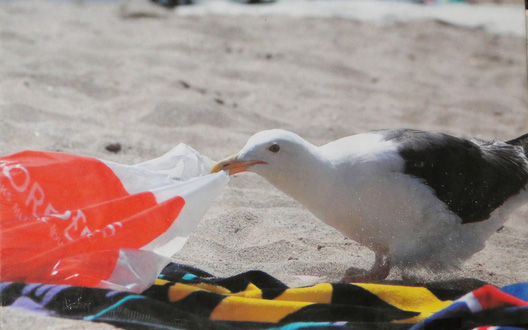
Tara Bono, program coordinator for Citizens Campaign for the Environment, said the village would be the first municipality in the state to adopt such a ban. Ms. Bono propped up large photos of a seagull tugging at a plastic bag and a seal with shredded plastic dangling from its mouth. “Experts now say there is more plastic in our oceans than plankton,” she said, adding that tourism and fishing communities on the East End could be devastated by continued, unchecked use of plastics.
Meanwhile, Jose Collazo, the store manager of Waldbaum’s on Jagger Lane, the village’s only supermarket, said banning the bags is not the answer, but that education is. He said he empties recycling bins for plastic bags at his store twice a day, and customers can earn credits for reusing bags. The mayor and Ms. McGann later countered that they had never heard of such bins at his store.
Patricia Brodhagen, vice president of public affairs for the Food Industry Alliance of New York State, said her industry agrees with the aim of reducing the use of plastic bags but objects to a ban, saying recycling and education should be more aggressively promoted.
“By banning the plastic bag, it will drive the business to paper,” Ms. Brodhagen cautioned, citing paper’s heavier weight and taking more resources to transport. She also claimed that such a ban would place village businesses at a competitive disadvantage because of the higher costs associated with paper.
Another opponent, Bonny Betancourt of the American Chemistry Council, who said she came on behalf of her company’s plastic bag industry group, which represents plastic bag manufacturers, said her industry is disturbed by the amount of plastic in the environment, but is generally against bans. Rather, she promoted recycling. Pulling examples of plastic film out of a plastic bag she brought to the podium, Ms. Betancourt said they could all be recycled.
Mr. Robinson agreed with opponents that educational measures about recycling had not been given enough time yet, which Ms. McGann openly disagreed with. She said she would like to see paper bags eventually eliminated as well. Mr. Yastrzemski spoke of the area’s unique ecosystem, while Ms. Cannon cited the negative impact of plastics on local waters and wildlife.
“We in the Village of Southampton are going to make a difference,” Mr. Epley said.
Some proponents suggested that the ban might extend beyond the village. P. Claire Pertalion, co-chairperson of the Eastern Long Island chapter of the Surfrider Foundation, which seeks to protect oceans and beaches, said her national organization and its local branch support the legislation and believes a ban is likely to spread to East Hampton, too. “Every time I go to the beach, my little thing is I pick up five pieces of trash,” she said, noting that she plucks bags out of the water when surfing.
Tip Brolin, chair of Sustainable Southampton, SAVE’s counterpart at the town level, said his group plans to present similar legislation to the Town Board.
At the recommendation of Building Inspector Jonathan Foster, the Village Board unanimously enacted new legislation on Tuesday prohibiting pile driving—the process of forcing large poles into the ground to support docks and other structures—on weekends and holidays between Memorial Day and Labor Day.


 Colleen Reynolds on Apr 20, 2011