



 16 Photos
Southampton Village Mayor Jesse Warren addresses the crowd. DANA SHAW

Paul Travis

Mark Parash

Kimberly Allan

Panalists Mark Parash, Kimberly Allan and Beau Hulse.

Beau Hulse

Beau Hulse
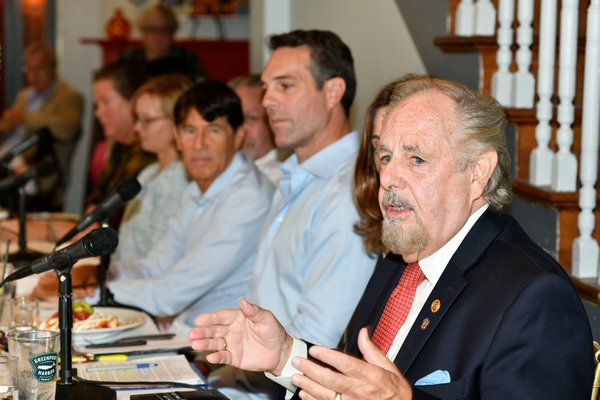
Beau Hulse

Mark Waxman

Executive Editor Joseph Shaw poses a question to the panalists at the first-ever Express News Group "Press Session."

Dennis Schmidt

Marc Rowan

Erin Hattrick Meaney and Shannon Willey

Erin Hattrick Meaney

Katherine Dietze poses a question to the panel.

Lane Brettschneider
Southampton Village residents, officials, property and business owners, non-profit directors, attorneys and various other parties gathered at Union Cantina on Friday afternoon to discuss a topic that affects everyone who is part of the village in some form or fashion: the business district — in what was the first of many to come “Press Sessions,” hosted by The Express News Group.
One property owner, Mark Waxman, found out about the event the day before, while he was at his home in Florida, and immediately flew in so that he could attend the sold out discussion.
Mr. Waxman owns numerous commercial properties in the village, including the space that Brooks Brothers occupies on Main Street, and brought a perspective that only a few in the room could provide.
Mr. Waxman, along with a panel made up of Village Mayor Jesse Warren; village trustees Kimberly Allan and Mark Parash; Village Planning Commission Chairman Paul Travis; Coldwell Banker Beau Hulse Realty Group owner Beau Hulse; Erin Hattrick Meaney, the owner of Topiaire Flower Shop; Shannon Willey, the owner of Sea Green Designs; and Dennis Schmidt, the owner of Schmidt’s Market, all offered their opinions and expertise on many of the topics discussed, including the need for sewers, how parking could be improved, why so many stores are vacant, how to get landlords to fill their spaces and what the potential impact of more restaurants would be on current eateries.
At the forefront of the discussion, was the need for sewers.
Mr. Waxman told everyone that if he could encourage one thing, it would be to have sewers installed at whatever cost — an expense, he suggested, that may be borne by local property and business owners.
“We’re willing to put our money and our checkbook where our mouth is,” he said. “We will pay, we will participate. Whatever it takes, let’s do it.”
When Mr. Warren ran for mayor earlier this year, a big part of his campaign was driven by the perception of a declining business district, and the need for sewers, whether for business needs or to help improve the environment.
The business district is located upstream from Lake Agawam, which was deemed one of the most polluted bodies of water in New York. Dr. Christopher Gobler of Stony Brook University did a study on the lake that focused on sources of nitrogen, and faulty septic systems from businesses and homes accounted for 70 percent of the nitrogen entering the lake.
“We are pumping our waste water, as we are eating our lunch here, right into the ground, and that can no longer happen,” Mr. Warren said at the event. “It’s a major problem in Suffolk County. Our county executive, Steve Bellone, said that water quality is his mission, and between the introduction of a sewer system and innovative alternative septic systems, this is critical for our environment and our business district.”
He also said he met with Robert Chaloner, the chief administrative officer of Stony Brook Southampton Hospital, as well as other representatives from the hospital, to discuss possibly tapping into its wastewater treatment system.
Currently, Mr. Warren said, there are approximately 50,000 to 60,000 gallons of wastewater treatment available per day, so it will not be able to sewer the entire village — maybe not even the entire downtown — but it could be a move in the right direction and might be able to serve as a medium-term solution until more infrastructure can be put in place.
Installing a sewer system in the village is something that has been looked at in the past under different administrations. In 2015, former mayor Mark Epley and the Village Board at the time looked into installing sewers, but the projected price tag of more than $30 million was enough to stop its consideration as a feasible option.
In fact, Mr. Warren said he and local business leaders have come up with an idea to create a sewer funding district to help pay for the project.
“Many people in the community do have a fear that this is a $30 million project. How are we going to pay for that?” Mr. Warren said. “What we came up with is a vehicle for that fund.”
Southampton Village has a AAA bond rating, he said, and can borrow money at approximately 2-percent interest. At that rate, a $30 million bond would carry $600,000 in interest per year, or $50,000 per month.
With business owners like Mr. Waxman expressing interest in funding the sewers, Mr. Warren said not a single dollar of interest would be paid by the taxpayers.
“We can have a sewer system funded by very cheap debt at the moment, and paid for by business leaders who simply want to opt into this program,” Mr. Warren said.
The addition of sewers would help businesses, according to some people in the room — including Mr. Waxman.
He explained that as soon as Patchogue and Sag Harbor installed sewers, their business districts began to thrive.
“If the Village of Southampton does not get sewers, we are going to have a serious, serious problem,” he added. “All these stores would be rented if you had sewers here.”
At the beginning of the discussion, Mr. Warren said the Suffolk County Department of Health would lift a moratorium on restaurant openings in the village if a water treatment system were to be installed.
But some people questioned whether more restaurants were, in fact, needed, or would be supported, especially when some of the eateries in the village have been vacant for long periods of time.
Ms. Hattrick Meaney expressed concerns about the repetitive talk about opening more restaurants, because many of the restaurants in the village are empty on any given Tuesday night in October.
“We have a finite amount of space, and certainly, at the moment, a finite amount of restaurants,” Ms. Hattrick Meaney said. “Do we want to get more in, or do we want to fine tune what we have? To me, that’s what I’d like to focus on: Fine tuning what we have, and make it work.”
Little Red on Jobs Lane remained empty through most of the summer until August 15, when the Tackle Box opened up in the spot, she noted. The length of time to get a tenant in the space was concerning to Ms. Hattrick Meaney.
“I’m floored that a restaurant only opened on August 15 in the village when it was empty for six months or more,” she said.
A survey conducted by The Press prior to Friday’s event indicated that 29-percent of people surveyed like to dine in the village, and Mr. Travis said that tells him a lot about how the modern consumer is acting.
Along with serving on the Village Board, Mr. Parash is co-owner of Sip ’n Soda on Hampton Road and said people are looking for “experiences,” whether in entertainment or dining.
When visitors come to Southampton Village, they want to eat, drink, have a coffee and walk around, Mr. Parash said, and if they have a couple of spirits in them, they may stay longer.
Although many restaurants will help attract and keep visitors in the village, Mr. Parash is also aware of the consequences.
“My slice might get smaller when the pie gets bigger,” he said. “As a building owner … that could hurt my bottom line, possibly, but I think it’s worth the investment to the village.”
Marc Rowan, an audience member who owns a number of restaurants and properties on the East End, said to be a successful restaurant in a seasonal location, breakfast, lunch and dinner needs to be offered.
The Little Reds and Red Bars will have a difficult time sustaining themselves, he said, when they only offer one meal a day.
“I hope in the pursuit of septic, that this does not become all or none,” Mr. Rowan said. “Thirty million dollars, even at a low interest, is a lot of money. It is unclear to me that every space, every commercial space in the village, needs to be rented out to restaurants. Restaurants generate a lot of septic waste. There’s no way around that.”
Mr. Rowan also said he would be willing to help pay, like Mr. Waxman, for the sewers.
He said experiences are what is replacing retail — mostly food and drink, and not necessarily restaurants.
“No matter what we do, we will have empty storefronts if we only offer one use,” he added.
Since being elected, Mr. Warren has set his sites on finding out what can be done to fill vacant storefronts in the business district, or make them appear as something other than dark, empty spaces.
He has reached out to numerous landlords to find out what type of problems they are running into when trying to fill the vacancies, and while some want to fill the stores, he said others do not because it is an inconvenience.
“Ultimately, this is a community,” he said. “We all have things together, and it is very important for our business district to be vibrant … and it’s our hope and our desire to get more landlords to be invested in our community and be a part of it and to bring everyone together and to provide homes for our year ’round entrepreneurs and our local merchants, instead of intentionally pushing it out.”
The discussion on Friday pointed to a few reasons why so many storefronts are vacant, including issues like the rise of internet retail and the high cost of rent.
With increased internet shopping, more people are going online to purchase items they see in stores because they can find them cheaper on sites like Amazon.com
“The internet has changed business throughout,” Mr. Waxman said. “We’re all going through dramatic changes in our industry.”
As a property owner, Mr. Waxman said the internet is making it possible for businesses to operate a store in less space. He gave the example of his tenant, Brooks Brothers, which moved out of the space in December because they did not need as much room. But after negotiating with the tenant, Mr. Waxman said he made a deal in which the space would be subdivided into smaller spaces and the retailer moved back in.
Other landlords, though, are not as flexible.
Ms. Hattrick Meaney said when she first opened her flower shop, a local family owned the space and would respond to calls when the plumbing went out, and if they could not fix it, they would call someone else. The property owners even paid for garbage pickup, which was nice for Ms. Hattrick Meaney because flower shops generate a lot of trash.
Every now and then, she said, the landlord would yell at her about the garbage, and eventually it became her responsibility to pay for the garbage. That led to what she referred to as the “triple net lease,” meaning she was responsible for paying the rent, insurance and property taxes — not the landlord.
“I would say that was the biggest change for small business owners,” Ms. Hattrick Meaney said. “With the natural progression of your lease that grows each year, now we have to pay our portion, our landlord’s portion of their insurance, as well as their property taxes. But I believe those are killers for a small business owner.”
Ms. Willey said the addition of insurance and taxes adds approximately $7,000 to her rent per month.
She suggested that the village offer some sort of year-round incentive to businesses since they can not dictate what a landlord charges for rent. The idea is that a portion of the taxes paid by the tenant goes back to the year-round businesses. It would also serve as an incentive to the landlord who may be paying taxes directly.
“I think that if we get an incentive to want to be part of the community, year ’round, I think we can draw business here,” Ms. Willey said. “I think it’s an incentive to landlords to actually seek out year-round tenants. I think it would be something that would be fairly simple to get set up.”
Ultimately, Ms. Hattrick Meaney said the responsibility falls on some landlords who feel they do not have to take a hit, and that it should fall on the tenant.
If landlords are seeing their spaces left vacant, they should question whether the rent is too high, or why a sweater costs more in the store than online.
“We drove them to the internet,” she said. “They had to go to the internet, because the prices had to try to pay the rent.
“I want some people to be responsible for these vacancies because we can’t say it’s all of us,” she added.
Mr. Waxman suggested Mr. Warren reach out to the various landlords if a space is empty and they do not want to work with the village.
He said landlords always want to make sure the tenant is going to be good for the community, and is going to be successful. If they do not think the tenant is going to have success, they will not rent the space.
But in terms of the insurance, taxes and rent being charged to a tenant, he said it all depends on the market.
“There’s no free lunch in the business world,” he said. “Someone has to pay the bills.”
Getting people into the stores and restaurants and finding out why stores are vacant are important aspects to the business district, but just as important is where the visitors are going to park, the panelists stressed.
But parking is a major issue in the village, as many people say there is not enough available spaces, and the parking that is in place, is hard to find.
Mr. Travis said if you ask someone from another village to visit Southampton Village, they are going to find that the parking lots are full of potholes, the technology is from 1965, and the spots are the wrong size.
In total, there are 1,200 parking spaces in the village, whether along the main roads or in parking lots behind buildings, according to Mr. Travis, and in the peak portion of the summer, the spaces are only 80 percent occupied.
“We don’t have a parking issue, we have a parking management issue,” he said. “I would give a bet to anyone in the room, to ask their friend who’s never been here before, coming to the village, and see if they can figure out where the parking lots are.”
Mr. Hulse said parking along the street is even more of a problem in the summer. To help open up some spaces, he pledged to not park along the street, and to have his staff do the same.
He also suggested the village move into the digital age and implement metered parking, which could be connected to a cell phone application called ParkMobile.
Using the application, a person could reserve a spot for two hours, and if they are at dinner and unable to get back to their car in time, they could extend the time for a small fee from their phone.
“Now they’re paying,” he said.
Being able to extend time instead of having tires marked by traffic police to know how long a person was parked in a particular spot, he said, may reduce the feeling of anxiety.
Mr. Schmidt said the village paid for a study about 10 years ago, and from that, there was a suggestion that parking needed to be metered and a parking garage needed to be installed. Nothing ever came of the study.
Even though Mr. Schmidt’s business is technically outside of the main business corridor, he said he feels the impacts of parking issues at his store.
“It actually hurts my business outside of the village, in that people in the village who got a parking spot don’t want to leave and come for lunch or anything else,” he said. “They won’t leave their parking spot.”
If a parking garage were to be installed, Lynn Arthur from the Southampton Town Sustainability Committee suggested that solar panels be installed, which in turn, could lower energy costs. She also suggested charging stations be installed for electric vehicles.
Ms. Allan said EV stations were being looked into by the Planning Commission and Village Board.
Along with parking, sewers and vacant buildings, some people in attendance on Friday asked about affordable housing, nightlife and the future of the village.
Mr. Warren said he met with Ashley John Heather of the Spur and Bruce Bockmann, who suggested turning Nugent Street into an area for nightlife and lively fun.
“Young people, millennials and other generations — doesn’t matter the age — don’t want to hang out in Southampton Village after Labor Day,” Mr. Warren said. “In fact, most don’t want to hang out in Southampton Village before Labor Day. That’s a real situation, and I’d love to explore that further. We need fun.”
Mr. Warren also said his vision for the village is to become a technology hub, similar to Silicon Valley.
Many people, he explained, are leaving Silicon Valley because it is too expensive, and they are leaving New York City.
“We can turn Southampton Village,” he said, “and we really want to channel and focus our efforts, into some type of hub, a technology hub, where everybody from my generation and younger are working remotely and use everything that Southampton Village has to offer, from our great downtown, to our amazing beaches to a vibrant village and vibrant community that can start with something like this.”


 Greg Wehner on Sep 17, 2019