



 2 Photos
The revised Sandy Hollow Cove proposal was presented to the Town Board on Tuesday. M. Wright
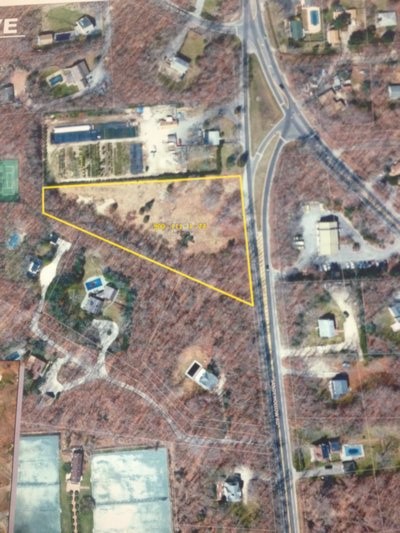
The revised Sandy Hollow Cove proposal was presented to the Town Board on Tuesday. M. Wright
Residents of Tuckahoe on Tuesday applauded Southampton Town’s desire to create more housing that is affordable to middle-income residents and workers, but many redoubled their objections to a specific proposal, targeting a parcel of land in their neighborhood, to do it.
A parade of residents blasted revised designs of a proposed apartment complex on Sandy Hollow Road, saying that the plans still called for far too many residents to inhabit a 2.6-acre lot on an already busy road, despite the admittedly desperate need for more affordable housing in the town.
“I thought this was insane at the first proposal—now I think it’s just crazy,” West Neck Road resident Brian Cooke told the Town Board on Tuesday night. “They’ve got some great ideas, some really nice pictures, but it’s just too much on too small a lot.”
“Nobody is against affordable housing. They just think this is the wrong spot,” added Phillip Woodie, who lives near the parcel proposed for the apartments. “Sometimes you have to say, great idea but bad location. There’s a better way to do it.”
The proposal calls for 28 studio and one-bedroom apartments in three buildings on the 2.6-acre lot, which fronts on Sandy Hollow Road near the intersection with North Sea Road. If approved, the developers, Georgica Green Ventures, would partner with the Southampton Town Housing Authority to purchase the lot and construct the apartments, which would be operated by Georgica Green. Rents would be in the range of $950 per month.
Attorney David Gilmartin Jr. told board members and the large audience on Tuesday afternoon that the apartments would provide the sort of modestly priced rental housing that is in significant need in the town for young residents and middle-income professionals like those employed at Southampton Hospital and Town Hall. He pointed to studies that have forecast a decline in the professional workforce on the East End because of a lack of housing options.
“This is for people of moderate income means—you can call it affordable, you can call it middle income, but what it is not is subsidized housing,” Mr. Gilmartin said. “Your predecessors have failed to provide the affordable housing that is needed here.”
Mr. Gilmartin pointed to the town’s 1999 Comprehensive Plan Update, which called for the town to create more affordable housing options, to disperse those options evenly throughout the town, and to leverage partnerships with private entities to do it—all of which the Sandy Hollow Cove project, as it is known, does, he said.
Georgica Green and the Housing Authority have applied to the Town Board for a planned development district, or PDD, a tool the town has used often in the last decade to change the zoning on parcels of land deemed suitable for developments that offer a substantial and identifiable “community benefit.” The zoning in the areas surrounding the property calls for a minimum lot size of 2 acres per single-family house. That also was the original zoning on the targeted parcel, though the board, in 2009, approved a PDD allowing condos on the site.
A new PDD would need to be granted for the proposed project, and approval requires a supermajority of the board, four members, to vote in favor.
At least two board members, Brad Bender and Bridget Fleming, seemed firmly in support of the proposal.
“We do have an obligation to look to the Comprehensive Plan. It says create affordable housing ... but since 1999, there has been almost zero, very few units at all,” Ms. Fleming said. “Our young people are leaving in droves.”
Mr. Bender likewise spoke in favor, saying, “This would be a big benefit to our community.”
Supervisor Anna Throne-Holst was absent from Tuesday’s meeting but has expressed support for the siting of a multifamily development on the Sandy Hollow property in the past. That could mean the success of the PDD application will turn on the votes of Councilwoman Christine Scalera or newly elected Councilman Stan Glinka, neither of whom offered impressions of their position in the initial hearing on the latest proposal.
In 2009, the Town Board—which, at the time, included just one of its current members—approved a PDD for the same property allowing 16 two-bedroom condos at the site, to be sold rather than rented, and that proposal did not draw widespread objection from the surrounding neighborhoods. The project died amid the credit crisis, and the developers now say it is not viable and doesn’t address the real needs in the town’s housing shortage.
Last year, Georgica Green and the Housing Authority submitted a new design, asking for 34 smaller rental apartments—double the number of units but with the same number of bedrooms and, thus, they argued, a similar expected occupancy level. That plan was withdrawn in the face of withering opposition from neighbors and reintroduced in slightly pared-down form this spring. They have said that the proposal as designed now is the bare minimum in scale that would make the development financially worth Georgica Green’s investment and effort and make a dent in housing needs.
The parcel of land would be purchased by the Housing Authority, for an expected cost of $1.2 million. Georgica Green, which owns and operates several apartment complexes on Long Island, would offset the estimated $9 million cost of the development with approximately $7 million in federal and state tax credits and benefits.
But the project hinges on the town granting permission for the large increase in development density on the 2.6 acres. Opponents have argued that such steep increases in allowable density should be directed to areas in the immediate vicinity or easy walking distance of hamlet centers, as a recent “Sustainability Element” amendment to the Comprehensive Plan recommended.
The Housing Authority and Town Board have said their attempts at identifying any suitable sites for housing, to say nothing of ideal ones, have been repeatedly stymied by the high cost of land in the region, and by objections from those in the adjacent neighborhoods—hurdles that must be overcome if the region is to address its needs. The Sandy Hollow property presents a rare opportunity, they have said.
“We’re looking to establish a template for housing here on the South Fork, and every place we’ve looked there have been issues,” Housing Authority Managing Director Curtis Highsmith, a Southampton native, said. “There is always going to need to be a compromise between the town and the community so there can be a housing initiative, so that my kids can live here.”


 Michael Wright on May 14, 2014