


 1 Photo
NULL
SHINNECOCK HILLS—When word spread that Stony Brook Southampton would shut down most of its academic programs at the end of the summer session, a casualty of dwindling state funds, the people of Southampton raised their pitchforks—and Peter Maniscalco pitched a tent.
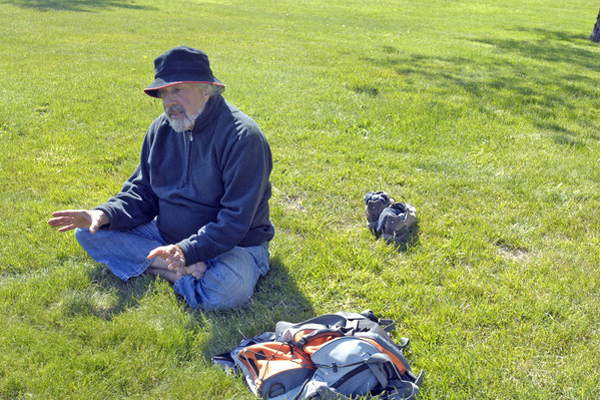
The 68-year-old environmental activist from Manorville camped out for four days last week under a gnarled tree beside the campus volleyball court. There, he led a series of nightly fireside ceremonies to call forth the ancestral spirits of the land and, he hoped, guide the fate of the beleaguered environmental school.
“Some years I ago, I understood that all environmental issues are symptomatic of a deeper issue,” he said. “Basically, the college issue is a symptom of a far deeper issue.”
Mr. Maniscalco, who has studied Shamanic ceremony for 28 years and has been active in Long Island environmental issues for even longer, said that the students who will be booted from the dorms on August 31 are the latest victims in a long history of mistreatment at the Shinnecock Hills campus. As Mr. Maniscalco tells it, it began when the Shinnecock Indian Nation was forced off the rolling meadows centuries ago, and continued when Long Island University shuttered Southampton College in 2006.
“Most of us have patterns in our lives that keep repeating until we reconcile them,” he said, sitting cross-legged on a campus hilltop last Thursday.
Reconciling the history of the site was one of the stated goals of his vigil, which culminated in a sunrise meditation on Friday. On that overcast morning, Mr. Maniscalco—aided by a handful of students, staff, teachers and administrators—sprinkled a pouch of tobacco, which had been blessed in a Shinnecock ceremony the week before, around the perimeter of the southern portion of the campus.
“What Peter was doing was trying to find a very peaceful resolution for this land for whatever happens in the future,” said Kathleen Furey, a student who lives in Hampton Bays and carried a stick of burning sage during the ceremony.
Dr. Mary Pearl, the dean of Stony Brook Southampton, was one of about 10 people present, Mr. Maniscalco said.
Mr. Maniscalco is no stranger to the campus. He taught a class on spirituality and the environment there earlier in the decade, when it was run as Southampton College by Long Island University. But when he pitched a similar course to Stony Brook University after it took over the campus in 2006, he said he couldn’t even get a meeting with administrators—although he was invited to give a workshop last semester.
Elise Tyrie, a student from Manorville who attended one of Mr. Maniscalco’s ceremonies, said that the Stony Brook Southampton curriculum sometimes shunned the spiritual or visceral elements of sustainability in favor of the purely scientific. “The way the campus was being run, as great as it was, they focused mostly on the technological aspects of environmental problems and sustainability,” she said.
That was one of the things that Mr. Maniscalco said he hoped to change with his ceremonies last week. On top of keeping the sustainability programs open, he said he hoped to move the school in a more spiritual direction, with more of a focus on an individual relationship with nature.
“I’m not here to save this college—I’m here to renew this college,” he said.
At the nightly ceremonies, Mr. Maniscalco would play a drum, and the students and staff who gathered around him would meditate. Afterward, they would discuss how they felt about their fledgling campus closing its sustainability programs and mothballing its dorms.
Last Tuesday, the day after the vigil began, two campus police officers approached Mr. Maniscalco at his camp and questioned him, he said. But when the officers called a campus dean, he told them that the administration was aware of Mr. Maniscalco and to let him be.
“Now, in this crisis, things are happening that didn’t happen before,” he said. “I’m well received now.”
Mr. Maniscalco, who now works as a renewable energy consultant, has a storied history of attacking environmental issues from a spiritual angle. In 1989, he lived in his car outside the Shoreham Nuclear Power Plant for 55 days, meditating and singing. In 2007, he returned to the same site and lived for a month in a tent on the shore of the Long Island Sound, where he sought to garner positive energy to fight a natural gas barge proposed by Broadwater Energy.
Considering the fates of those two projects—neither came to fruition—he boasts a pretty impressive track record.
But the fate of the Stony Brook Southampton campus remains up in the air. Since the cuts were announced in early April, elected officials have taken Stony Brook University to task in the media, and coaxed them to the bargaining table. Students took to the streets in demonstrations, and continue to threaten legal action. The university has stated its intention to hold on to the 81-acre campus, but remains silent on what it will put there to replace the sustainability school.
In any case, the fate of the site is now in the able hands of the nature spirits, according to Mr. Maniscalco. Immediately before the sunrise walk began on that dewy morning last week, Mr. Maniscalco said he heard the song of a great horned owl, a classic symbol of wisdom and magic in western culture—and a sign that his work was coming to an end.
“That owl was my ally,” he said. “It meant a great deal to me personally. It was an affirmation of what I was doing there.”


 Will James on May 19, 2010