


 4 Photos
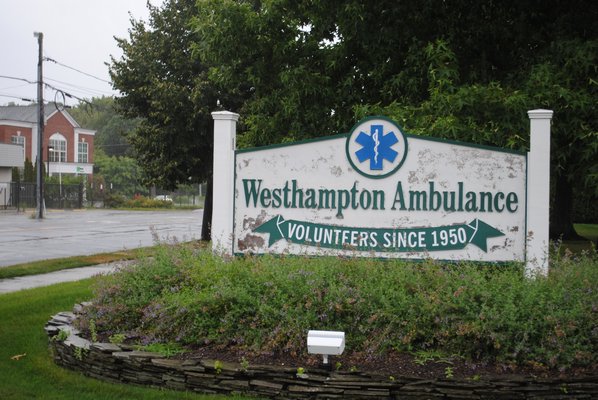
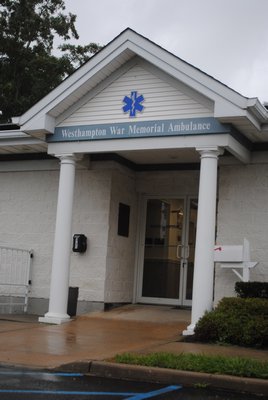
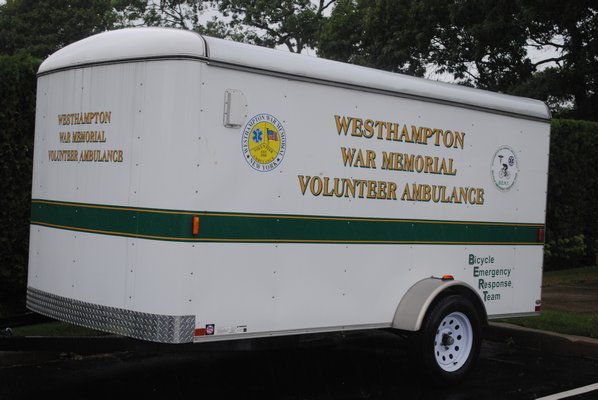
The Westhampton War Memorial Ambulance
whose crew members were criticized by some witnesses for their response following the August 1 death of a swimmer at Rogers Beach
confirmed this week that it took seven minutes for a first responder to arrive at the scene.
The Westhampton War Memorial Ambulance took seven minutes to get a first responder to Rogers Beach on August 1
The chief of the Westhampton War Memorial Ambulance, whose crew members were criticized by some witnesses for the speed of their response following the August 1 death of a swimmer at Rogers Beach, said this week that it took just seven minutes for a first responder to arrive at the scene.
The Suffolk County Department of Fire, Rescue and Emergency Services, in response to a Freedom of Information Act request filed last week by The Press, on Monday also confirmed that the call in question was received at 1:40 p.m. on August 1—the same time that the Westhampton Beach Village Police were notified of the same possible drowning.
County officials confirmed that the ambulance company’s first responder—who was still answering a “traumatic injury” call at Cupsogue Beach that was received 45 minutes earlier—arrived at Rogers Beach at 1:47 p.m. The responding ambulance, meanwhile, was on the road by 1:48 p.m.—eight minutes after the initial call came in—and made it to Rogers Beach at 1:53 p.m., at which time crew members took over resuscitation efforts, according to the county records.
Immediately following the death of the swimmer, later identified as 23-year-old Jordan Boris of Brooklyn, several eyewitnesses estimated that it took ambulance crews between 20 and 30 minutes to arrive. Officials said he died after suffering some sort of medical event while in the surf, though the results of an autopsy are still pending.
“If you’re standing there and your house is on fire … even if the fire truck is there in a few minutes, the minutes feel like hours,” said Albert Tudisco, the Westhampton War Memorial Ambulance chief and a former chief of the Westhampton Beach Fire Department, said in an interview on Friday.
Mr. Tudisco, who insisted that his ambulance crews never take between 20 and 30 minutes to respond to a call, added that it is “frustrating” to hear such criticisms, especially when those leveling the accusations are not keeping close tabs on a clock.
Witness Debra Treto of Center Moriches, who said both she and her family watched the rescue attempt, estimated that it took more than 20 minutes for the first EMT to arrive. Similarly, Alison Cohen of Staten Island, a registered respiratory therapist employed with Staten Island University Hospital, said she also witnessed the ordeal and also participated in the ongoing CPR rotation prior to officers arriving. “It took the EMTs took good half hour to get there,” Ms. Cohen said at the time.
But the parents of the victim, Roberta and Harris Boris of Westhampton and Roslyn, who were there when their son suffered some sort of seizure while in the ocean, did not have an issue with the response time of paramedics, according to their daughter, Lisa Boris of Great Neck.
“They didn’t criticize [the response],” said Ms. Boris, who was not at the beach the day her only brother died. “But my mom believes that everything that could have been done was done. They did everything they could have and we believe that.”
When the call came in at 1:40 p.m. on August 1, it was categorized as a “delta,” which alerts responders that the patient is a high priority, according to Mr. Tudisco. That category was determined based on information received through the 911 call, he said.
On a typical call, a pager goes off at ambulance company headquarters on Hazelwood Avenue in Westhampton Beach, and the dispatcher—in this instance, a dispatcher with Suffolk County Fire, Rescue and Emergency Services—informs officials of the situation. The outfit’s first responder, a paid paramedic with his own transportation, is simultaneously alerted and, in most cases, arrives at the scene well ahead of an ambulance, which must wait for a full crew before hitting the road.
While both the first responder and ambulance were en route on August 1, lifeguards had already started CPR and even attempted to administer an automated external defibrillator, or AED, on Jordan Boris; the device did not administer a shock, meaning that such action would not have helped Mr. Boris, according to officials. Responding Village Police officers then continued CPR and also affixed their own AED to Mr. Boris; again, the device did not administer a shock.
The first responder arrived at the scene after the police officers and immediately intubated Mr. Boris, providing him with an airway, according to Mr. Tudisco.
The ambulance arrived at the scene at 1:53 p.m. and transported Mr. Boris to the Peconic Bay Medical Center in Riverhead, where he was pronounced dead, authorities said. The Suffolk County medical examiner’s office has not yet released the results of an autopsy, according to Ms. Boris. She said it could be several weeks before her family learns the results.
As for Mr. Tudisco, he said his responders did all in their power to save Mr. Boris.
“We do whatever it takes to bring someone back,” he said, noting that his crews have made four saves so far this year. “Our job is to take care of people, clean up the mess and do the best you can.”
He explained that his company, which boasts about 50 volunteers, always has at least one of its 12 paid paramedics on duty. He also noted that his outfit has three ambulances and two first responder vehicles, and that the company provides coverage from Eastport to Quogue, including all of Dune Road between East Quogue and Cupsogue Beach County Park, which is technically in East Moriches.


 Amanda Bernocco on Aug 11, 2015