


 17 Photos

Is it easy living green? That’s a question that the Dubins of North Sea are on a quest to find out for themselves.
David and Saundra, and their three children, Jordan, 16, Jeremy, 14, and Noa, 13, recently moved into a new 4,700-square-foot house on Parkside Avenue—outfitted from roof to basement in Earth-friendly, energy-saving features. Intended to be a model of net zero energy, carbon neutral living, the Dubins’ hilltop home sits at the forefront of the sustainability movement, after having arisen from the ashes of the family’s previous home that burnt to a crisp in the same spot in a December 2008 fire.
“On every dark cloud, there is a silver lining,” remarked State Senator Kenneth P. LaValle at the home’s official unveiling on Saturday, April 17.
The Hamptons Green Alliance—a group founded by Telemark, a Wainscott-based builder of luxury homes—undertook the project and has termed it a “platinum lining,” project in its literature. The play on words is in reference to the platinum rating the house is expected to receive by the United States-based Green Building Council’s Leadership in Energy and Environmental Design (LEED). A platinum rating is the highest LEED rate a residence can receive; other LEED rate tiers are silver and gold.
Colorful linings aside, the house is also serving as a live-in science project for the Dubin family.
Jeremy, a sophomore at Southampton High School, is currently studying how geothermal heating and cooling affects energy consumption and production, with architect Richard Stott as his mentor.
Jeremy’s sister, Jordan, a junior at Southampton High School, is measuring the combined effects of solar panels and photovoltaic cells with her mentor, Kevin Farrell from Telemark, who was the project supervisor on the house.
Noa, a seventh-grader at Southampton Intermediate School, said—while grasping a newel post of reclaimed wood on the staircase to the second floor—that she hopes to design a science project involving her home in the future.
“Talk about lifelong learning,” enthused Kimberly Milton, a Southampton High School science teacher, at an unveiling of the house earlier this month. “This is a teacher’s dream.”
In addition to the hard science benefits of their home, the family of five has found a new source of entertainment—their outdoor energy meter, which spins backwards, indicating that the house is producing more energy than it is consuming.
Mr. Dubin, an attorney who serves as the vice president of the Southampton School Board and who used to teach environmental law at the former Southampton College, said he is the one who enjoys this aspect of the house the most. But his wife said she has been amazed to see the energy-producing benefits of the house too.
“It’s incredible to be home,” Ms. Dubin said, three weeks after moving in. “Even when it’s only a little sunny, we still get an incredible amount of hot water.”
When asked about their favorite feature of their new home, all three Dubin children named the energy efficient solar panel-topped roof, which stores energy from the sun.
One local politician also present at the house opening earlier this month applauded the benefits of harnessing the sun’s power.
“The concept of LIPA (the Long Island Power Authority) paying you and you not paying them will have political significance,” observed Assemblyman Fred W. Thiele Jr. of Sag Harbor.
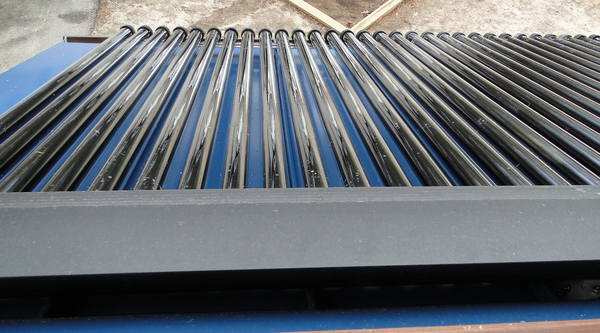
In addition to the photovoltaic system, the house’s plentiful hot water supply is warmed by a geothermal heating unit and evacuated solar tubes. Both units also heat the outdoor pool. And rainwater is harvested much like the cisterns in old farmhouses.
Solar tubes along the ceiling allow natural light to pour into the home. With mirrors concentrating the sunlight, the light is even brighter than the outdoor light on a cloudy day, the Dubins reported.
The light bulbs in the house are also LEED-compliant. They are all recessed light-emitting diode lights or compact fluorescent lights. Even the honeycomb shape of the window shades is designed to regulate temperatures in the house’s south-facing windows. Additionally, the toilets are all dual-flush. And the fireplace burns extra slowly, according to Telemark Project Manager Tim Dalene.
Another energy-efficient aspect of the two-story house is that it is sheathed in a shell of spray-foam insulation that expands more than 100 times its size. Because the house is airtight, energy recovery ventilators circulate fresh air, reducing the volatile organic compounds that would otherwise accumulate.
Approximately 80 percent of the wood in the home is reclaimed from the original house or other projects, such as local windmill renovations. Additionally, most of the building materials are recycled and come from within a 500-mile radius of the house.
Another aspect of the house that the Dubins said is remarkable is that when nobody is using power, it drifts into sleep-mode like a resting laptop, conserving resources.
Content now that they have moved into their dream home, the Dubin family said there is one other thing that they hope to achieve in their quest to go green: that others will follow in their light carbon footprints.


 Colleen Reynolds on Apr 26, 2010