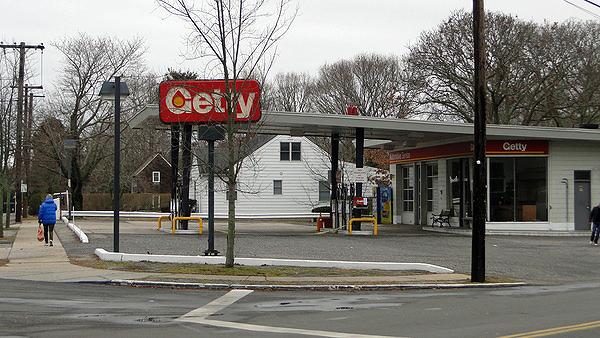
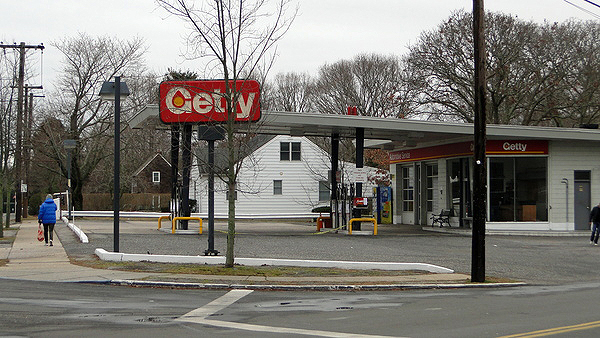
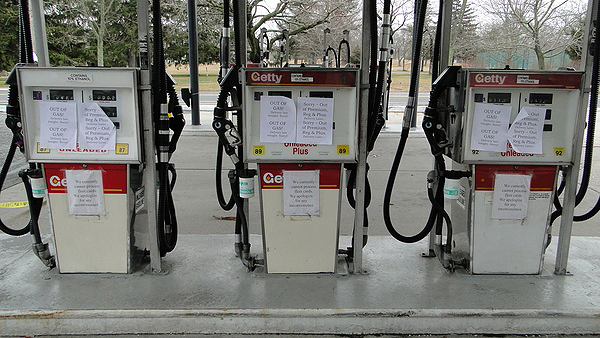
The Getty gas station and auto repair shop in Sag Harbor was shuttered earlier this month after its owner, Jim Shelly, said he lost money selling gasoline in 2012 and saw no hope for turning a profit this year.
The closure leaves just one operating gas station in the village, Harbor Heights on Route 114, which currently has an application before the Village Zoning Board of Appeals to expand, upgrade and add a convenience store—an application strongly opposed by neighbors who argue the change would disrupt the character of the community.
The Getty, on Main Street, across from Mashashimuet Park and Otter Pond, was leased by East Hampton’s Georgica Services, which started running it in 2005. It closed on January 8.
Mr. Shelly, who owns Georgia Services, said that the gasoline supplier Getty... more
The closure leaves just one operating gas station in the village, Harbor Heights on Route 114, which currently has an application before the Village Zoning Board of Appeals to expand, upgrade and add a convenience store—an application strongly opposed by neighbors who argue the change would disrupt the character of the community.
The Getty, on Main Street, across from Mashashimuet Park and Otter Pond, was leased by East Hampton’s Georgica Services, which started running it in 2005. It closed on January 8.
Mr. Shelly, who owns Georgia Services, said that the gasoline supplier Getty... more


Jan 23, 2013 10:06 AM


Looks like simple supply and demand.
Good luck to Mr. Kelley in his new endeavors.
Its been a tough road for all small businesses. I can say things are way better for me than they were 5 years ago. Its a shame the small gas station ...more owners are at a complete disadvantage when competing against large chains. Sorry to see Georgica services leave the village.
Obama Deficits
FY 2012: $1,089 billion
FY 2011: $1,300 billion
FY 2010: $1,293 billion
FY 2009: $1,413 billion
Bush Deficits
FY 2008: $459 billion
FY 2007: $161 billion
FY 2006: $0
FY 2005: $0
He put them on a credit card for future presidents to deal with.
Must have been excercising some of that 'personal responsibility' we hear so much about.
From Politifact-
"Obama inherited deficits from Bush administration
Share this story:
In a spirited and unscripted debate with the House GOP, President Barack Obama said Republicans were wrong to portray him as running up large deficits.
Speaking at a retreat for House Republicans in Baltimore on Jan. 29, 2010, Obama was particularly critical of a question from Rep. Jeb Hensarling of Texas. Hensarling asked Obama, "You are soon to submit a new budget, Mr. ...more President. Will that new budget, like your old budget, triple the national debt and continue to take us down the path of increasing the cost of government to almost 25 percent of our economy?"
"The fact of the matter is," Obama replied, "is that when we came into office, the deficit was $1.3 trillion -- $1.3 trillion. So when you say that suddenly I've got a monthly deficit that's higher than the annual deficit left by Republicans, that's factually just not true, and you know it's not true. And what is true is that we came in already with a $1.3 trillion deficit before I had passed any law. What is true is, we came in with $8 trillion worth of debt over the next decade."
We checked Hensarling's claim in a separate item. Here, we'll look at Obama's claim that he came into office with a $1.3 trillion deficit and $8 trillion worth of debt over the next decade.
On Jan. 7, 2009, two weeks before Obama took office, the Congressional Budget Office reported that the deficit for fiscal year 2009 was projected to be $1.2 trillion. The 10-year projection was estimated to be about $3.1 trillion. So Obama's number was very close on the 2009 deficit -- he said $1.3 trillion -- but substantially different from the 10-year projection -- he said $8 trillion.
There are two reasons why he differs from the CBO. On the difference between the $1.2 trillion and the $1.3 trillion, the Obama administration credited a small portion of spending on its watch to policies of the previous administration. The reason for this is that the federal government runs on a fiscal year that starts Oct. 1, so Bush and Obama technically split responsibility for 2009 spending.
The large difference on the 10-year projection has to do with Bush administration tax cuts. The CBO creates its estimates based on current law, which means the CBO assumes that the Bush tax cuts will end in 2010 and everyone will start paying higher taxes in 2011 and going forward. The Obama administration, on the other hand, assumed in its baseline that those tax cuts would be renewed.
Economists we spoke with -- Josh Gordon, policy director for the Concord Coalition, and Brian Riedl, lead budget analyst of the conservative Heritage Foundation -- both said they believe the White House approach is more realistic because it assumes current policy will continue.
So the CBO's estimate is $5 trillion lower than the White House numbers, though economists don't quibble with the White House methodology. It does highlight, however, that when it comes to budget projections, people can have differences of opinion about what to include. In any budget projection there is room for interpretation, but it seems reasonable to assume for a baseline that the Bush tax cuts will continue. Obama's numbers are fairly solid, so we rate his statement Mostly True.
It addresses the projected affect on deficits for the years that the tax cuts were in effect.
Still won't do your own research,huh?
I don't know who cooks their books better, the Fed, the Treasury, or the White House.
$3.5 trillion – Economic changes (including lower than expected tax revenues and higher safety net spending due to recession)
$1.6 trillion – Bush Tax Cuts (EGTRRA and JGTRRA), primarily tax cuts but also some smaller spending increases
$1.5 trillion - Increased non-defense discretionary spending
$1.4 trillion – Wars in Afghanistan and Iraq
$1.4 trillion - Incremental interest due to higher debt balances
$0.9 ...more trillion - Obama stimulus and tax cuts (ARRA and Tax Act of 2010)
Looks like 900 billion toward the current administration, and most of the rest to the previous leaders (and I use that term loosely) of our governmental, and fiscal entities...
Factcheck addresses this as of September 2012... President Obama is falsely claiming that his administration’s policies are responsible for “about 10 percent” of the deficits “over the last four years.” The cumulative deficit during that time is nearly $5.2 trillion. Obama signed two bills ...more — the 2009 stimulus and the 2010 tax cut — that alone cost $1.6 trillion during that time, or nearly a third of the cumulative four-year deficit.
How could he have been so wrong? Although he said “the last four years,” the administration tells us that he was referring to a Treasury analysis of a 10-year period from 2002 to 2011 — which includes all eight years of the Bush administration and excludes the 2012 fiscal year, which ends Sept. 30 with a $1.17 trillion deficit.
We’re also told that Obama meant 12 percent, not 10 percent, and that 12 percent figure does not represent a percentage of cumulative deficits ($6 trillion) during those 10 years. It’s 12 percent of $11.9 trillion — which is the difference between the Congressional Budget Office’s rosy 10-year budget projection issued in January 2001 ($5.9 trillion in cumulative surpluses from 2002 to 2011) and what actually happened ($6 trillion in deficits).
Obama’s response leaves the false impression that President George W. Bush and the 2008 recession are responsible for a whopping 90 percent of the deficits in the last four years.
It’s true that Obama “inherited the biggest deficit in our history,” as he said on CBS. By the time Obama took office in January 2009, the nonpartisan Congressional Budget Office had already estimated that increased spending and decreased revenues would result in a $1.2 trillion deficit for fiscal year 2009, which began Oct. 1, 2008. In a detailed analysis of fiscal year 2009, we found that Obama was responsible for adding at most $203 billion to the deficit, which in the end topped $1.4 trillion that year.
But that was just the first of four years of trillion-plus deficits. The last three budgets fall squarely under Obama. And, during that time, the federal government ran up deficits of $1.3 trillion in 2010, $1.3 trillion in 2011, and about $1.2 trillion in the fiscal year that ends Sept. 30 — for a total of nearly $5.2 trillion in deficit spending.
It seems the supplemental figures were not made part of the debt, but were made part of the budget deficit, two ...more distinctly different animals to which I was confusing. A point of distinction is that it isn’t anything nefarious concocted by Bush or his handlers, it was merely federal budget rules which were corrected given the level of need for supplemental funding and the impending global financial crisis. You learn something everyday.
As of end of fiscal 2011:
$3.5 trillion – Economic changes (including lower than expected tax revenues and higher safety net ...more spending due to recession)
$1.6 trillion – Bush Tax Cuts (EGTRRA and JGTRRA), primarily tax cuts but also some smaller spending increases
$1.5 trillion - Increased non-defense discretionary spending
$1.4 trillion – Wars in Afghanistan and Iraq
$1.4 trillion - Incremental interest due to higher debt balances
$0.9 trillion - Obama stimulus and tax cuts (ARRA and Tax Act of 2010)
Why don't you OT ranters go back to the other thread?
GO BACK TO YOUR CORNER!
AND STAY THERE!
http://www.27east.com/news/article.cfm/East-End/448120/Sandy-Hook-Tragedy-Is-Felt-At-East-End-Schools#comment78277
With wafer thin profit margins on gasoline alone, these stations need to be of the mini mart variety. Unfortunately due to zoning, it is very difficult and expensive to expand. I feel for these business owners.
Gas stations that charge less do more volume with almost same overhead as the station with the lower volume.
Hess is the place where they control refining and distribution and their price naturally will be lower.
It seems everyone likes to pick on the gas prices why not look at King Kullen prices etc.
Toma drive ...more the x-tra miles and spend the x-tra time and yes you will see the small stations disappear. Oh remember in the cold and snow and rain when you didn't have to pump your own because you had the small town touch of having someone there to pump for you.
Drink up the Pelligrino on sale today.
If Harbor Heights has to close for their renovation (if approved), will Sag Harbor go without a gas station, or will the Getty station be opened up in some way?
Unlimited corporate charter has led us to small businesses disappearing. Look at what happened to Riverhead's Main St. when Route 58 was developed into chains. Would you rather put food on your neighbor's table, or save a couple bucks and support a company with questionable business ethics on the world wide stage? ...more "The People" have apparently shortsightedly spoken on that too. Look at any town which a Wal-Mart was built in. The big picture needs to be seen, and I implore each of you to look for it. It would seem Abraham Lincoln was right to "tremble for the safety" and future of this country.
Alliance is likely watching the fate of the Harbor Heights application to expand and include a mini-mart, which has come under fire for being too expansive.
This trend has taken hold on the East End, ...more and may be reaching its end, as the Harbor Heights expansion is not a sure thing by any means. If their application is denied, the Getty station could see a new lease happen quickly IMO.