Sag Harbor Express

Stony Brook University Study Shows Benefits Of Growing Kelp Near Oyster Farm Beds

icon 4 Photos
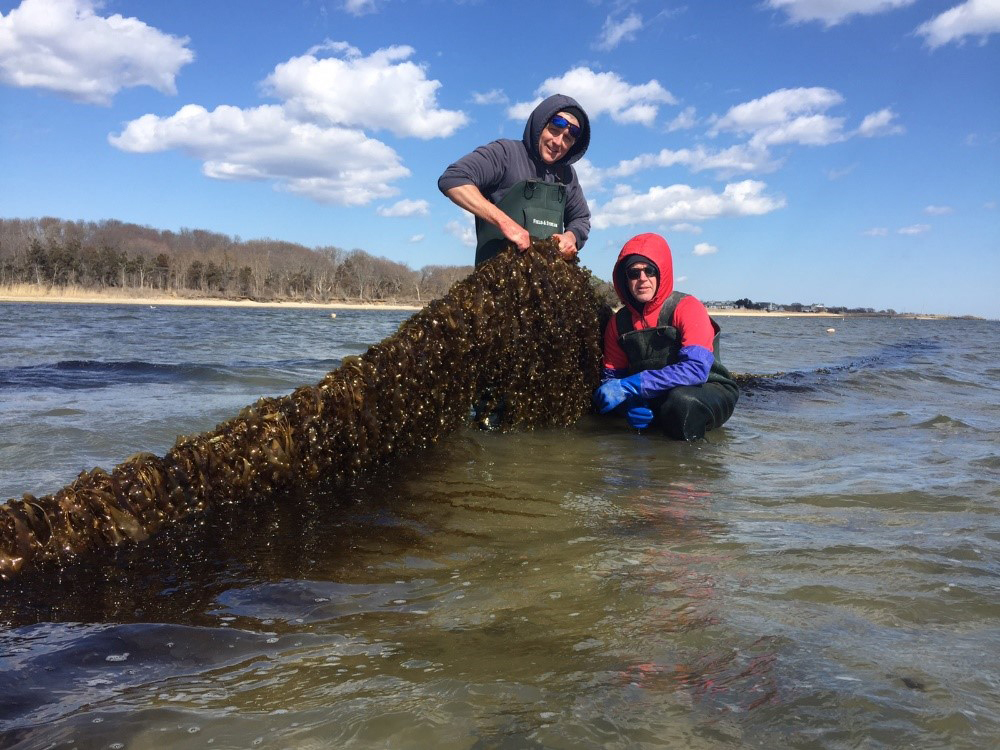
Mike Doall and oyster farmer Paul McCormick with kelp grown on the Great Gun oyster farm.  COURTESY CHRIS GOBLER

Mike Doall and oyster farmer Paul McCormick with kelp grown on the Great Gun oyster farm. COURTESY CHRIS GOBLER
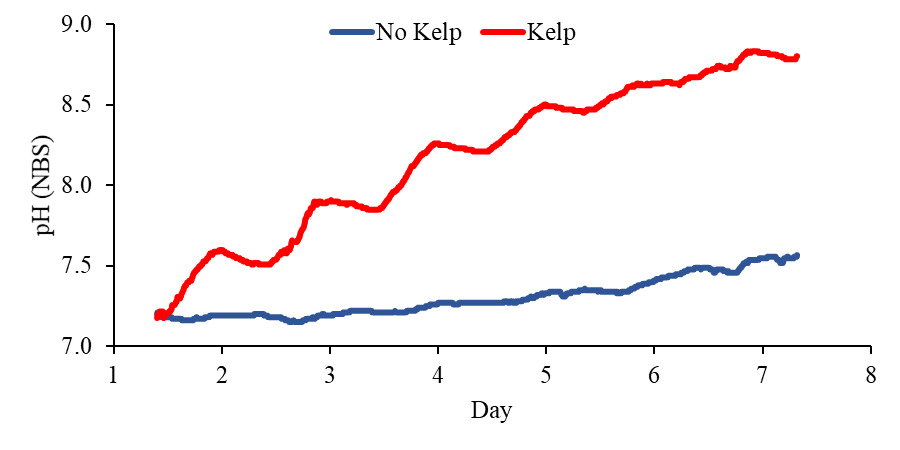
pH scale measurements with and without kelp. The graph shows continuous pH (NBS scale) bubbling, and the addition of 4 x 10⁴ cells mL-1 Isochrysis galbana added daily to simulate daily feedings of bivalves.    COURTESY CHRIS GOBLER

pH scale measurements with and without kelp. The graph shows continuous pH (NBS scale) bubbling, and the addition of 4 x 10⁴ cells mL-1 Isochrysis galbana added daily to simulate daily feedings of bivalves. COURTESY CHRIS GOBLER
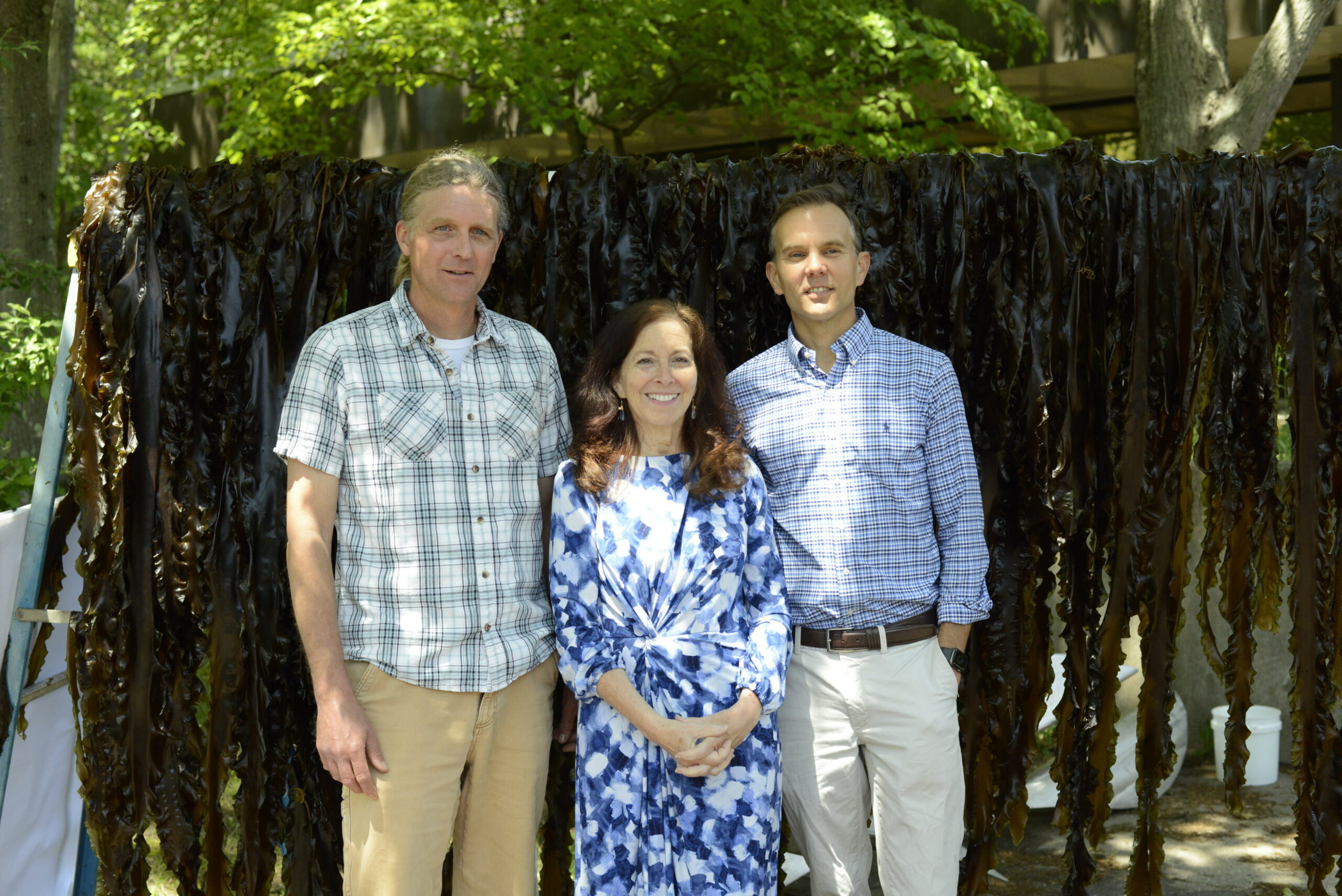
Mike Doall, Adrienne Esposito and Christopher Gobler (left to right) at a press conference at Stony Brook University in front of kelp harvested from the East River.
Mike Doall, Adrienne Esposito and Christopher Gobler (left to right) at a press conference at Stony Brook University in front of kelp harvested from the East River.

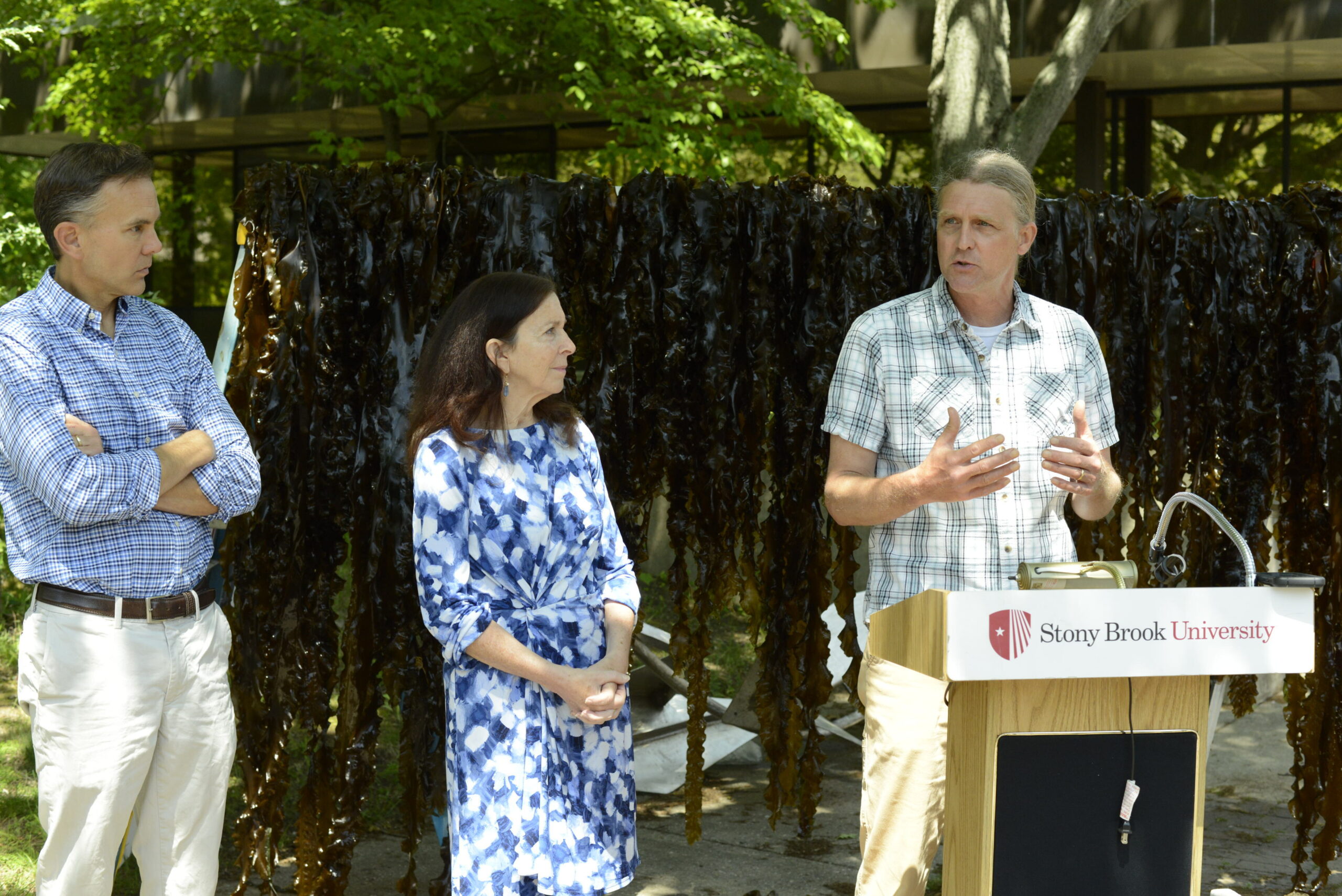
Mike Doall speaks during the press conference at Stony Brook University.

Mike Doall speaks during the press conference at Stony Brook University.

authorJulia Heming on Jun 2, 2022

Scientists from Stony Brook University, led by Dr. Christopher Gobler, have discovered that the growth of kelp reduces ocean acidification, an effect of climate change.

“Kelp can raise the pH of seawater from acidification conditions to actually what we call baseification,” said Gobler. “The conditions that the shellfish need to have maximum growth.”

Ocean acidification is a decrease in the pH of ocean waters and has the greatest effect on shellfish, causing slower shell growths for bivalves, like clams and oysters. In addition, ocean acidification causes the death of fish larvae, slows molting of lobsters and crabs, and kills plankton.

“Ocean acidification is often referred to as the evil twin of climate change,” said Adrienne Esposito, executive director of Citizens Campaign for the Environment. “According to the National Oceanic and Atmospheric Administration, 30 percent of all carbon dioxide released into the atmosphere from burning fossil fuels gets deposited into our ocean and marine environment, causing ocean acidification.”

The results of the four-year-long study have been published in Frontiers of Marine Science to show the positive effects of growing kelp alongside Eastern oysters, blue mussels and hard clams.

“The results were crystal clear,” said Gobler. “If we grew the oysters exposed to ocean acidification, their growth rates slowed to almost nothing. But by simply co-growing the oysters with the kelp in the lab, we could rescue that growth rate and bring it up to the same exact conditions as the same oysters that were exposed to normal pH conditions.”

The kelp is line grown: Spooling line is pollinated with kelp spores, then planted in the water in the fall, and the kelp grows over the winter.

Gobler and his team are hopeful that they can spread the conjoined growth of oysters and kelp to more oyster farms but recognize that the current system in New York makes it difficult.

Their team faced these problems in their research since New York lacked a hatchery for kelp spores, leading the team to create one.

Gobler and his team were the first group to grow kelp in shallow local waters when the experiment began in 2018. Over the past four years, they were able to conduct six experiments in Gobler’s lab, in addition to a field experiment at Great Gun Oyster Farm in Moriches Bay.

The study showed that in areas with kelp, there was a reduction of ocean acidification. The study also shows a halo effect for bivalves — those grown closer to the kelp have the biggest effects, as oysters grew faster in water with a higher pH.

“The results were actually dramatic,” said Gobler. “The growth rates of the oysters that were grown with the kelp were five times higher than the oysters that were farther away from the kelp.”

Gobler’s team included Mike Doall, associate director of shellfish restoration and aquaculture at Stony Brook University, and a former oyster farmer.

“It’s a localized impact around oyster farms,” said Doall. “We are not trying to solve the global ocean acidification crisis with growing kelp — that’s the furthest thing. But within an oyster farm, more specifically within the halo around the kelp, it could provide a benefit to the shellfish to protect against ocean acidification.

“This is a part of a solution to a very big problem,” he added.

For the future of the experiments to reduce ocean acidification and nitrogen content in local waters, Gobler is planning to begin a study focused on the benefits of Gracilaria, a red algae, with an opposite growing season to kelp.

Additionally, Gobler will begin experimenting with putting the kelp in earlier in the growing season.

You May Also Like:

A New 27east and More Big Changes for The Express News Group

The Express News Group is launching a brand-new 27east.com this month, a major step forward ... 13 Dec 2025 by 27Speaks

Sag Harbor Village Police Reports for the Week of December 11

SAG HARBOR VILLAGE — An officer responded to a call from a Rysam Street address a little after midnight on Saturday. The caller told the officer that a man wearing a black ski mask had walked onto her porch and banged on the front door then ran off. The woman provided the officer with surveillance video from her Ring camera, which visually confirmed what the woman said had happened. Police described the man as white, “approximately 6 feet tall, wearing a black ski mask, black hoodie with a red logo on the back, and wording on the left chest, a ... 12 Dec 2025 by Staff Writer

Harmony for the Holidays

Let’s be real: As jolly as the holidays can be, they can also be overwhelming. ... by Jessie Kenny

A Little Time, a Big Impact: Pierson's Interact Club Brings Joy to Seniors and Revives Blood Drive

Isabella Carmona DeSousa didn’t know much about Pierson’s Interact Club when she joined two years ... 11 Dec 2025 by Cailin Riley

Dear Neighbor

Congratulations on your new windows. They certainly are big. They certainly are see-through. You must be thrilled with the way they removed even more of that wall and replaced it with glass. It must make it easier to see what is going on in your house even when the internet is down. And security is everything. Which explains the windows. Nothing will make you feel more secure than imagining yourself looking over the rear-yard setback from these massive sheets of structural glass. Staring at the wall has well-known deleterious impact, and windows the size of movie screens are the bold ... by Marilee Foster

I Can Dish It Out

Our basement looks like the final scene in “Raiders of the Lost Ark,” where the (found) ark is crated and wheeled into the middle of a government warehouse with stacked crates going on for miles. In other words, we have a lot of stuff. This tracks. Mr. Hockey and I have been married for 36 (according to my calculator) years. We’ve had four (no calculator needed) pucks. We’ve lived in seven (according to my fingers) different homes in three (no calculator or fingers needed) countries. In 2010, we moved back to East Hampton full time. We brought everything we had ... by Tracy Grathwohl

The Urgency of Real

The Hamptons International Film Festival typically takes up a lot of oxygen in the fall on the South Fork, but it’s worth celebrating a slightly smaller but just as vital event in late autumn: the Hamptons Doc Fest. Running this week for its 18th year, the festival of documentaries was founded by Jacqui Lofaro and has become an essential part of the region’s arts scene every year. It’s a 12-month undertaking for Lofaro and her staff, and the result is always a tantalizing buffet of outstanding filmmaking, not to mention unforgettable stories. The arrival of the era of streaming services ... 10 Dec 2025 by Editorial Board

Hitting Pause

East Hampton’s housing shortage is real; the town can’t afford to ignore any potential long-term solutions. But the recent — and now scrapped — plan for a large employer-run complex on Three Mile Harbor Road raises too many questions that haven’t been fully answered. The proposal, put forward by Kirby Marcantonio and an unnamed partner, would have created 79 units of employer-controlled housing, comparable to a project he has pitched on Pantigo Road. To make it happen, the East Hampton Town Board would have had to allow the project to sidestep the town’s 60-unit limit on affordable developments, and rezone ... by Editorial Board

Proceed With Caution

Overlay districts are a common zoning tool used by many municipalities. Southampton Town has used them to varying degrees of success — the aquifer protection overlay district has been a winner; a downtown overlay district in Hampton Bays less so — in various parts of the town. They essentially look at the existing zoning, then allow those rules governing what can be done on properties to be reconsidered if there’s a newer concern to be addressed. In a bid to clean up the process for creating more affordable housing, the Town Board is looking at a new overlay district that ... by Editorial Board

The Whole Picture

When it comes to evaluating a complex development proposal, splitting up the application into separate parts may seem tempting, especially when environmental uncertainties loom. But in the case of Adam Potter’s plan for 7 and 11 Bridge Street, the Sag Harbor Village Planning Board should resist any temptation to segment the project for review. Potter’s attorney has asked the board to consider the gas ball property at 5 Bridge Street — a site that could provide the 93 parking spaces required for Potter’s 48 residential units and commercial spaces nearby — separate from the main development. The reason is understandable: ... by Editorial Board