


 1 Photo
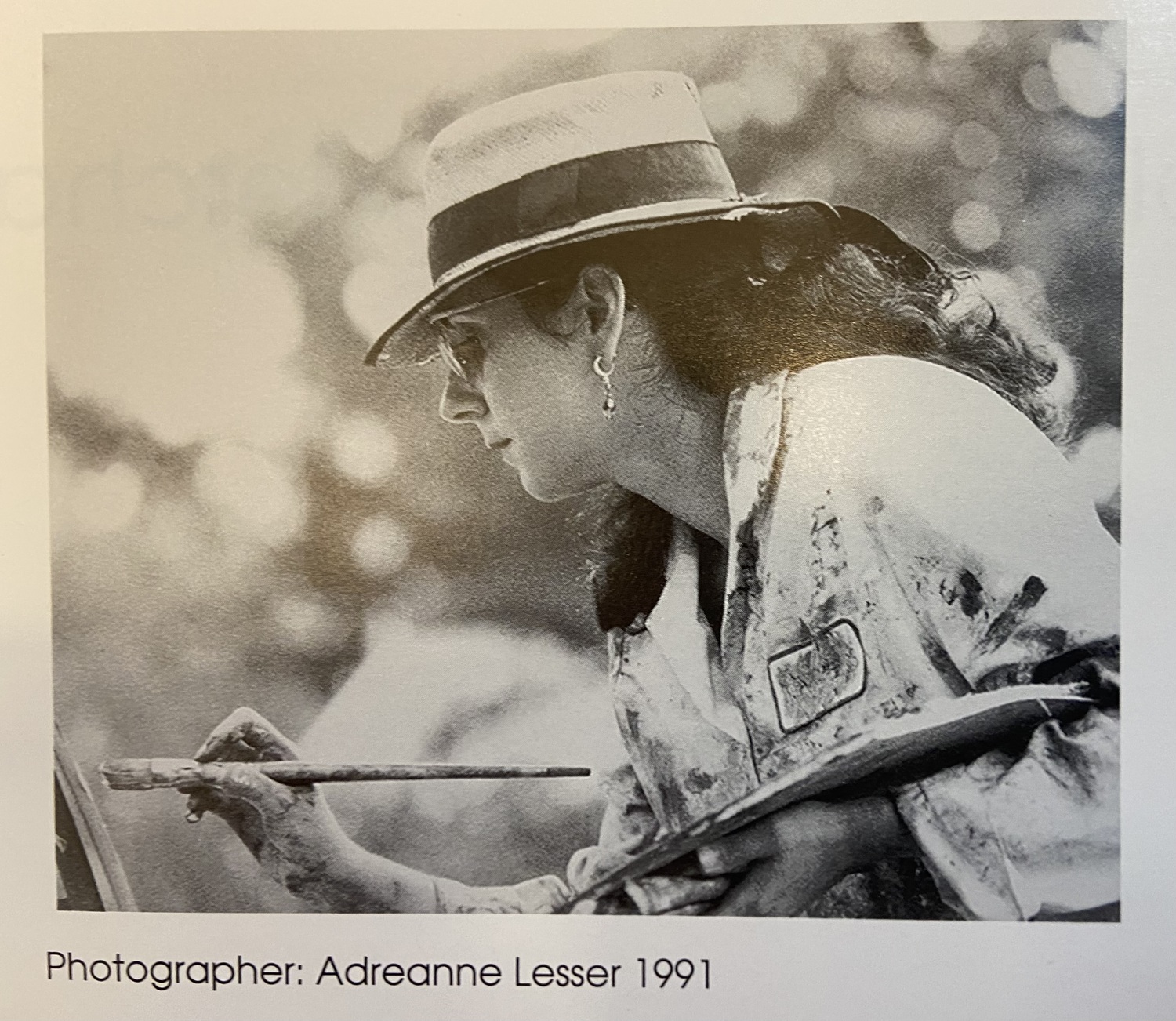
An early photo of Yolanda Suárez de Ferregur Merchant.
Yolanda Suárez de Ferregur Merchant died in New York City on August 16. She was 68.
An accomplished painter in the expressionist tradition, Merchant’s vibrant, characteristically pastose work features in diverse private collections and was exhibited in museums and galleries around the world.
“Nobody uses yellow like she does,” Amy Ernst, collagist and granddaughter of surrealist painter and sculptor Max Ernst, told The New York Times in 1998. “Artists are always afraid to use brilliant colors, but Yolanda is not afraid.”
Survivors said “fearless” describes Merchant well — and, fittingly, it was the title of her penultimate series of paintings.
“She is truly an American original whose talent for making wonderful and inspirational art should be treasured,” Louis A. Zona, then director of the Butler Institute of American Art, wrote in 1994. “Yolanda Merchant draws from lifelong experience, and the clashing of two worlds. The traditions of her family, whose Hispanic culture formed her early consciousness, at times conflict with the influences of the American popular culture.”
Merchant painted landscapes, familiar objects like her children’s tricycles, palm trees, and self-portraits. She worked in heavy, layered oil paint, in series, and exclusively on Masonite later in her career. Her inspirations were her Cuban heritage, family and the East End of Long Island.
“She uses thick paint undiluted, mixed on the palette, and rarely wipes out problem areas, preferring to overpaint,” wrote art historian and critic Helen Giambruni in her review of Merchant’s 1992 show at the Carolyn J. Roy Gallery in New York City. “Eventually, she achieves a thickness that can be psychically manipulated … conceiving of her work almost as a kind of sculpture.”
One of Merchant’s most notable projects was a collaboration with Puerto Rican jazz musician Tito Puente, “In Two Worlds: Exiles in America.” The influence of Puente’s music changed the trajectory of her art, marking a shift from a focus on plein-air landscapes signed only with her husband’s last name, Merchant, to more colorful themes tied to her Cuban heritage, signed Suárez Merchant.
“My palette, which had been close to nature and calm, suddenly became exuberant,” Merchant told The Times in 1993. “The sounds I was hearing were reflected in the colors I started painting.”
Puente invited Merchant to a 1992 recording at the Village Gate in New York City, recounting in an interview for an exhibit at the Butler Institute of American Art that he told her, “‘The environment will make you feel better and you’ll listen to the music and be more creative’ … The encounter was beautiful. It was a first for me and for her.”
In addition to the Butler (in Youngstown, Ohio), the museums where Merchant showed or is in the permanent collection include the Metropolitan Museum of Art (Manhattan), Guild Hall (East Hampton), the Housatonic Museum (Bridgeport, Connecticut), and the Mattatuck Museum (Waterbury, Connecticut).
She was a longtime part of the East End arts community. Much of her work depicted local landscapes, particularly from her summers at the Georgica Association in Wainscott. She had a summer solo exhibition in the area for decades, including at the Elaine Benson, Sara Nightingale, Ashawagh Hall, Millennium, Vered and Solarium galleries.
Cindy Crawford was one of Merchant’s notable collectors.
“She has a sunny Caribbean disposition,” longtime friend and daughter of painter Fairfield Porter, Katie Porter, told the Times in 1998. “She’s very optimistic and positive.”
Born in Santiago de Cuba, Merchant emigrated to the United States with her family soon after watching from her father’s shoulders as Fidel Castro marched into Havana. At 10, after the death of her father, Rene Pablo Suarez Sanchez, she moved with her family to Southampton. Merchant’s mother, Magdalena Gonzalez-Ferregur Vento, who had a Ph.D. in zoology from the La Escuela Normal in Havana, taught Spanish at Southampton College until her retirement.
Family history has that Merchant’s mother met Che Guevara in a successful effort to free her brother, Sigfredo Ferregur. Merchant’s uncle was a prisoner at the notorious El Morro Prison in Havana, where Che Guevara was commander.
“She achieved her goal, as the Revolution wanted to ingratiate itself with the intellectuals,” Magdalena Shannon, Merchant’s older sister, wrote in an email.
Merchant identified with Buckminster Fuller’s introduction at a lecture she heard in 1978. This was during a formative summer in Paris, working for a collaboration between Parsons School of Design and UNESCO, the United Nations agency responsible for arts and culture. “My name is Buckminster Fuller and I am from the planet Earth,” said the architect known for the geodesic dome.
Merchant spoke Spanish, French, and Italian, skills that allowed her to serve as a volunteer translator at the Metropolitan Museum of Art for years. Her history as a political refugee left Merchant with a passion for international affairs and an openness to different perspectives.
Merchant lived on the East End on and off, with stints in New York City, Pennsylvania, Connecticut, Beijing, Dubai, Tangiers, Florence, Paris, and the Greek islands. But the East End was always her home base.
Paul Bowles, author and ethnomusicologist, who was Merchant’s teacher in Tangier, wrote in a 1980 letter in response to her complaints about western Pennsylvania: “Pittsburgh may not be the ideal place to live, particularly since you love the sea. But doubtless you won’t live there forever!”
She particularly enjoyed swimming in Georgica Pond, visits to Munn Point, and milkshakes with her children at Sip’n Soda and the Candy Kitchen. Merchant was involved in Southampton Village politics, and unsuccessfully pushed for creating a hiring hall to give dignity to immigrant day laborers. A friend wrote: “Only [in Southampton] did Yolanda begin to lose her sense of exile, to feel at last she belonged somewhere.”
Merchant earned her bachelor’s degree in painting at Carnegie Mellon University in Pittsburgh and trained with artists worldwide, from Nerina Simi in Florence to Albert York in Water Mill. She was a longtime and active member of the National Arts Club in New York City. Merchant also attended the Sorbonne in Paris, Hampshire College and Northfield Mount Hermon School in Western Massachusetts, the American School of Tangier in Morocco, and Southampton High School and Sacred Heart Academy in her hometown.
She is survived by her two children and their spouses, Emily (George Hill) and Alexander (Madeline Lagattuta); her sister, Magdalena Shannon (Conrad Marcotte); and four grandchildren who will grow up surrounded by art, swimming in the ocean and listening to Joni Mitchell.
The family will have a private commemoration in Southampton. Memorial donations may be made to the Peconic Land Trust.


 Staff Writer on Sep 26, 2023