


 1 Photo
Those of us, of a certain age, used to “wonder, wonder, wonder who, who wrote the book of love.” And who put “the bomp in the bomp bah bomp bomp.”
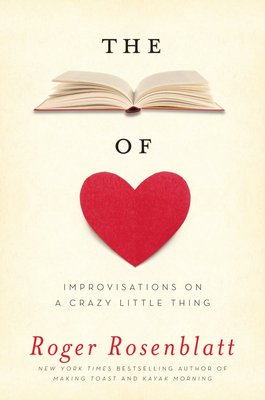
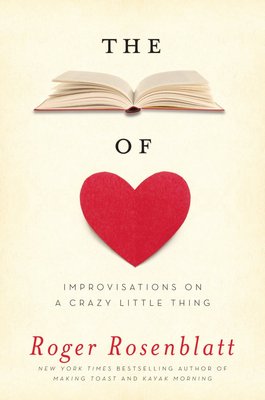
Well, while we may never know for sure who’s responsible for putting the “bomp” where it did the most good, we now know for certain that it is Roger Rosenblatt who has written “The Book of Love: Improvisations on a Crazy Little Thing” (Ecco/HarperCollins, 177 pp., $22.99).
Mr. Rosenblatt is the distinguished professor of English and writing at Stony Brook University. He was an essayist for Time and PBS NewsHour, where his work won two George Polk Awards, a Peabody and an Emmy. He is the author of, among other works, the novel “Lapham Rising,” two classics in the literature of grief—written after the death of his daughter—“Making Toast” and “Kayak Morning,” and the memoir, “The Boy Detective: A New York Childhood.”
“The Book of Love” is an extended essay on love, most notably his love for his wife, Ginny. “The story I have to tell,” he writes, “is of you. Of others, too. Other people, other things. But mainly of you. It begins and ends with you. It always comes back to you.” And it wends its way on the wings of song, particularly of pop music of the mid-20th century. He has woven bits and pieces, titles and refrains from popular songs that we all know and love into a rich and colorful tapestry. I often found myself humming along.
The book is a free-associative stream of consciousness narrative with an occasional undercurrent of giddiness, of sheer Edward Lear-like nonsense. “Swonderful, sblunderful, sromantic, frantic, logical, biological whimsical, flimsical, writerly, golighterly, puppy, yuppie, durable, curable, erratic, ecstatic, erotic, robotic, national, passional, powerful, flowerful, ephemeral, dilemmeral, musical, abusical, tragic, magic, mawkish, New Yawkish, ubiquitous, insickuous, loyal, cloyal, fleeting, cheating, parental, demental, beautiful, dutiful, diurnal, eternal, sawfullynice, sparadise.”
All of this Joycean wordplay would be incomplete without a few handfuls of puns thrown in, running from the groan-inducing “Talibanana” to the forgivable “felonious monks” to the genuinely funny “bipolar bears.”
Of course, they can’t all be gems, but most of them can be welcomed because they exist alongside moments of real beauty. “The past had changed, as it does sometimes, and instead of the self-regard I have worn like a white linen suit, I saw only you, and the strawberries, and the windfall of light on your hair,” he writes. The poetry of everyday life is embodied in a father playing catch with his son. “They do not call it a game of throw, though throwing is half the bargain.”
There are many kinds of love. Mr. Rosenblatt doesn’t write about them all, but who could. Nevertheless, I can’t imagine a more personal and enchanting exploration of its varieties. It is full of surprises. He discusses some of the great lovers of literature. Of Cyrano, he writes, “It wasn’t the nose that scared the girls away; it was the force of his passion. What’s more, I think he recognized this, and so lent his passion to others for delivery. Size matters. A lot of girls can’t take a heart that big.”
He writes of friendship, “Love is hysteria. But friendship is a peaceful little thing.” He describes a visit that Coleridge made to Wordsworth. “He walked in, sat down, and did not utter a word for hours. Neither did Wordsworth. When the hours were up, he rose from his chair, and exiting the door, thanked Wordsworth for a perfect evening.”
We learn a new word: philematology, or the study of kissing. The record for kissing, by the way, is held by “a couple from Bangkok [that] held a kiss for fifty-eight hours, thirty-five minutes, and fifty-eight seconds.” They couldn’t hang in there for another two seconds? “A kiss is just a kiss,” Mr. Rosenblatt writes. “A sigh is just a sigh. The fundamental things apply as time goes by.”
“A sigh,” he continues, “may be at once the most emotionally complex and timid sound we make. And the most private. The gentle breath one offers to fate.”
I have quoted a great deal. There are so many riches to be quoted. Perhaps the best possible review of the book would be simply to copy it out in its entirety.
The book ends, as it began, with one last word to Ginny, in remembering their first snowfall together: “And there was no light in the world but you.”
“The Book of Love” can be read in one sitting, but it can also be picked up and dipped into at any point to discover some new revelation, some uniquely tender, many-splendored thing, allowing us to delight in the pleasure that Mr. Rosenblatt gives so abundantly.


 on May 25, 2015