


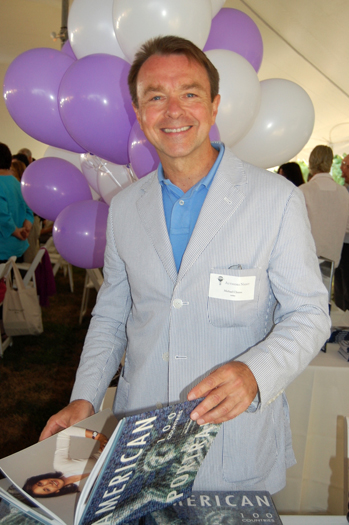
 2 Photos
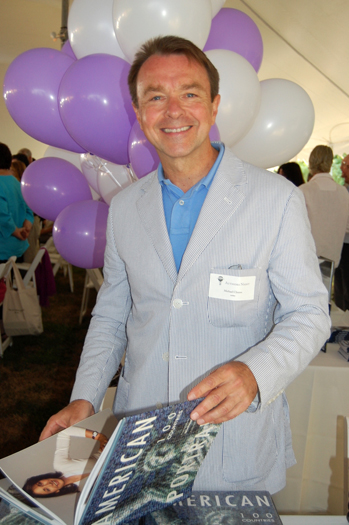

“American Portraits” is photographer Michael Clinton’s fourth book and, to hear him tell it, his most challenging to date.
The idea, the part-time Water Mill resident explained recently over coffee, was “to create a portrait of America today.” More specifically, the goal was to capture Americans in all their diversity, Americans whose bloodlines add up to 100 countries of origin.
What he learned in the process, he said with a laugh, is that capturing the essence of an individual with a camera “is not like shooting a gorgeous landscape in Africa.” Unlike a spectacular mountain range or a ravishing river, the people to be included in the book had first to be sought out and persuaded to pose for the camera. Moreover, for Mr. Clinton to achieve what he set out to do, each subject had to boast a distinct bloodline that none of the others had.
“I had this big chart,” he said. Each time a recruit representing a sought-after country of origin was found and photographed he would mark it off on the chart, telling himself, “Okay, I’ve got my Malaysian, my East Indian, my Australian.”
From the moment of inspiration, which occurred during a search for his own roots in Lithuania, where he spied a woman who looked exactly like his grandmother, to its recent publication by Glitterati ($50), the book took two years to complete. Considering his demanding day job (executive vice president/publishing director of Hearst Magazines, where he oversees 15 titles) and his globe-trotting habit (he just visited his 121st country in May), that seems a stunning feat.
Just evidence of a “Type A” personality, a smiling Mr. Clinton suggested.
An e-mail blast and a Facebook posting alerted contacts that he was searching for people with all sorts of ethnic backgrounds. In addition, wherever he went, Mr. Clinton struck up conversations with anyone who looked like a prospect. In the end, he said, “the majority of the people came through personal referrals. It was also easier that way”
Some of his subjects, like Paulo Pacheco, he already knew. Mr. Clinton had been unaware of Dr. Pacheco’s background, though, before the search for subjects prompted him to ask and to learn, to his delight, that the doctor’s parents had emigrated from Portugal and raised their son in a Portuguese-American community.
“I told him, ‘You are my Portugal!’” recalled Mr. Clinton, whose pleasure was apparently shared by his subject, who wears a winning smile for his portrait.
Others were complete strangers, sometimes rather tough cases at first.
An example: “This guy shows up. I look at him. I don’t even know where to begin.”
Nor, apparently does the guy.
So Mr. Clinton pulls out his most obvious ice-breaker: “Tell me about yourself.”
“I used to weigh 500 pounds,” Anthony Zales (Guatemala, Mexico, Navajo, Sioux) tells him. “I weigh 350 now.”
A good start. Then Mr. Clinton spies Mr. Zalez’s impressive tattoos, one on each arm. He jokes that he wants one like it, they laugh, and the camera captures an irresistible image of his hefty subject, a big grin on his face as he displays spectacularly embellished forearms.
Sometimes it’s easy. Heideh Hirmand, one of several subjects with homes in the Hamptons whose faces may look vaguely familiar, was apparently a natural. Now a plastic surgeon with a practice in New York and a home in Southampton, she is the daughter of parents who left Iran after the fall of the shah.
“She got right up on the set,” said Mr. Clinton. “She was animated and I was sure she had done this before.” (She hadn’t.)
An English bloodline is represented by Campion Platt, who also has a house in Southampton. Both of his parents are descendants of Mayflower Americans, which makes him one of the earliest Americans, though a relative newcomer compared to Rolise R. Spink, whose Hopi bloodline gives her the edge.
Mr. Clinton’s “newest American” is Juan Paysse, the son of fourth-generation Uruguayans, who just became a citizen as the book was being produced.
Mr. Paysse, who studied business in America after graduating from law school in Uruguay, explains his decision to make the U.S. his home in the brief text that appears beneath each of the portraits.
“I returned to live in my home country,” he writes, “but realized that America and all that it represented was the dream that I wanted to pursue. It is here that I am happy and where I want to realize my professional and personal ambitions.”
Similar sentiments are expressed over and over again in the book and reflect those that Mr. Clinton says he encounters everywhere in his travels. He asserts in the book’s introduction that he has “never met anyone who has not been intrigued or hasn’t dreamed about coming to America ... to visit, to work, or to start again. Even in the places where there is political tension with America, the people have a curiosity.” Mr. Clinton concedes that not everyone in this country is ready to put out the welcome mat, but it is hard not to recognize in these portraits of 93 Americans who trace their ancestry to 100 different countries the positive energy that comes with diversity.
In any case, there is no turning back. At one time, Mr. Clinton asserted, if an Irish man married an Italian woman it was considered multicultural. He contrasted that quaint notion with the reality today, when the presence of five or six ethnicities in one American’s bloodline is hardly unusual.
Young people, as always, are out front in embracing diversity, a fact that Mr. Clinton, who oversees Seventeen magazine among his other responsibilities, is well placed to appreciate. No longer do the editors choose from a selection of Anglo images for their covers, he said. The influences today on pop culture are global, he added. The celebrities are multicultural. Food and design take inspiration from cultures worldwide.
“Salsa now outsells ketchup,” he asserted, clinching his argument. “The face of America is changing.”


 on Aug 31, 2010