


 1 Photo
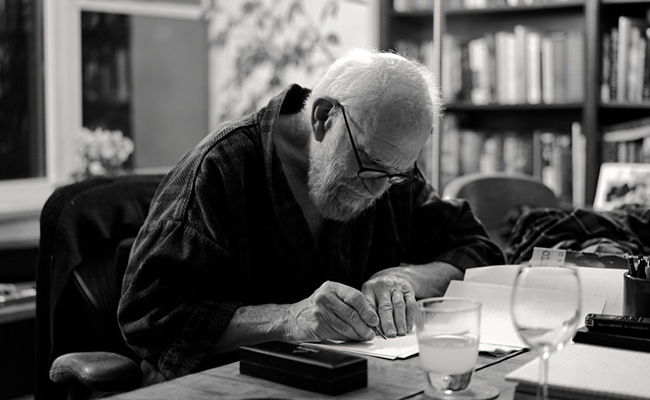
Oliver Sacks in "Oliver Sacks: His Own Life,” by Ric Burns.
Filmmaker Ric Burns has made lot of documentaries in his career. Not only did he collaborate with older brother Ken Burns on the PBS documentary “The Civil War,” over the years he has also produced several of his own films on topics including the Donner Party, the Chinese Exclusion Act, and an 8-part epic simply titled “New York: A Documentary Film.”
In making his documentaries, Burns is prone to spending a fair amount of time in preproduction raising money and researching topics. But he admits that his most recent documentary didn’t come about in the usual way — which makes perfect sense when considering that the subject of the film was Oliver Sacks, an unusual and brilliant man who defined his life in very unique terms.
In “Oliver Sacks: His Own Life,” Burns explores the largely untold story of the late, legendary neurologist who was most famously known as the real-life doctor depicted by Robin Williams in the 1990 film “Awakenings.” While “Oliver Sacks: His Own Life” will have a theatrical release in May, the documentary will be screened on two consecutive Saturdays, December 21 and 28, at Guild Hall in East Hampton as part of HamptonsFilms “Now Showing” program. In October, the film won the Audience Award for Best Documentary Feature at the 27th annual Hamptons International Film Festival.
In a recent interview, Burns explained that shooting for the film began in early 2015 right after Sacks was diagnosed with terminal cancer. The illness followed an earlier melanoma in his eye that had spread to his liver. Because of the seriousness of the prognosis, Burns and his team had no time to research or even get to know their subject in advance.
“Oliver’s friend Kate Edgar called us up the week after the diagnosis. She said he’s going to die and we would love you to start filming,” Burns recalled. “Within weeks we were in his Horatio Street living room. Without time to raise money, we launched in.”
“In early February 2015, we couldn’t say where it was going to go. Here’s this odd celebrated English doctor, your antenna is out — will I like him?” he asked. “We got thrown into the deep end of the pool and spent 60 hours over five days getting to know him, laying it all out on the line … We got an accelerated course in Oliver Sacks and there was no looking back. We were in for a penny and in for pound.”
Burns’ initial interviews with Sacks ran 12 hours a day from February 9 to 13, 2015. Over the next three months, Burns and his crew interviewed Sacks three more times.
“And he died on August 30,” said Burns.
There was a lot to unpack in the story of Oliver Sacks — good, bad and ugly — and in the film, the neurologist openly shares the stories of his battle with drug addiction, his shame at being a closeted gay man, and the medical establishment that was resistant to accepting his work for most of his career.
Yet despite his human failings and flaws, in watching the film it’s hard not to see Oliver Sacks as a friend. Though he spent years studying the complex structure of molecules and neurons, ultimately his ability to connect with his patients through an immense capacity for compassion, understanding and empathy is his ultimate legacy.
“I think it’s such a beautiful spot on way to describe him, as a friend, in writing and in person,” said Burns. “He was living helplessly out at the end of his nerve endings, and though he’s someone you’ve never met before, you already have a rapport. When people live at the end of the nervous system like that, it’s a very sensitive point of contact and they can’t help but bring that with them.
“You can trust them,” he added. “They have skin in the game and risk it by being there in a completely open way.”
In many ways, Sacks’ ability to be empathetic with all sorts of patients who suffered from a range of mental disorders may have been his biggest gift and was largely the sum of his cumulative experiences. His older brother Michael was diagnosed as schizophrenic as a teenager, so understanding and relating to him no doubt inspired him to study the science of the mind later in life. Sacks was born in the 1930s and grew up in a conservative England at a time when homosexuality was still illegal. His mother called him an abomination when he came out to her and his response was to move to California where he embraced the liberal lifestyle, spending hours in the gym as a body builder, taking amphetamines and riding motorcycles for days on end.
But Sacks struggled privately with his homosexuality and remained celibate for 35 years. His only true relationship came in the final years of his life and were spent with his partner, Bill Hayes, whom he met in 2008 and was 30 years his junior.
It would seem that so much of Sacks’ life was defined by such a unique set of circumstances, unusual times and sheer coincidence that one has to wonder if he would have existed as he did had he lived in another period in history.
Burns agrees.
“I think of Oliver Sacks as Mr. Magoo, the myopic cartoon character who goes into the open construction site, walks up onto the girder, through a Rube Goldberg kind of device, and walks off without a scratch on the other side,” he said. “He had dumb blind luck, enormous energy and he had a narrow path, but there was one. He could not be a scientist or head neurologist at UCLA, so he went right off the cliff to the open construction site to make his way forward.”
For Sacks, that way forward came in the 1960s at Beth Abraham Hospital in the Bronx where he encountered hundreds of dead-end neurological cases.
“Eighty or so of those patients were alive inside,” said Burns. “They had sleeping sickness and had been warehoused for 40 years. He said ‘I’ll pull them out of themselves for them and me. I’m going to make a career out of doing this.’”
Sacks had stumbled onto the remnants of a rare and long forgotten form of encephalitis that had swept the country in the 1930s, rendering the patients in a perpetually catatonic state they had been trapped in for decades. But Sacks was certain their brains were intact and, as told in the movie “Awakenings,” used the drug L-dopa to reverse the effects of the illness in many patients, some of whom “woke up” with the understanding that it was still the 1930s.
But the effects of the drug didn’t last and came with such horrendous side effects, the project was eventually abandoned. The study eventually became the neurologist’s claim to fame, and another example of his being in the right place at the right time.
“It was sleeping sickness, and it’s long gone,” said Burns. “It’s like Oliver is the historian and it’s a disease that doesn’t even have currency anymore. He was going forward by going backward.”
In making this film, Burns relied not only on his interviews with Sacks and many of his friends and colleagues, but was fortunate to also have access to his archives of notes, books, writings, and even films and recordings of his catatonic patients — material that Burns feels functioned as a shelter for Sacks, just as a homeless person relies on tarps and blankets for a sense of comfort.
“I think Oliver was that kind of homeless person. He felt exposed and vulnerable, and having his notebooks around him, those were his friends,” said Burns. “We make the shelter we can. He made it for himself and it was a shelter of other people as well.
“A lot of people are dangling in the wind. For Oliver, it wasn’t ‘There by the Grace of God go I,’ it was ‘There by the grace of God am I.’ This is me, I identify with this. He was taking the most difficult cases and saying, we’re family too.”
“His was a mental home of writing, science and literature,” Burns explained. “That’s ultimately all our homes. We may have an address, but it’s a temporary home and there’s no forwarding address … It’s so humane and human.”
Ric Burns’ documentary “Oliver Sacks: His Own Life” will be screened on Saturday, December 21, and Saturday, December 28, at 6 p.m. at Guild Hall, 158 Main Street, East Hampton. Tickets are $15 ($13 for HamptonsFilm and Guild Hall members) at hamptonsfilmfest.org or guildhall.org. Curated by HamptonsFilm, the “Now Showing” series brings notable films currently in theaters to the East End. Films will be presented at Guild Hall Saturdays at 6 p.m. from December 21 to March 14.


 Annette Hinkle on Dec 15, 2019