


 1 Photo
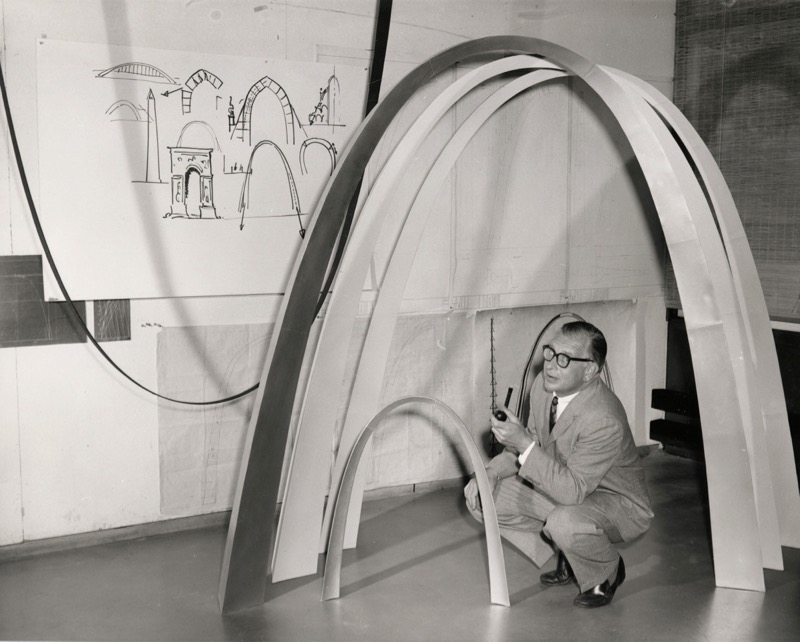
Architect Eero Saarinen contemplating renderings for the arch he designed as an iconic figure for the city of St. Louis
[caption id="attachment_57750" align="alignnone" width="800"]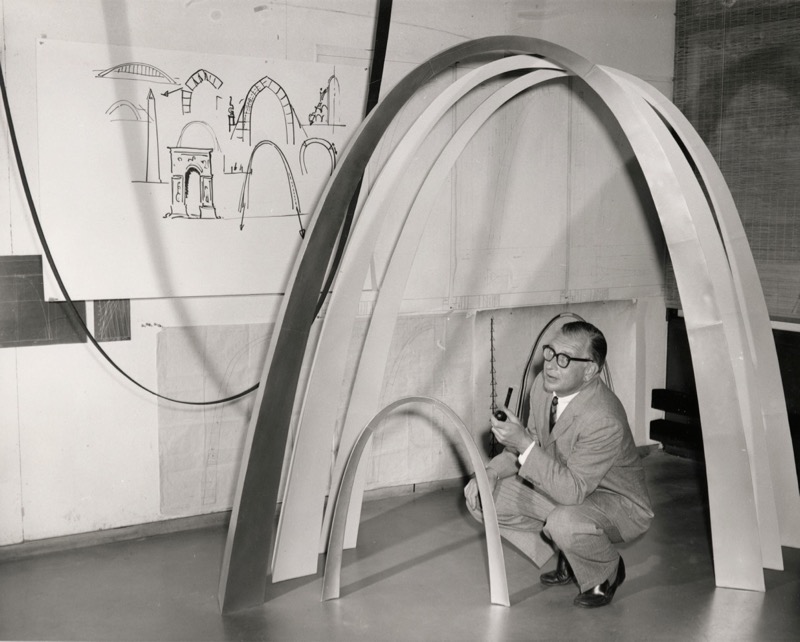 Architect Eero Saarinen contemplating renderings for the arch he designed as an iconic figure for the city of St. Louis, featured in the film "Eero Saarinen: The Architect Who Saw the Future."[/caption]
By Annette Hinkle
When the Hamptons Take 2 Documentary Film Festival returns to Bay Street Theater next week for its ninth incarnation, among the honorees will be American Masters, the PBS series created in 1986 by part-time Sag Harbor resident Susan Lacy.
American Masters, which is celebrating its 30th anniversary this season, has long been an outlet for documentaries about the most influential figures in American arts and culture. As part of the celebration, the Take 2 festival will screen “Eero Saarinen: The Architect Who Saw the Future,” a documentary by filmmaker Peter Rosen which is scheduled to air on PBS stations nationwide on December 27.
Mention Eero Saarinen’s name today, and, if people know him at all, they will immediately recall the futuristically mod TWA Terminal at JFK Airport or the iconic St. Louis Arch.
Both were designed by the Finnish-born Saarinen, who died in 1961 at the age of 51, and both projects were completed in the years after his death. Because he died so young there are only 10 buildings in existence that define his body of work, and therein lies the difficulty in making a documentary about the architect.
“He only had one decade of work. It was a very short career,” explains Mr. Rosen. “If we told the story of each of the 10 buildings, that doesn't really make a documentary. It can’t hold a general audience.”
That was a problem for Mr. Rosen, who in addition to being a filmmaker, is also a trained architect with degrees from Cornell and Yale which, ironically, is home to the Saarinen designed Ingalls hockey rink.
“When I was in architecture school, they never really talked about him. He died so young and there was a long period when people didn't recognize this body of work,” recalls Mr. Rosen. “He was not in academia, he didn’t write about his work and was kind of unknown when I was in school in the ‘70s.”
So Mr. Rosen had to find another way into the story. It turned out that the key figure was Eric Saarinen, the architect’s now 74-year-old son, who, as fate would have it, is a cinematographer by trade.
Eric Saarinen was 20 years old and estranged from his father when he died, and Mr. Rosen found that more than 50 years later, he was still reluctant to take part in a film about him.
“For a year I courted Eric,” says Mr. Rosen. “He also happens to be one of the more in demand cameramen in Hollywood. I thought it would be ideal for such a good cameraman to shoot a film about his father.”
In the end, Mr. Saarinen came around to the idea and Mr. Rosen made a film with two parallel story lines. The first is about the son coming to terms with the troubled relationship he had with his late father, the second is about the son, as director of photography, using his camera skills to thoroughly document the buildings that his father designed.
And that is how American Masters viewers will come to understand the story of Eero Saarinen.
The personal story begins in 1953 when Eero Saarinen met Aline Bernstein, a journalist and architecture critic, who traveled to Michigan to interview him about the building he designed for General Motors. The two fell in love and Saarinen soon left his family to marry Aline. Eric was 13 at the time and his younger sister was just 10.
“This love affair caused a lot of turmoil in his family,” Mr. Rosen explains. “A boy of that age and his relationship to his father is a crucial thing and Eric was resentful.”
“He hated his father,” he adds.
In the half century that followed, Mr. Saarinen never bothered to learn much about his father’s work. But eventually, after Mr. Rosen was able to convince him to sign on as the film’s cinematographer, he and Mr. Saarinen went on scouting trips around the country to visit all of Saarinen’s buildings in preparation for the film.
Along the way, Mr. Rosen casually filmed Mr. Saarinen and in the course of the project, Mr. Rosen learned a lot about the younger Mr. Saarinen as he encountered his father’s buildings.
“I kept shooting Eric cinema verite style as he discovered his father’s work for the first time,” explains Mr. Rosen. “Then we went back with a whole crew and Eric would shoot the buildings.”
“Those two stories run parallel,” he adds. “As soon as I knew we had two stories — the designs of Eero Saarinen and Eric discovering this work for the first time — that worked.”
For his part, Mr. Saarinen storyboarded and plotted out exactly how he would shoot each building, considering lighting and other nuances of his father’s architecture that he had never examined closely before.
“He had pictures and books. For the St. Louis Arch, he knew what time of day it would look best. But in quite a few places, he had never been there for real,” says Mr. Rosen. “At Ingalls hockey rink at Yale, he’s looking around and saying ‘Wow, I’ve never seen it before.’ You see these realizations and what they meant to him.”
Though Aline Saarinen was the force that alienated Mr. Saarinen from his father, ultimately, it was she who ensured the integrity of his legacy after he died.
“The whole last part of the film is how a lot of his work was incomplete — most of it, actually,” says Mr. Rosen. “Aline Saarinen knew his work so well, she took it on herself to ensure it was completed the way he specified.”
Ultimately, it was that vision which allowed Eric Saarinen to understand and accept his father in a way that he never could when he was young.
“He ended up at the end with a renewed respect for who his father was,” says Mr. Rosen. “It was very moving to be a part of that — to see Eric forgive his father on camera.”
“Eero Saarinen: The Architect Who Saw the Future” screens at 6 p.m. on Friday, December 2 at Bay Street Theater in Sag Harbor. A Q&A with director Peter Rosen follows. At 8 p.m. Susan Lacy and Michael Kantor, American Masters’ current executive producer, will receive awards. At 8:30 p.m., the American Masters film, “Maya Angelou: And Still I Rise” will be screened.
The 9th Annual Hamptons Take 2 Documentary Film Festival runs December 1 to 4 at Bay Street Theater. Other highlights include a gala and career achievement award presentation on Saturday, December 3 at 7 p.m. honoring filmmaker Alex Gibney followed by a screening of his latest film “Zero Days.”
For a complete schedule of all the films over the four day festival, visit ht2ff.com. Individual tickets start at $15. A full festival pass is $150.


 gavinmenu on Nov 29, 2016